Shimojo Hiromi, Ohtsuka Toshiyuki, Kageyama Ryoichiro
Institute for Virus Research, Kyoto University Kyoto, Japan.
Front Neurosci. 2011 Jun 14;5:78. doi: 10.3389/fnins.2011.00078. eCollection 2011.
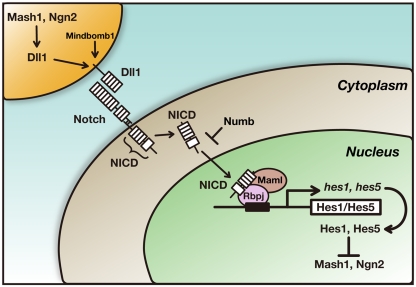
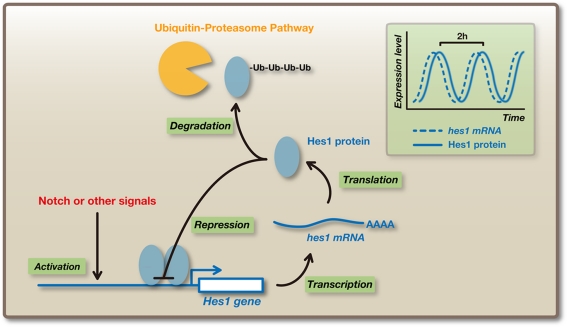
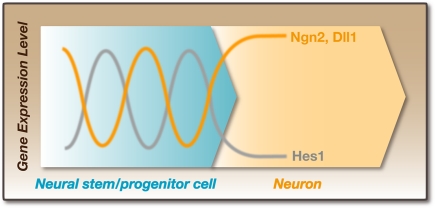
In neural stem/progenitor cells, expression of the Notch effector Hes1, a transcriptional repressor, oscillates with a period of 2-3 h by negative feedback, and Hes1 oscillations induce the oscillatory expression of the proneural gene Neurogenin2 (Ngn2) and the Notch ligand gene Delta-like1 (Dll1). Dll1 oscillation leads to the mutual activation of Notch signaling between neighboring cells, thereby maintaining a group of cells in the undifferentiated state. Not all cells express Hes1 in an oscillatory manner: cells in boundary regions such as the isthmus express Hes1 in a sustained manner, and these cells are rather dormant with regard to proliferation and differentiation. Thus, Hes1 allows cell proliferation and differentiation when its expression oscillates but induces dormancy when its expression is sustained. After Hes1 expression is repressed, Ngn2 is expressed in a sustained manner, promoting neuronal differentiation. Thus, Ngn2 leads to the maintenance of neural stem/progenitor cells by inducing Dll1 oscillation when its expression oscillates but to neuronal differentiation when its expression is sustained. These results indicate that the different dynamics of Hes1 and Ngn2 lead to different outcomes.
在神经干/祖细胞中,Notch效应器Hes1(一种转录抑制因子)的表达通过负反馈以2 - 3小时的周期振荡,并且Hes1振荡诱导神经源性基因Neurogenin2(Ngn2)和Notch配体基因Delta样1(Dll1)的振荡表达。Dll1振荡导致相邻细胞之间Notch信号的相互激活,从而使一群细胞维持在未分化状态。并非所有细胞都以振荡方式表达Hes1:诸如峡部等边界区域的细胞以持续方式表达Hes1,并且这些细胞在增殖和分化方面相当静止。因此,Hes1在其表达振荡时允许细胞增殖和分化,但在其表达持续时诱导静止。Hes1表达被抑制后,Ngn2以持续方式表达,促进神经元分化。因此,Ngn2在其表达振荡时通过诱导Dll1振荡导致神经干/祖细胞的维持,但在其表达持续时导致神经元分化。这些结果表明,Hes1和Ngn2的不同动态导致不同的结果。