Department of Clinical Biochemistry and Immunology, Statens Serum Institut, Ørestads Boulevard, Copenhagen, DK-2300, Denmark.
BMC Genet. 2011 Jul 4;12:58. doi: 10.1186/1471-2156-12-58.
The search to identify disease-susceptible genes requires access to biological material from numerous well-characterized subjects. Archived residual dried blood spot (DBS) samples, also known as Guthrie cards, from national newborn screening programs may provide a DNA source for entire populations. Combined with clinical information from medical registries, DBS samples could provide a rich source for productive research. However, the amounts of DNA which can be extracted from these precious samples are minute and may be prohibitive for numerous genotypings. Previously, we demonstrated that DBS DNA can be whole-genome amplified and used for reliable genetic analysis on different platforms, including genome-wide scanning arrays. However, it remains unclear whether this approach is workable on a large sample scale. We examined the robustness of using DBS samples for whole-genome amplification following genome-wide scanning, using arrays from Illumina and Affymetrix.
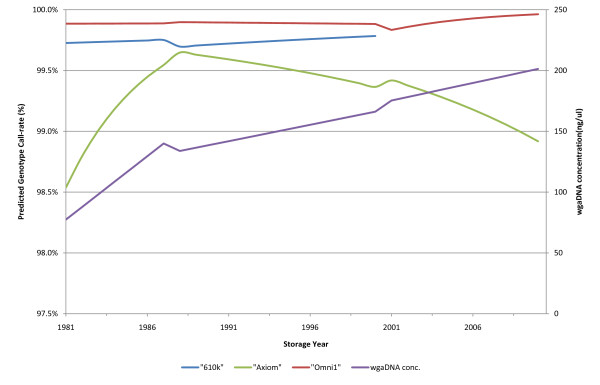
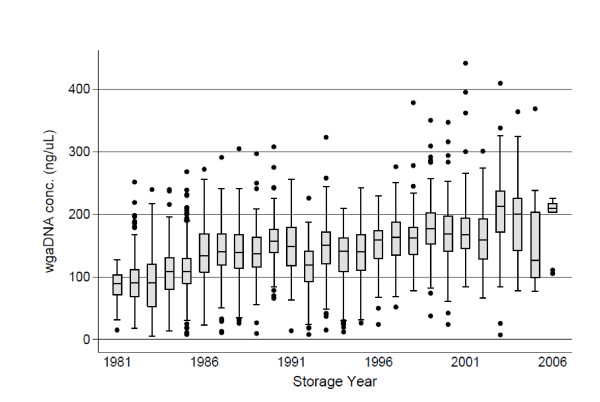
This study is based on 4,641 DBS samples from the Danish Newborn Screening Biobank, extracted for three separate genome-wide association studies. The amount of amplified DNA was significantly (P < 0.05) affected by the year of storage and storage conditions. Nine (0.2%) DBS samples failed whole-genome amplification. A total of 4,586 (98.8%) samples met our criterion of success of a genetic call-rate above 97%. The three studies used different arrays, with mean genotyping call-rates of 99.385% (Illumina Infinium Human610-Quad), 99.722% (Illumina Infinium HD HumanOmni1-Quad), and 99.206% (Affymetrix Axiom Genome-Wide CEU). We observed a concordance rate of 99.997% in the 38 methodological replications, and 99.999% in the 27 technical replications. Handling variables such as time of storage, storage conditions and type of filter paper were shown too significantly (P < 0.05) affect the genotype call-rates in some of the arrays, although the effect was minimal.
Our study indicates that archived DBS samples from the Danish Newborn Screening Biobank represent a reliable resource of DNA for whole-genome amplification and subsequent genome-wide association studies. With call-rates equivalent to high quality DNA samples, our results point to new opportunities for using the neonatal biobanks available worldwide in the hunt for genetic components of disease.
为了鉴定疾病易感基因,需要对大量经过充分鉴定的个体的生物材料进行研究。来自全国新生儿筛查计划的存档剩余干血斑(DBS)样本,也称为格思里卡,可能为整个人群提供 DNA 来源。结合来自医疗登记处的临床信息,DBS 样本可能成为丰富的研究资源。然而,从这些珍贵样本中提取的 DNA 量很少,可能会限制大量的基因分型。以前,我们证明了 DBS DNA 可以进行全基因组扩增,并可在不同平台上进行可靠的遗传分析,包括全基因组扫描阵列。然而,目前尚不清楚这种方法是否可以在大规模样本中使用。我们使用 Illumina 和 Affymetrix 的阵列,检查了在全基因组扫描后使用 DBS 样本进行全基因组扩增的稳健性。
本研究基于来自丹麦新生儿筛查生物库的 4641 个 DBS 样本,这些样本用于三项独立的全基因组关联研究。扩增 DNA 的量显著(P < 0.05)受储存年份和储存条件的影响。9 个(0.2%)DBS 样本全基因组扩增失败。共有 4586 个(98.8%)样本满足遗传分析成功率大于 97%的标准。这三项研究使用了不同的阵列,基因分型成功率的平均值分别为 99.385%(Illumina Infinium Human610-Quad)、99.722%(Illumina Infinium HD HumanOmni1-Quad)和 99.206%(Affymetrix Axiom Genome-Wide CEU)。在 38 次方法学重复中,我们观察到了 99.997%的一致性率,在 27 次技术重复中,我们观察到了 99.999%的一致性率。尽管影响很小,但储存时间、储存条件和滤纸类型等处理变量显著(P < 0.05)影响了某些阵列中的基因分型成功率。
我们的研究表明,来自丹麦新生儿筛查生物库的存档 DBS 样本代表了用于全基因组扩增和随后的全基因组关联研究的可靠 DNA 资源。我们的结果表明,在高成功率的 DNA 样本中,使用新生儿生物库的新机会可能会在全球范围内寻找疾病遗传成分。