School of Biological Sciences, Monash University, Clayton, Victoria 3800, Australia.
BMC Evol Biol. 2011 Jul 4;11:191. doi: 10.1186/1471-2148-11-191.
The mesic habitats of eastern Australia harbour a highly diverse fauna. We examined the impact of climatic oscillations and recognised biogeographic barriers on the evolutionary history of the delicate skink (Lampropholis delicata), a species that occurs in moist habitats throughout eastern Australia. The delicate skink is a common and widespread species whose distribution spans 26° of latitude and nine major biogeographic barriers in eastern Australia. Sequence data were obtained from four mitochondrial genes (ND2, ND4, 12SrRNA, 16SrRNA) for 238 individuals from 120 populations across the entire native distribution of the species. The evolutionary history and diversification of the delicate skink was investigated using a range of phylogenetic (Maximum Likelihood, Bayesian) and phylogeographic analyses (genetic diversity, ΦST, AMOVA, Tajima's D, Fu's F statistic).
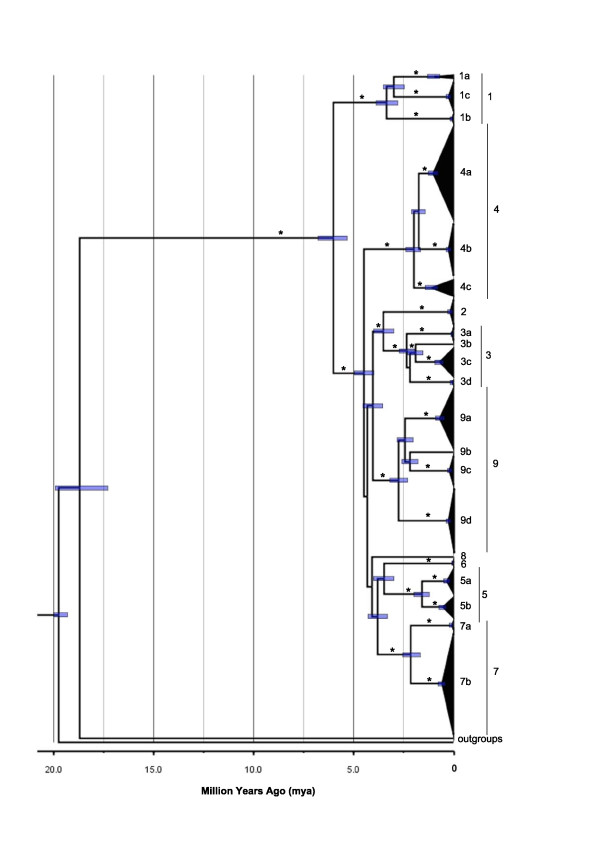
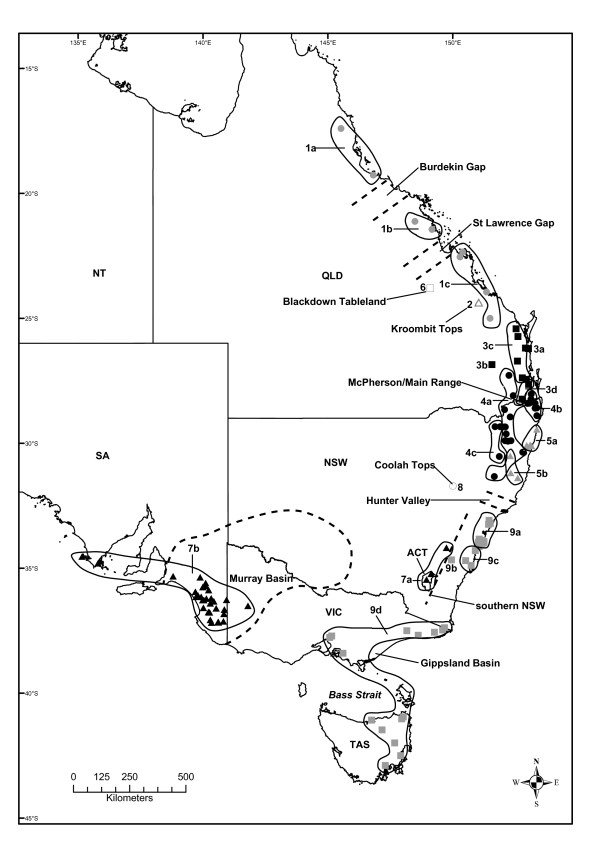
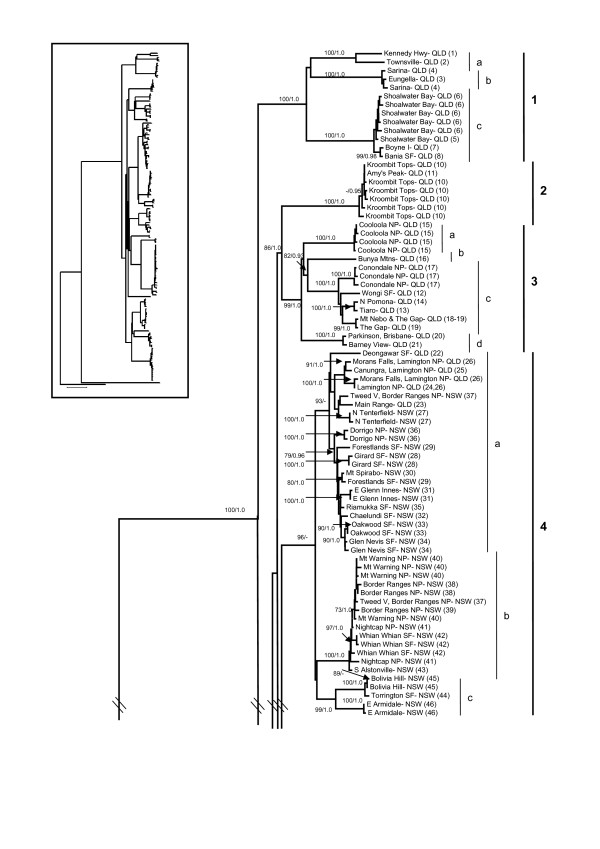
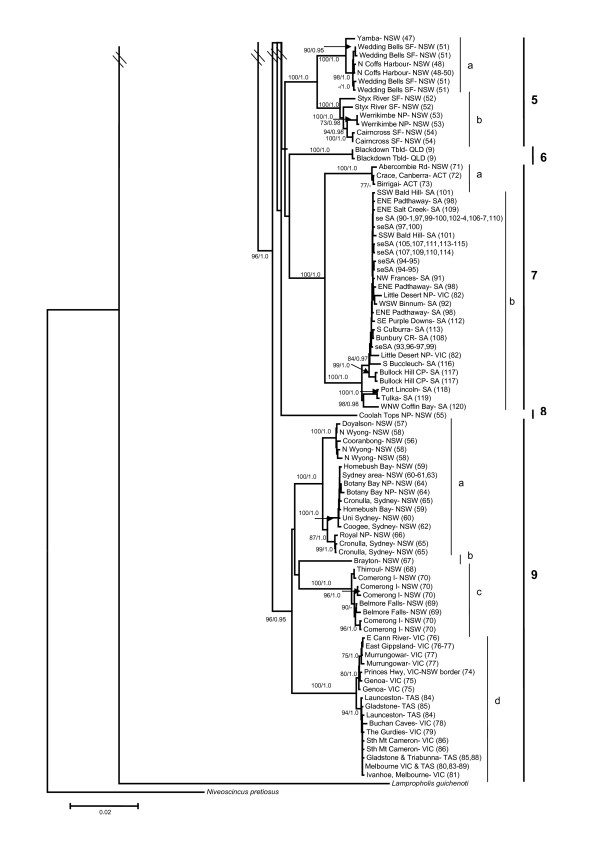
Nine geographically structured, genetically divergent clades were identified within the delicate skink. The main clades diverged during the late Miocene-Pliocene, coinciding with the decline and fragmentation of rainforest and other wet forest habitats in eastern Australia. Most of the phylogeographic breaks within the delicate skink were concordant with dry habitat or high elevation barriers, including several recognised biogeographic barriers in eastern Australia (Burdekin Gap, St Lawrence Gap, McPherson Range, Hunter Valley, southern New South Wales). Genetically divergent populations were also located in high elevation topographic isolates inland from the main range of L. delicata (Kroombit Tops, Blackdown Tablelands, Coolah Tops). The species colonised South Australia from southern New South Wales via an inland route, possibly along the Murray River system. There is evidence for recent expansion of the species range across eastern Victoria and into Tasmania, via the Bassian Isthmus, during the late Pleistocene.
The delicate skink is a single widespread, but genetically variable, species. This study provides the first detailed phylogeographic investigation of a widespread species whose distribution spans virtually all of the major biogeographic barriers in eastern Australia.
澳大利亚东部的湿润生境栖息着高度多样化的动物群。我们研究了气候波动对脆弱石龙子(Lampropholis delicata)进化历史的影响,这种石龙子分布于澳大利亚东部的湿润生境。脆弱石龙子是一种常见且分布广泛的物种,其分布范围跨越 26 个纬度,横跨澳大利亚东部的 9 个主要生物地理屏障。我们从四个线粒体基因(ND2、ND4、12SrRNA、16SrRNA)获得了来自 120 个种群的 238 个个体的序列数据,这些种群分布在该物种的整个原生分布区内。我们使用一系列系统发育(最大似然法、贝叶斯法)和系统地理学分析(遗传多样性、ΦST、AMOVA、Tajima's D、Fu's F 统计量)来研究脆弱石龙子的进化历史和多样化。
在脆弱石龙子中发现了 9 个地理结构上存在差异、遗传上分化的支系。主要支系在中新世-上新世分化,与澳大利亚东部雨林和其他湿润森林栖息地的减少和破碎化时间一致。脆弱石龙子内部的大多数系统地理学断裂与干旱生境或高海拔屏障一致,包括澳大利亚东部的几个公认的生物地理屏障(伯德金海峡、圣劳伦斯海峡、麦克弗森山脉、亨特谷、新南威尔士州南部)。遗传上分化的种群也位于远离脆弱石龙子主要分布区的高海拔地形孤立处(克鲁姆比托普斯、布莱克当高原、库拉托普斯)。该物种从新南威尔士州南部经内陆路线通过默里河系统向南扩散到南澳大利亚州。有证据表明,在更新世晚期,该物种通过巴斯海峡从东维多利亚州向塔斯马尼亚州扩张。
脆弱石龙子是一个单一的广泛分布但遗传上多样化的物种。本研究首次详细研究了分布几乎横跨澳大利亚东部所有主要生物地理屏障的广布物种的系统地理学。