University of Florida, Proton Therapy Institute, Jacksonville, FL, USA.
Technol Cancer Res Treat. 2011 Aug;10(4):317-22. doi: 10.7785/tcrt.2012.500208.
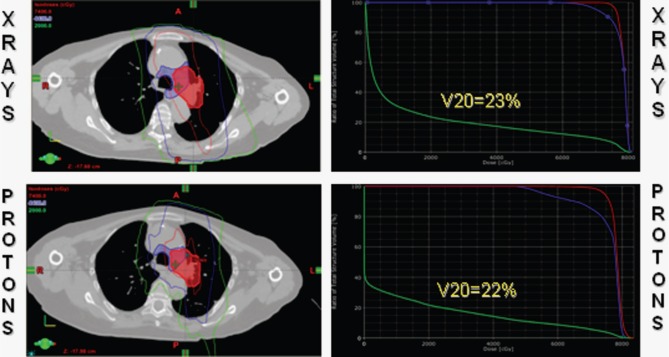
Our objective was to determine if protons allow for the expansion of treatment volumes to cover high-risk nodes in patients with regionally advanced non-small-cell lung cancer. In this study, 5 consecutive patients underwent external-beam radiotherapy treatment planning. Four treatment plans were generated for each patient: 1) photons (x-rays) to treat positron emission tomography (PET)-positive gross disease only to 74 Gy (XG); 2) photons (x-rays) to treat high-risk nodes to 44 Gy and PET-positive gross disease to 74 Gy (XNG); 3) protons to treat PET-positive gross disease only to 74 cobalt gray equivalent (PG); and 4) protons to treat high-risk nodes to 44 CGE and PET-positive gross disease to 74 CGE (PNG). We defined high-risk nodes as mediastinal, hilar, and supraclavicular lymph nodal stations anatomically adjacent to the foci of PET-positive gross disease. Four-dimensional computed tomography was utilized for all patients to account for tumor motion. Standard normal-tissue constraints were utilized. Our results showed that proton plans for all patients were isoeffective with the corresponding photon (x-ray) plans in that they achieved the desired target doses while respecting normal-tissue constraints. In spite of the larger volumes covered, median volume of normal lung receiving 10 CGE or greater (V10Gy/CGE), median V20Gy/CGE, and mean lung dose were lower in the proton plans (PNG) targeting gross disease and nodes when compared with the photon (x-ray) plans (XG) treating gross disease alone. In conclusion, proton plans demonstrated the potential to safely include high-risk nodes without increasing the volume of normal lung irradiated when compared to photon (x-ray) plans, which only targeted gross disease.
我们的目的是确定质子治疗是否能够扩大治疗体积,以覆盖局部晚期非小细胞肺癌患者的高危淋巴结。在这项研究中,连续 5 例患者接受了外照射放射治疗计划。为每位患者生成了 4 个治疗计划:1)光子(X 射线)仅治疗正电子发射断层扫描(PET)阳性大体疾病至 74Gy(XG);2)光子(X 射线)治疗高危淋巴结至 44Gy 和 PET 阳性大体疾病至 74Gy(XNG);3)质子仅治疗 PET 阳性大体疾病至 74 钴Gray 等效(PG);4)质子治疗高危淋巴结至 44CGE 和 PET 阳性大体疾病至 74CGE(PNG)。我们将高危淋巴结定义为与 PET 阳性大体疾病病灶解剖相邻的纵隔、肺门和锁骨上淋巴结站。所有患者均使用四维计算机断层扫描(4D-CT)来考虑肿瘤运动。使用标准正常组织约束。我们的结果表明,对于所有患者,质子计划与相应的光子(X 射线)计划一样有效,因为它们在尊重正常组织约束的同时实现了所需的靶剂量。尽管覆盖的体积更大,但在质子计划(PNG)中,包括大体疾病和淋巴结时,中位数正常肺接受 10CGE 或以上(V10Gy/CGE)的体积、中位数 V20Gy/CGE 和平均肺剂量均低于仅治疗大体疾病的光子(X 射线)计划(XG)。总之,与仅针对大体疾病的光子(X 射线)计划相比,质子计划显示出在不增加照射正常肺体积的情况下安全包括高危淋巴结的潜力。