Hashemi Hassan, Mohammadi S-Farzad, Mazouri Arash, Majdi-N Mercede, Jabbarvand Mahmoud, Z-Mehrjardi Hadi
Eye Research Center, Farabi Eye Hospital, Tehran University of Medical Sciences, Tehran, Iran.
Middle East Afr J Ophthalmol. 2011 Apr;18(2):173-7. doi: 10.4103/0974-9233.80709.
To provide objective evidence on the transition of cataract surgical care at Farabi Eye Hospital, Iran.
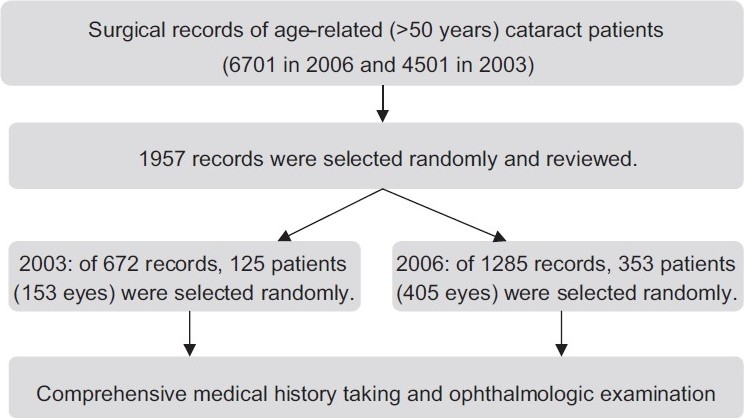
Two separate years, 2003 and 2006, were selected for evaluation. One thousand nine hundred fifty-seven surgical records of age-related cataract cases were randomly selected and reviewed. Three hundred fifty-three patients (405 eyes) in 2006 and 125 patients (153 eyes) in 2003 were selected randomly for a follow-up examination. The two phases were compared in terms of surgical routines, patient characteristics and outcomes for statistical differences. P <0.05 was considered statistically significant.
The phacoemulsification rate increased from 25% to greater than 90% between 2003 and 2006, rates of corneal incisions and use of foldable intraocular lenses tripled, administration of general anesthesia dropped from 80% to 12%, the outpatient admission rate rose from 5.2% to 71%, 4% vs. 66% of the operations were performed by a senior phacoemulsification surgeon and the number of advanced surgeons changed from 6% to 38% (all P-values < 0.001). In 2006, more patients at the two extremes of age, more patients with poor systemic conditions and myopes underwent surgery (all P-values < 0.05); the cataract surgery volume increased by 49% and post-operative visual acuity improved (P = 0.03) while patient satisfaction was unchanged.
We objectively documented the transition in cataract surgery technique to phacoemulsification at the Farabi Eye Hospital in the mid-2000s. This was accompanied by significant expansion of the spectrum of cataract surgery candidates and remarkable attainment of surgical skill.
为伊朗法拉比眼科医院白内障手术治疗的转变提供客观证据。
选择2003年和2006年这两个不同年份进行评估。随机抽取1957例年龄相关性白内障病例的手术记录并进行回顾。随机选取2006年的353例患者(405只眼)和2003年的125例患者(153只眼)进行随访检查。比较两个阶段在手术常规、患者特征和结果方面的统计学差异。P<0.05被认为具有统计学意义。
2003年至2006年间,超声乳化率从25%提高到90%以上,角膜切口率和可折叠人工晶状体的使用率增加了两倍,全身麻醉的使用率从80%降至12%,门诊入院率从5.2%升至71%,由资深超声乳化手术医生进行的手术比例从4%升至66%,高级手术医生的数量从6%增至38%(所有P值<0.001)。2006年,年龄两端的患者、全身状况较差的患者和近视患者接受手术的人数更多(所有P值<0.05);白内障手术量增加了49%,术后视力有所改善(P=0.03),而患者满意度未变。
我们客观记录了21世纪中期法拉比眼科医院白内障手术技术向超声乳化的转变。这伴随着白内障手术候选人群谱的显著扩大和手术技能的显著提升。