Li Ka Shing Centre, Cancer Research UK Cambridge Institute, Robinson Way, Cambridge CB2 0RE, UK.
Nature. 2011 Jul 6;475(7354):106-9. doi: 10.1038/nature10189.
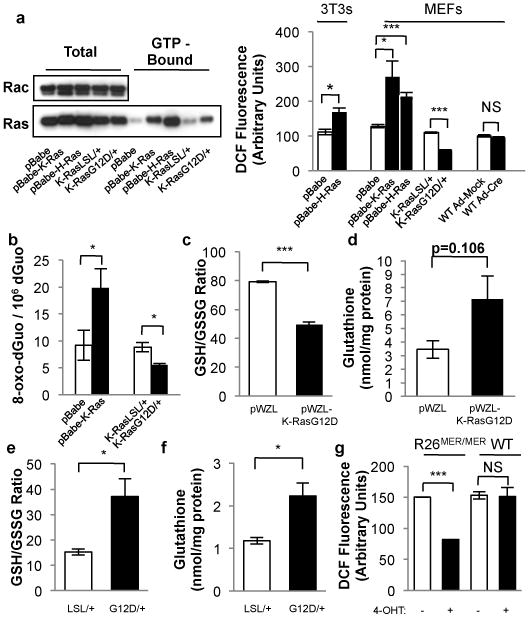
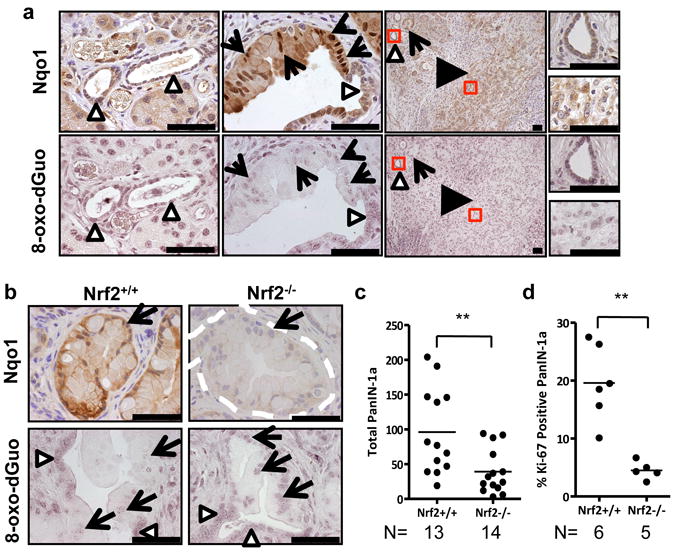
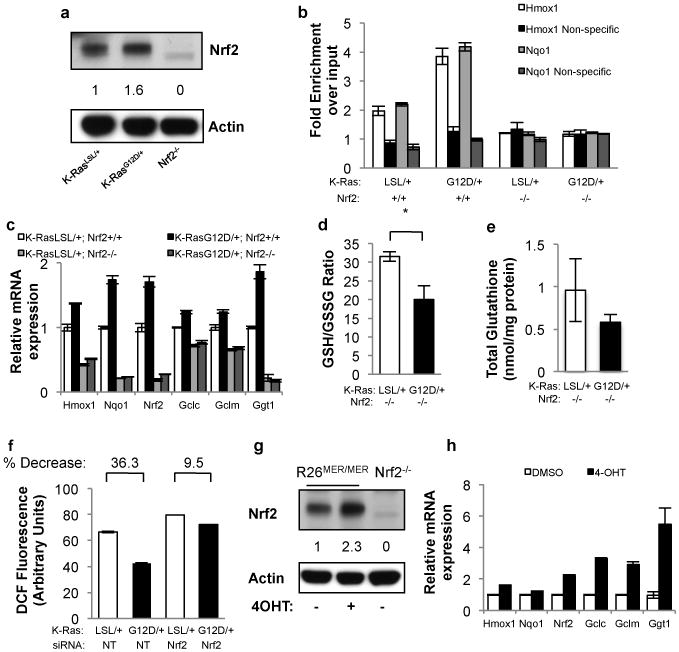
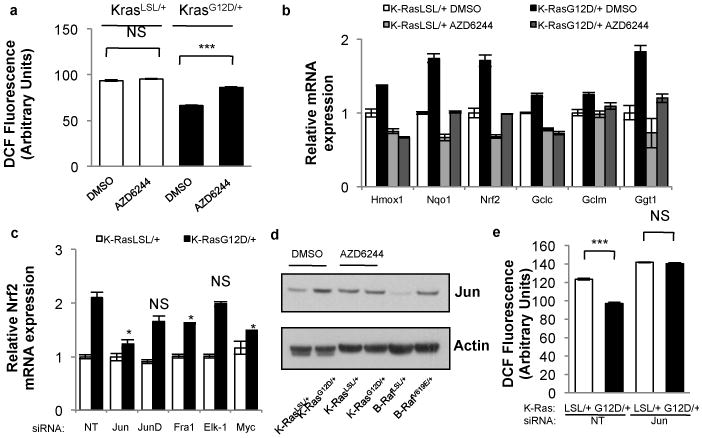
Reactive oxygen species (ROS) are mutagenic and may thereby promote cancer. Normally, ROS levels are tightly controlled by an inducible antioxidant program that responds to cellular stressors and is predominantly regulated by the transcription factor Nrf2 (also known as Nfe2l2) and its repressor protein Keap1 (refs 2-5). In contrast to the acute physiological regulation of Nrf2, in neoplasia there is evidence for increased basal activation of Nrf2. Indeed, somatic mutations that disrupt the Nrf2-Keap1 interaction to stabilize Nrf2 and increase the constitutive transcription of Nrf2 target genes were recently identified, indicating that enhanced ROS detoxification and additional Nrf2 functions may in fact be pro-tumorigenic. Here, we investigated ROS metabolism in primary murine cells following the expression of endogenous oncogenic alleles of Kras, Braf and Myc, and found that ROS are actively suppressed by these oncogenes. K-Ras(G12D), B-Raf(V619E) and Myc(ERT2) each increased the transcription of Nrf2 to stably elevate the basal Nrf2 antioxidant program and thereby lower intracellular ROS and confer a more reduced intracellular environment. Oncogene-directed increased expression of Nrf2 is a new mechanism for the activation of the Nrf2 antioxidant program, and is evident in primary cells and tissues of mice expressing K-Ras(G12D) and B-Raf(V619E), and in human pancreatic cancer. Furthermore, genetic targeting of the Nrf2 pathway impairs K-Ras(G12D)-induced proliferation and tumorigenesis in vivo. Thus, the Nrf2 antioxidant and cellular detoxification program represents a previously unappreciated mediator of oncogenesis.
活性氧 (ROS) 具有诱变作用,可能促进癌症的发生。通常,ROS 水平受到诱导型抗氧化程序的严格控制,该程序响应细胞应激,并主要由转录因子 Nrf2(也称为 Nfe2l2)及其抑制蛋白 Keap1 调节 2-5。与 Nrf2 的急性生理调节相反,在肿瘤发生中,有证据表明 Nrf2 的基础激活增加。事实上,最近发现了破坏 Nrf2-Keap1 相互作用以稳定 Nrf2 并增加 Nrf2 靶基因组成型转录的体细胞突变,表明增强的 ROS 解毒和额外的 Nrf2 功能实际上可能具有促肿瘤作用。在这里,我们研究了内源性致癌基因 Kras、Braf 和 Myc 表达后原代小鼠细胞中的 ROS 代谢,发现这些致癌基因积极抑制 ROS。K-Ras(G12D)、B-Raf(V619E) 和 Myc(ERT2) 均增加了 Nrf2 的转录,从而稳定地提高了基础 Nrf2 抗氧化程序,从而降低了细胞内 ROS 并赋予了更还原的细胞内环境。致癌基因定向增加 Nrf2 的表达是激活 Nrf2 抗氧化程序的新机制,在表达 K-Ras(G12D)和 B-Raf(V619E)的小鼠原代细胞和组织以及人类胰腺癌中都很明显。此外,Nrf2 途径的遗传靶向会损害体内 K-Ras(G12D)诱导的增殖和肿瘤发生。因此,Nrf2 抗氧化和细胞解毒程序代表了以前未被重视的致癌介质。