Department of Anatomy, University of Kiel, Olshausenstraße 40, 24098 Kiel, Germany.
Clin Exp Metastasis. 2011 Dec;28(8):713-20. doi: 10.1007/s10585-011-9403-y. Epub 2011 Jul 7.
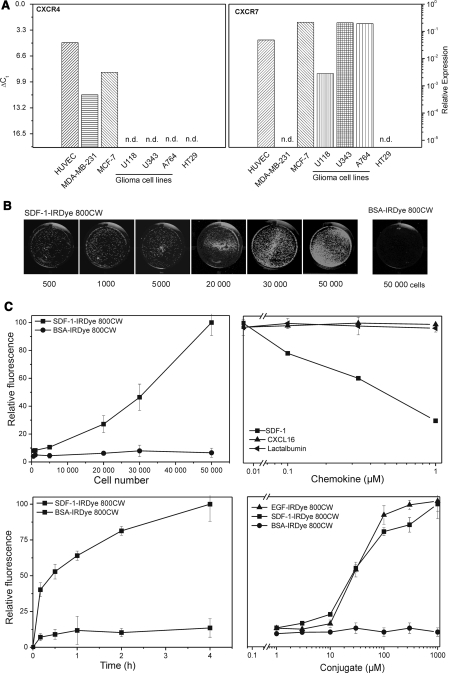
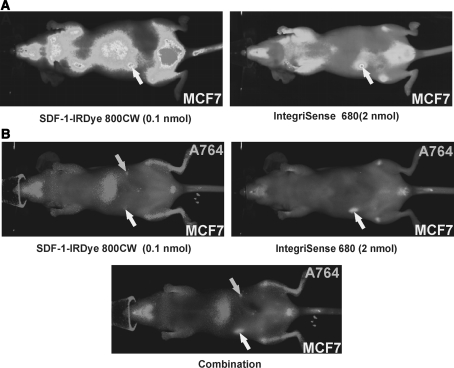
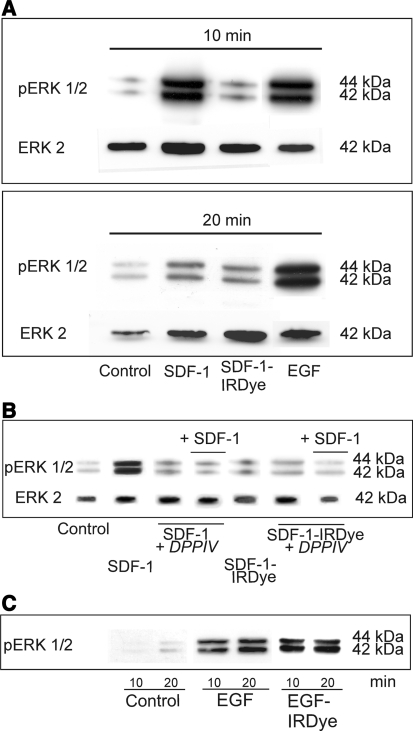
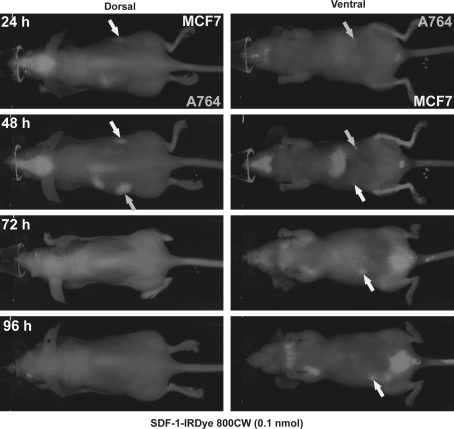
The chemokine CXCL12/SDF-1 and its receptors CXCR4 and CXCR7 play a major role in tumor invasion, proliferation and metastasis. Since both receptors are overexpressed on distinct tumor cells and on the tumor vasculature, we evaluated their potential as targets for detection of cancers by molecular imaging. We synthesized conjugates of CXCL12 and the near-infrared (NIR) fluorescent dye IRDye(®)800CW, tested their selectivity, sensitivity and biological activity in vitro and their feasibility to visualize tumors in vivo. Purified CXCL12-conjugates detected in vitro as low as 500 A764 human glioma cells or MCF-7 breast cancer cells that express CXCR7 alone or together with CXCR4. Binding was time- and concentration-dependent, and the label could be competitively displaced by the native peptide. Control conjugates with bovine serum albumin or lactalbumin failed to label the cells. In mice, the conjugate distributed rapidly. After 1-92 h, subcutaneous tumors of human MCF-7 and A764 cells in immunodeficient mice were detected with high sensitivity. Background was observed in particular in liver within the first 24 h, but also skull and hind limbs yielded some background. Overall, fluorescent CXCL12-conjugates are sensitive and selective probes to detect solid and metastatic tumors by targeting tumor cells and tumor vasculature.
趋化因子 CXCL12/SDF-1 及其受体 CXCR4 和 CXCR7 在肿瘤侵袭、增殖和转移中发挥重要作用。由于这两种受体在不同的肿瘤细胞和肿瘤血管上过度表达,我们评估了它们作为通过分子成像检测癌症的潜在靶点的能力。我们合成了 CXCL12 与近红外(NIR)荧光染料 IRDye(®)800CW 的缀合物,测试了它们在体外的选择性、灵敏度和生物活性,以及在体内可视化肿瘤的可行性。体外纯化的 CXCL12 缀合物可检测到低至 500 个 A764 人神经胶质瘤细胞或单独表达 CXCR7 或与 CXCR4 一起表达的 MCF-7 乳腺癌细胞。结合是时间和浓度依赖性的,并且可以通过天然肽进行竞争性置换。带有牛血清白蛋白或乳白蛋白的对照缀合物未能标记细胞。在小鼠中,缀合物分布迅速。在免疫缺陷小鼠中,1-92 小时后,可高度敏感地检测到皮下的 MCF-7 和 A764 细胞肿瘤。在最初的 24 小时内,特别是在肝脏中观察到背景,但颅骨和后肢也产生了一些背景。总的来说,荧光 CXCL12 缀合物是敏感和选择性的探针,可通过靶向肿瘤细胞和肿瘤血管来检测实体瘤和转移性肿瘤。