Sewkani Ajit, Jain Aruna, Maudar Kk, Varshney Subodh
Department of Surgical Gastroenterology & Clinical Nutrition, Bhopal Memorial Hospital and Research Center, Bhopal (MP) 462038, India.
J Med Case Rep. 2011 Jul 7;5:297. doi: 10.1186/1752-1947-5-297.
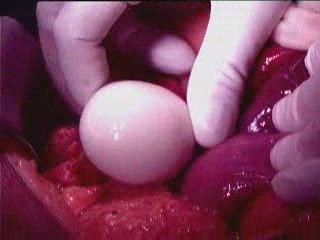
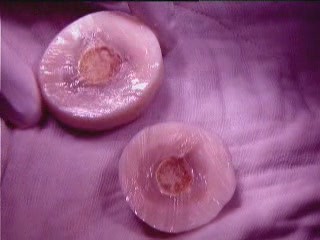
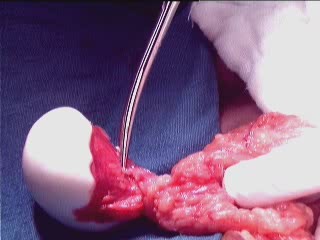
Peritoneal loose bodies, or peritoneal mice, are rare asymptomatic lesions that are usually found as an incidental finding during abdominal surgery or autopsy. Giant loose bodies, measuring more than 5 cm, are rare and only a few cases are reported in the literature. These bodies are usually infarcted appendices epiploicae, which become detached and appear as a peritoneal loose body in the abdominal cavity. They may re-attach themselves to a surface, such as the lower aspect of the spleen or omentum, in which case they can be called a "parasitized peritoneal body", as in our case.
We report a case of a giant loose peritoneal body measuring 7 × 5 cm found incidentally in a 64-year-old Indian man who presented with acute intestinal obstruction. We present the current hypothesis and our opinion on the genesis of such large bodies and discuss the problems in diagnosis.
Peritoneal loose bodies are common but giant peritoneal loose bodies are very rare. These giant bodies usually do not require any treatment until they become complicated. Present diagnosis modalities have limitations in the diagnosis of mobile lesions in the abdominal cavity, so care must be taken to avoid unnecessary laparotomies in uncomplicated cases.
腹膜游离体,即腹膜鼠,是罕见的无症状病变,通常在腹部手术或尸检时偶然发现。直径超过5厘米的巨大游离体很罕见,文献中仅报道了少数病例。这些物体通常是梗死的网膜阑尾,它们脱落并在腹腔内表现为腹膜游离体。它们可能会重新附着于某个表面,如脾脏或网膜的下表面,在这种情况下,就像我们的病例一样,它们可被称为“寄生性腹膜体”。
我们报告一例在一名64岁印度男性患者中偶然发现的直径为7×5厘米的巨大腹膜游离体病例,该患者表现为急性肠梗阻。我们阐述了关于此类巨大物体形成的当前假说和我们的观点,并讨论了诊断中的问题。
腹膜游离体很常见,但巨大腹膜游离体非常罕见。这些巨大物体在出现并发症之前通常无需任何治疗。目前的诊断方法在诊断腹腔内可移动病变方面存在局限性,因此在未出现并发症的病例中必须小心避免不必要的剖腹手术。