Felix Ron, van Wielink Paul
Hazelaarlaan 51, 5056 XP Berkel Enschot, The Netherlands.
Zookeys. 2011(100):533-44. doi: 10.3897/zookeys.100.1544. Epub 2011 May 20.
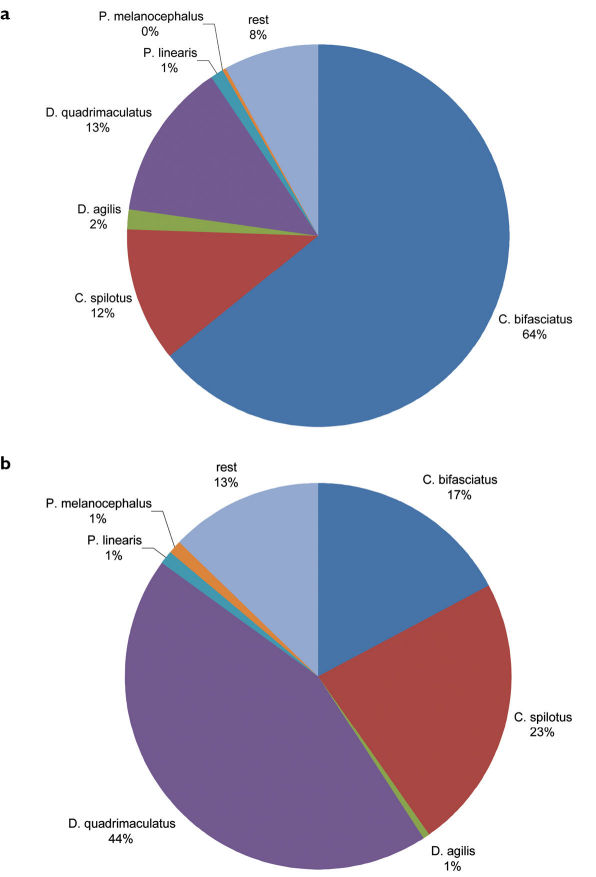
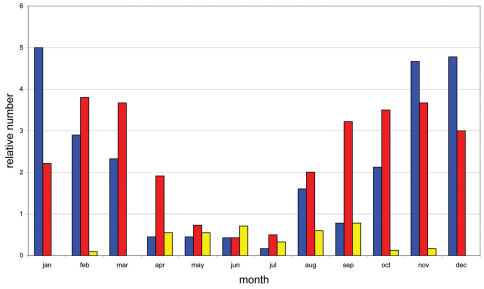
The discovery of Calodromius bifasciatus in the nature reserve 'De Kaaistoep', the Netherlands, initiated research on this and related carabid beetles between 2000 and 2006. During this period we investigated the trunks of 26 Pedunculate oaks, mainly during nightly observations, to learn more about arboricolous carabid species. We observed more than 3000 specimens of 24 carabid species. The majority of these species were Dromiuss.l., however Calodromius bifasciatus dominated the dataset. Our data on phenology clearly show that Calodromius bifasciatus is mainly active in winter; it even copulates just above freezing point. Other interesting observations were made as well; for instance the presence of a small sphere at the end of the abdomen and their hiding behaviour at low temperatures. Subsequently, we obtained similar information about other tree dwelling carabid species. In this article we present an overview of all species observed on the trunks, after which we shall focus on the observations made on Calodromius bifasciatus.
在荷兰“De Kaaistoep”自然保护区发现双带卡洛步甲后,于2000年至2006年间开启了对该物种及相关步甲科甲虫的研究。在此期间,我们主要在夜间观察了26棵英国栎的树干,以更多地了解栖息于树上的步甲物种。我们观察到了24种步甲的3000多个标本。这些物种大多数属于广义的Dromius属,不过双带卡洛步甲在数据集中占主导地位。我们关于物候学的数据清楚地表明,双带卡洛步甲主要在冬季活跃;它甚至在接近冰点的温度下交配。我们还进行了其他有趣的观察;例如,在腹部末端有一个小球体,以及它们在低温下的隐藏行为。随后,我们获得了关于其他树栖步甲物种的类似信息。在本文中,我们将概述在树干上观察到的所有物种,之后将重点关注对双带卡洛步甲的观察。