Institute of Preventive Medicine, College of Public Health, National Taiwan University, Taipei, Taiwan.
PLoS One. 2011;6(6):e21368. doi: 10.1371/journal.pone.0021368. Epub 2011 Jun 27.
Preclinical and observational studies raise the concern about the safety of insulin glargine in terms of cancer initiation and promotion. This study is designed to examine cancer incidence associated with use of insulin glargine vs. intermediate/long-acting human insulin (HI).
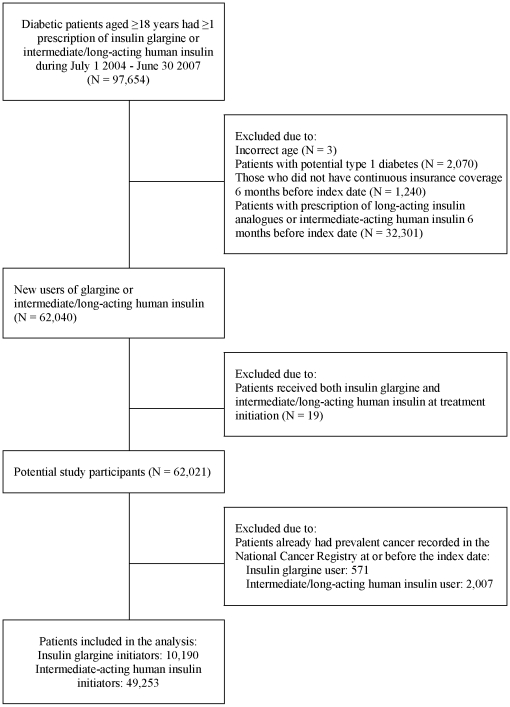
A retrospective cohort study using the Taiwan National Health Insurance claims database was conducted to identify adult patients with type 2 diabetes mellitus and without a history of cancer who initiated insulin glargine (n = 10,190) or intermediate/long-acting HI (n = 49,253) during 2004-2007. Exclusive users were followed from the date of insulin initiation to the earliest of cancer diagnosis, death, disenrollment, or December 31 2007. We estimated adjusted hazard ratios and 95% confidence intervals (CIs) with Cox proportional hazards models adjusting for baseline propensity score.
The incidence rate of all cancer per 1,000 person-years was 13.8 for insulin glargine initiators (179 cases) and 16.0 for intermediate/long-acting HI initiators (1,445 cases) during an average follow-up of 2 years. No significant difference in overall cancer risk between insulin glargine initiators and HI initiators was found. For men, however, the adjusted hazard ratio of insulin glargine use as compared with intermediate/long-acting HI was 2.15 (95% CI 1.01-4.59) for pancreatic cancer, and 2.42 (95% CI 1.50-8.40) for prostate cancer. The increased risk was not observed among women.
Insulin glargine use did not increase the risk of overall cancer incidence as compared with HI. The positive associations with pancreatic and prostate cancer need further evaluation and validation.
临床前和观察性研究引起了人们对甘精胰岛素在癌症发生和促进方面安全性的关注。本研究旨在检查使用甘精胰岛素与中效/长效人胰岛素(HI)相关的癌症发病率。
使用台湾全民健康保险理赔数据库进行回顾性队列研究,以确定 2004 年至 2007 年期间无癌症病史的 2 型糖尿病成年患者,他们开始使用甘精胰岛素(n=10190)或中效/长效 HI(n=49253)。从胰岛素开始使用的日期到最早的癌症诊断、死亡、退出或 2007 年 12 月 31 日,对排他性使用者进行随访。我们使用 Cox 比例风险模型估计调整后的危险比和 95%置信区间(CI),并调整了基线倾向评分。
在平均 2 年的随访中,甘精胰岛素起始者的每 1000 人年所有癌症的发病率为 13.8(179 例),而中效/长效 HI 起始者的发病率为 16.0(1445 例)。甘精胰岛素起始者与 HI 起始者之间的总体癌症风险无显著差异。然而,对于男性,与中效/长效 HI 相比,甘精胰岛素的使用调整后的胰腺癌危险比为 2.15(95%CI 1.01-4.59),前列腺癌的危险比为 2.42(95%CI 1.50-8.40)。在女性中未观察到这种风险增加。
与 HI 相比,甘精胰岛素的使用并未增加总体癌症发病率的风险。与胰腺癌和前列腺癌的阳性关联需要进一步评估和验证。