Division of Endocrinology, Diabetology, Angiology, Nephrology and Clinical Chemistry, Department of Internal Medicine, Eberhard Karls University Tübingen, Tübingen, Germany.
PLoS One. 2011;6(6):e21594. doi: 10.1371/journal.pone.0021594. Epub 2011 Jun 27.
In the human brain, there are at least as many astrocytes as neurons. Astrocytes are known to modulate neuronal function in several ways. Thus, they may also contribute to cerebral insulin actions. Therefore, we examined whether primary human astrocytes are insulin-responsive and whether their metabolic functions are affected by the hormone.
Commercially available Normal Human Astrocytes were grown in the recommended medium. Major players in the insulin signaling pathway were detected by real-time RT-PCR and Western blotting. Phosphorylation events were detected by phospho-specific antibodies. Glucose uptake and glycogen synthesis were assessed using radio-labeled glucose. Glycogen content was assessed by histochemistry. Lactate levels were measured enzymatically. Cell proliferation was assessed by WST-1 assay.
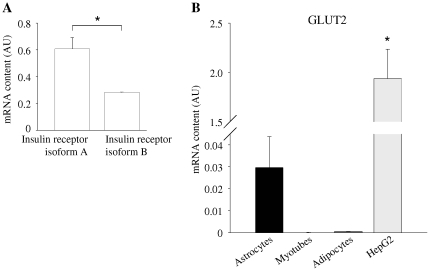
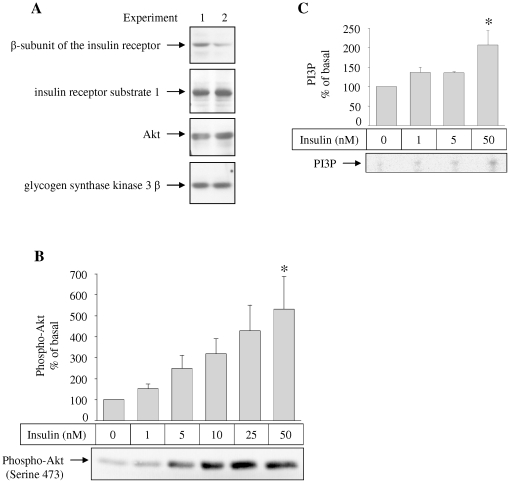
We detected expression of key proteins for insulin signaling, such as insulin receptor β-subunit, insulin receptor substrat-1, Akt/protein kinase B and glycogen synthase kinase 3, in human astrocytes. Akt was phosphorylated and PI-3 kinase activity increased following insulin stimulation in a dose-dependent manner. Neither increased glucose uptake nor lactate secretion after insulin stimulation could be evidenced in this cell type. However, we found increased insulin-dependent glucose incorporation into glycogen. Furthermore, cell numbers increased dose-dependently upon insulin treatment.
This study demonstrated that human astrocytes are insulin-responsive at the molecular level. We identified glycogen synthesis and cell proliferation as biological responses of insulin signaling in these brain cells. Hence, this cell type may contribute to the effects of insulin in the human brain.
在人类大脑中,星形胶质细胞的数量至少与神经元一样多。已知星形胶质细胞通过多种方式调节神经元功能。因此,它们也可能有助于大脑胰岛素的作用。因此,我们研究了原代人星形胶质细胞是否对胰岛素有反应,以及激素是否影响其代谢功能。
使用市售的正常人类星形胶质细胞在推荐的培养基中生长。通过实时 RT-PCR 和 Western blot 检测胰岛素信号通路中的主要参与者。通过磷酸特异性抗体检测磷酸化事件。使用放射性标记的葡萄糖评估葡萄糖摄取和糖原合成。通过组织化学评估糖原含量。通过酶法测量乳酸水平。通过 WST-1 测定法评估细胞增殖。
我们在人星形胶质细胞中检测到胰岛素信号的关键蛋白的表达,如胰岛素受体β亚基、胰岛素受体底物-1、Akt/蛋白激酶 B 和糖原合酶激酶 3。胰岛素刺激后,Akt 磷酸化,PI-3 激酶活性呈剂量依赖性增加。在这种细胞类型中,胰岛素刺激后并未发现葡萄糖摄取增加或乳酸分泌增加。然而,我们发现胰岛素依赖性葡萄糖掺入糖原增加。此外,细胞数量随胰岛素处理呈剂量依赖性增加。
本研究表明,人星形胶质细胞在分子水平上对胰岛素有反应。我们确定了糖原合成和细胞增殖作为这些脑细胞中胰岛素信号的生物学反应。因此,这种细胞类型可能有助于胰岛素在人脑中的作用。