Department of Preventive Medicine, University of Southern California Keck School of Medicine, Los Angeles, California, United States of America.
PLoS One. 2011;6(6):e21657. doi: 10.1371/journal.pone.0021657. Epub 2011 Jun 28.
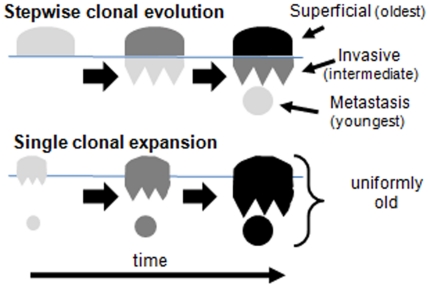
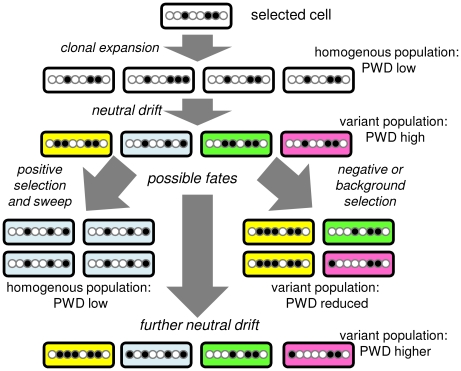
It is possible to infer the past of populations by comparing genomes between individuals. In general, older populations have more genomic diversity than younger populations. The force of selection can also be inferred from population diversity. If selection is strong and frequently eliminates less fit variants, diversity will be limited because new, initially homogeneous populations constantly emerge.
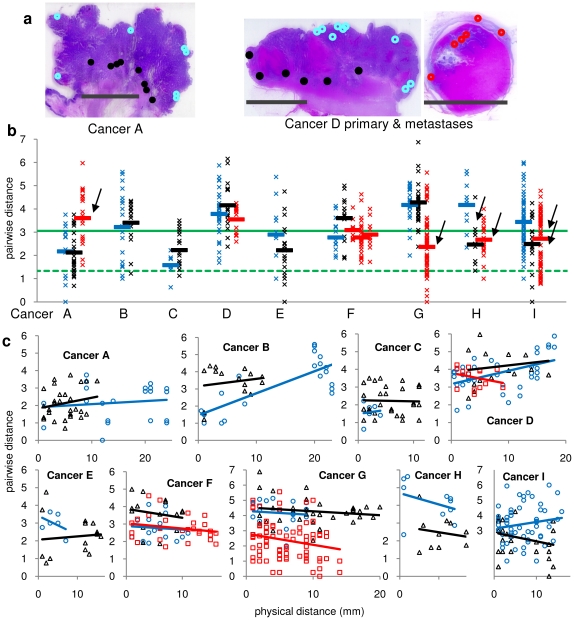
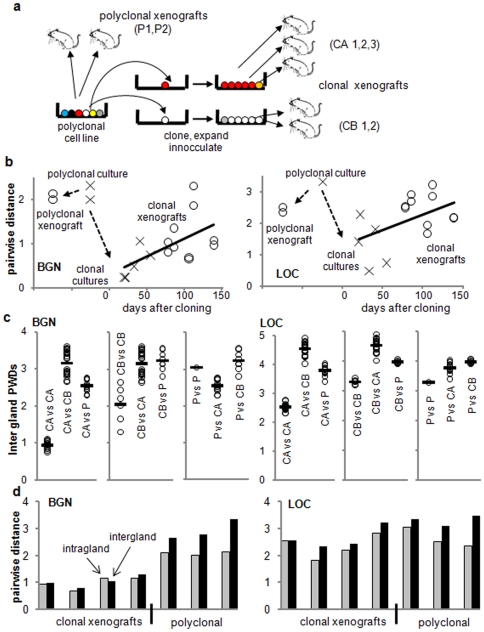
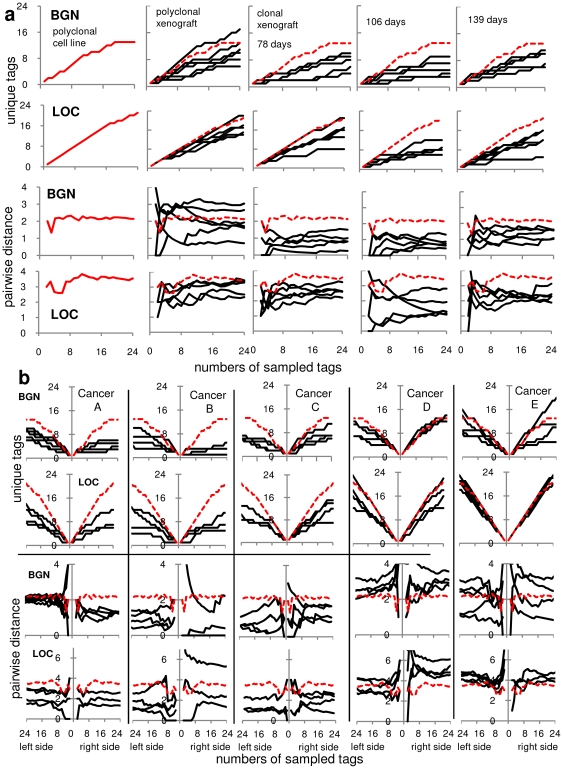
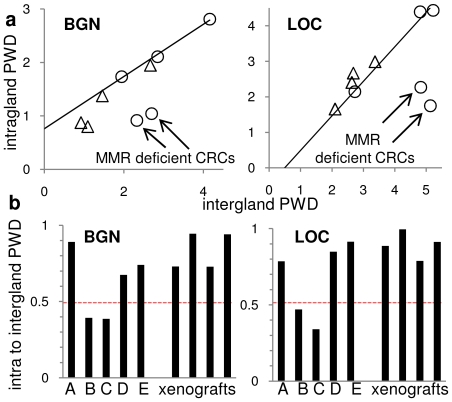
Here we translate a population genetics approach to human somatic cancer cell populations by measuring genomic diversity within and between small colorectal cancer (CRC) glands. Control tissue culture and xenograft experiments demonstrate that the population diversity of certain passenger DNA methylation patterns is reduced after cloning but subsequently increases with time. When measured in CRC gland populations, passenger methylation diversity from different parts of nine CRCs was relatively high and uniform, consistent with older, stable lineages rather than mixtures of younger homogeneous populations arising from frequent cycles of selection. The diversity of six metastases was also high, suggesting dissemination early after transformation. Diversity was lower in DNA mismatch repair deficient CRC glands, possibly suggesting more selection and the elimination of less fit variants when mutation rates are elevated.
CONCLUSION/SIGNIFICANCE: The many hitchhiking passenger variants observed in primary and metastatic CRC cell populations are consistent with relatively old populations, suggesting that clonal evolution leading to selective sweeps may be rare after transformation. Selection in human cancers appears to be a weaker than presumed force after transformation, consistent with the observed rarity of driver mutations in cancer genomes. Phenotypic plasticity rather than the stepwise acquisition of new driver mutations may better account for the many different phenotypes within human tumors.
通过比较个体之间的基因组,可以推断出群体的过去。一般来说,较老的群体比年轻的群体具有更多的基因组多样性。选择的力量也可以从群体多样性中推断出来。如果选择很强,经常消除不太适应的变异,那么多样性就会受到限制,因为新的、最初同质的群体不断出现。
在这里,我们通过测量小的结直肠(CRC)腺内和之间的基因组多样性,将一种人群遗传学方法转化为人类体细胞癌群体。对照组织培养和异种移植实验表明,某些乘客 DNA 甲基化模式的群体多样性在克隆后减少,但随后随着时间的推移而增加。当在 CRC 腺群体中测量时,来自九个 CRC 的不同部位的乘客甲基化多样性相对较高且均匀,与较老的、稳定的谱系一致,而不是来自频繁选择循环的年轻同质群体的混合物。六个转移瘤的多样性也很高,这表明转化后早期就发生了传播。在错配修复缺陷的 CRC 腺中,多样性较低,可能表明当突变率升高时,选择更多,适应不良的变体被消除。
结论/意义:在原发性和转移性 CRC 细胞群体中观察到的许多搭乘乘客变体与相对较老的群体一致,这表明导致选择清扫的克隆进化可能在转化后很少见。人类癌症中的选择似乎比转化后假定的力量弱,这与癌症基因组中观察到的驱动突变罕见一致。表型可塑性而不是逐步获得新的驱动突变,可能更好地解释了人类肿瘤中的许多不同表型。