Service de Neurologie, Centre Hospitalier Universitaire Côte de Nacre, 14033 cedex 9, Caen, France.
BMC Neurol. 2011 Jul 9;11:84. doi: 10.1186/1471-2377-11-84.
Paradoxical embolism due to pulmonary arteriovenous malformations is the main mechanism of brain infarction in patients with hereditary hemorrhagic telangiectasia. International Guidelines have recently been published to clarify the performance of screening tests and the effectiveness of treatment for pulmonary arteriovenous malformations.
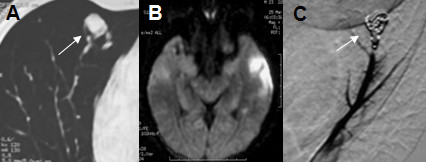
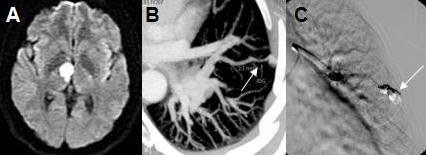
We present two cases of hereditary hemorrhagic telangiectasia patients of our hospital who experienced an acute stroke secondary to paradoxical embolism.
These two cases show that the guidelines must be followed to prevent the occurrence of ischemic stroke in patients with hereditary hemorrhagic telangiectasia, and that although they may be adequate in most cases, there are some patients who need a more personalized approach.
遗传性出血性毛细血管扩张症患者的脑梗死主要机制是由于肺动静脉畸形导致的反常栓塞。最近发布了国际指南,以阐明对肺动静脉畸形的筛查试验和治疗效果。
我们介绍了我院两名遗传性出血性毛细血管扩张症患者的病例,他们因反常栓塞而发生急性脑卒中。
这两个病例表明,必须遵循指南以预防遗传性出血性毛细血管扩张症患者发生缺血性脑卒中,尽管在大多数情况下这些指南可能是足够的,但有些患者需要更个性化的方法。