Department of Psychology, West Virginia University, Morgantown, WV 26506, USA.
Pharmacol Biochem Behav. 2011 Oct;99(4):718-25. doi: 10.1016/j.pbb.2011.06.022. Epub 2011 Jun 29.
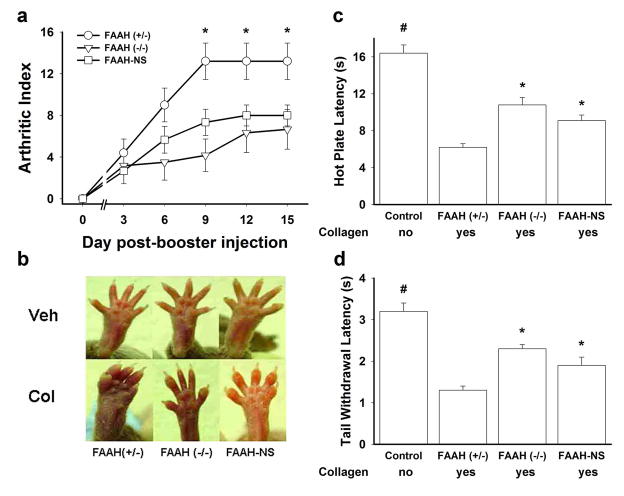
Fatty acid amide hydrolase (FAAH) is the primary degradative enzyme of the endocannabinoid anandamide (N-arachidonoylethanolamine), which activates cannabinoid CB(1) and CB(2) receptors. FAAH disruption reduces nociception in a variety of acute rodent models of inflammatory pain. The present study investigated whether these actions extend to the chronic, collagen-induced arthritis (CIA) model. We investigated the anti-arthritic and anti-hyperalgesic effects of genetic deletion or pharmacological inhibition of FAAH in the CIA model. FAAH (-/-) mice, and FAAH-NS mice that express FAAH exclusively in nervous tissue, displayed decreased severity of CIA and associated hyperalgesia. These phenotypic anti-arthritic effects were prevented by repeated daily injections of the CB(2) receptor antagonist, SR144528, but not the CB(1) receptor antagonist rimonabant. Similarly, repeated administration of the FAAH inhibitor URB597 reduced CIA severity, and acute administration of rimonabant, but not SR144528, blocked the anti-hyperalgesic effects of prolonged FAAH inhibition, suggesting that prolonged CB(2) receptor activation reduces the severity of CIA, whereas acute CB(1) receptor activation reduces CIA-induced hyperalgesia. In contrast, acute administration of URB597 elicited a CB(1) receptor-dependent anti-hyperalgesic effect. The observed anti-arthritic and anti-hyperalgesic properties of FAAH inhibition, coupled with a lack of apparent behavioral alterations, suggest that endocannabinoid modulating enzymes offer a promising therapeutic target for the development of novel pharmacological approaches to treat rheumatoid arthritis and associated hyperalgesia.
脂肪酸酰胺水解酶(FAAH)是内源性大麻素大麻素(N-花生四烯酰乙醇胺)的主要降解酶,它能激活大麻素 CB1 和 CB2 受体。FAAH 缺失可降低多种急性啮齿动物炎症痛模型中的痛觉过敏。本研究探讨了这些作用是否扩展到慢性胶原诱导性关节炎(CIA)模型。我们研究了 FAAH 基因缺失或药理学抑制在 CIA 模型中的抗关节炎和抗痛觉过敏作用。FAAH(-/-)小鼠和仅在神经组织中表达 FAAH 的 FAAH-NS 小鼠表现出 CIA 严重程度降低和相关痛觉过敏减轻。这些表型抗关节炎作用可被反复每日注射 CB2 受体拮抗剂 SR144528 阻断,但不能被 CB1 受体拮抗剂利莫那班阻断。同样,重复给予 FAAH 抑制剂 URB597 可减轻 CIA 严重程度,而利莫那班的急性给药,而不是 SR144528,可阻断 FAAH 抑制的急性抗痛觉过敏作用,表明延长 CB2 受体激活可降低 CIA 的严重程度,而急性 CB1 受体激活可降低 CIA 引起的痛觉过敏。相反,URB597 的急性给药引起 CB1 受体依赖性抗痛觉过敏作用。观察到的 FAAH 抑制的抗关节炎和抗痛觉过敏特性,加上缺乏明显的行为改变,表明内源性大麻素调节酶为开发治疗类风湿性关节炎和相关痛觉过敏的新型药物治疗方法提供了有希望的治疗靶点。