Lowin Torsten, Kok Christina, Smutny Sophie, Pongratz Georg
Poliklinik, Funktionsbereich & Hiller Forschungszentrum für Rheumatologie, University Hospital Duesseldorf, 40225 Duesseldorf, Germany.
Biomedicines. 2022 May 11;10(5):1118. doi: 10.3390/biomedicines10051118.
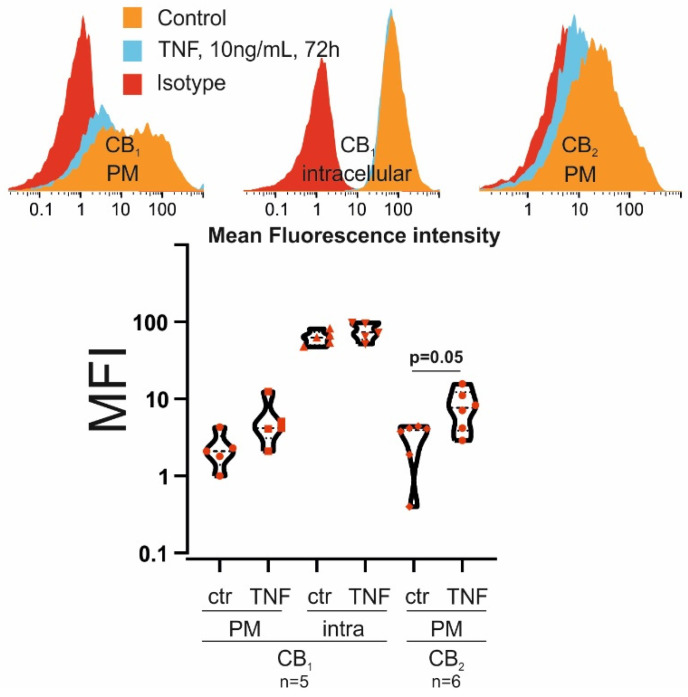
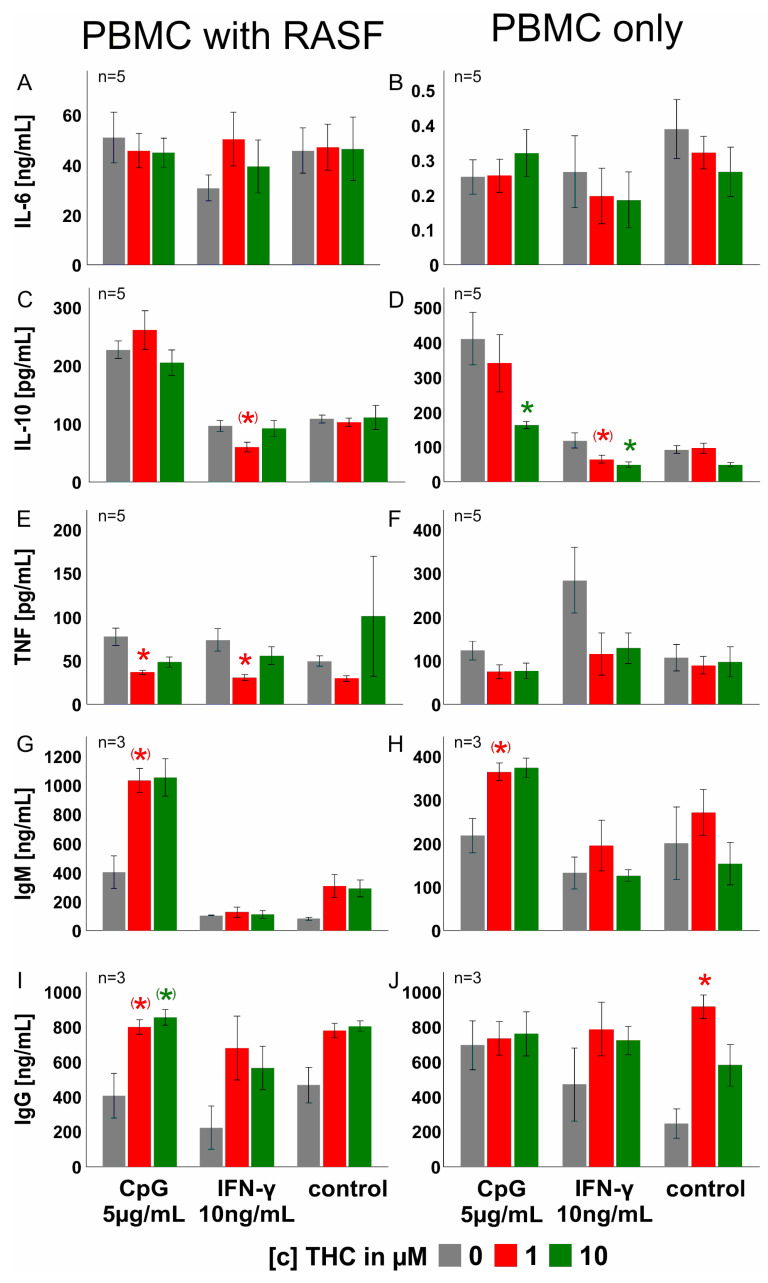
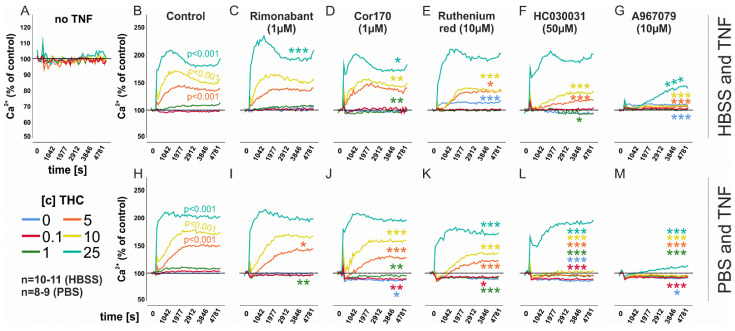
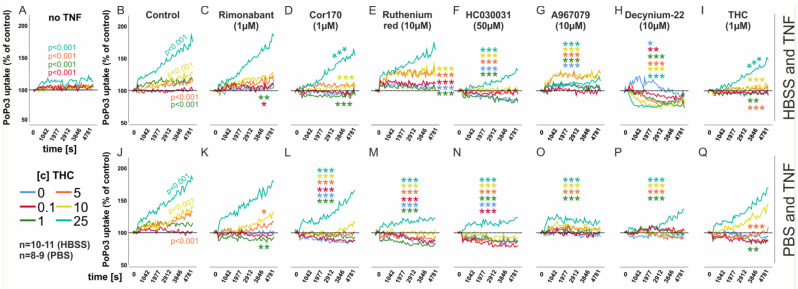
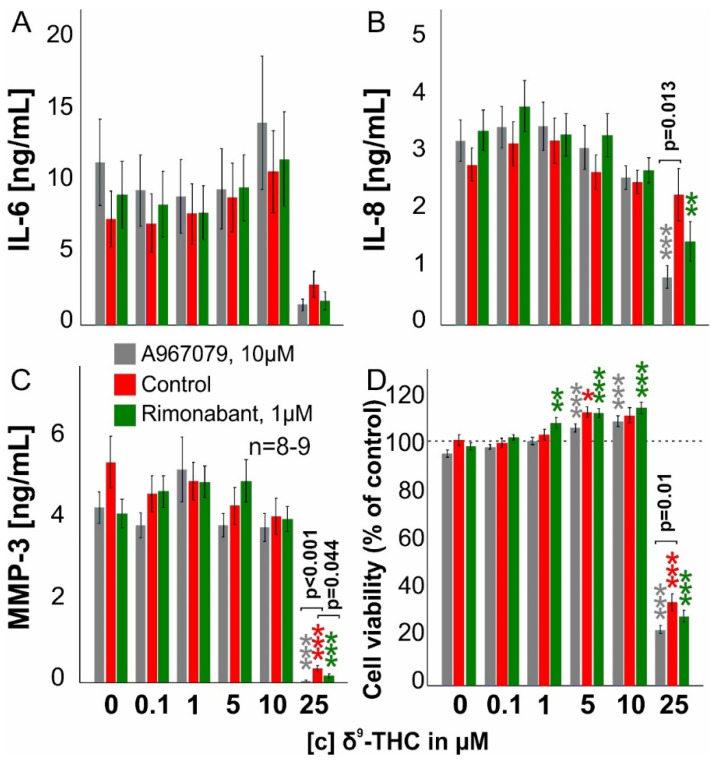
δ9-Tetrahydrocannabinol (THC) has demonstrated anti-inflammatory effects in animal models of arthritis, but its mechanism of action and cellular targets are still unclear. The purpose of this study is to elucidate the effects of THC (0.1-25 µM) on synovial fibroblasts from patients with rheumatoid arthritis (RASF) and peripheral blood mononuclear cells (PBMC) from healthy donors in respect to proliferation, calcium mobilization, drug uptake, cytokine and immunoglobulin production. Intracellular calcium and drug uptake were determined by fluorescent dyes Cal-520 and PoPo3, respectively. Cytokine and immunoglobulin production were evaluated by ELISA. Cannabinoid receptors 1 and 2 (CB and CB) were detected by flow cytometry. RASF express CB and CB and the latter was increased by tumor necrosis factor (TNF). In RASF, THC (≥5 µM) increased intracellular calcium levels/PoPo3 uptake in a TRPA1-dependent manner and reduced interleukin-8 (IL-8) and matrix metalloprotease 3 (MMP-3) production at high concentrations (25 µM). Proliferation was slightly enhanced at intermediate THC concentrations (1-10 µM) but was completely abrogated at 25 µM. In PBMC alone, THC decreased interleukin-10 (IL-10) production and increased immunoglobulin G (IgG). In PBMC/RASF co-culture, THC decreased TNF production when cells were stimulated with interferon-γ (IFN-γ) or CpG. THC provides pro- and anti-inflammatory effects in RASF and PBMC. This is dependent on the activating stimulus and concentration of THC. Therefore, THC might be used to treat inflammation in RA but it might need titrating to determine the effective concentration.
δ9-四氢大麻酚(THC)在关节炎动物模型中已显示出抗炎作用,但其作用机制和细胞靶点仍不清楚。本研究的目的是阐明THC(0.1 - 25μM)对类风湿性关节炎患者的滑膜成纤维细胞(RASF)和健康供体的外周血单核细胞(PBMC)在增殖、钙动员、药物摄取、细胞因子和免疫球蛋白产生方面的影响。细胞内钙和药物摄取分别通过荧光染料Cal-520和PoPo3测定。细胞因子和免疫球蛋白产生通过酶联免疫吸附测定(ELISA)评估。大麻素受体1和2(CB1和CB2)通过流式细胞术检测。RASF表达CB1和CB2,后者可被肿瘤坏死因子(TNF)上调。在RASF中,THC(≥5μM)以TRPA1依赖的方式增加细胞内钙水平/PoPo3摄取,并在高浓度(25μM)时降低白细胞介素-8(IL-8)和基质金属蛋白酶3(MMP-3)的产生。在中等THC浓度(1 - 10μM)时增殖略有增强,但在25μM时完全被抑制。仅在PBMC中,THC降低白细胞介素-10(IL-10)的产生并增加免疫球蛋白G(IgG)。在PBMC/RASF共培养中,当细胞用干扰素-γ(IFN-γ)或CpG刺激时,THC降低TNF的产生。THC在RASF和PBMC中具有促炎和抗炎作用。这取决于激活刺激和THC的浓度。因此,THC可能用于治疗类风湿性关节炎中的炎症,但可能需要滴定以确定有效浓度。