Department of Psychology, Northwestern University, Evanston, IL 60208, USA.
Cognition. 2011 Oct;121(1):133-9. doi: 10.1016/j.cognition.2011.06.003. Epub 2011 Jul 8.
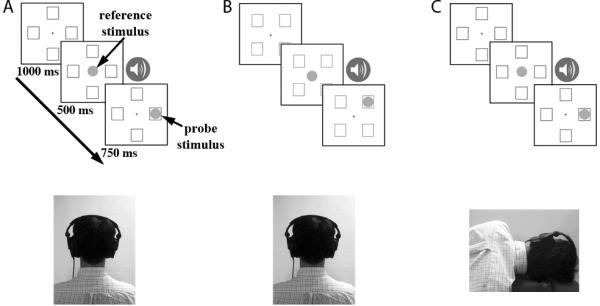
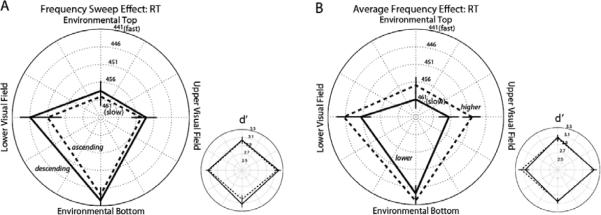
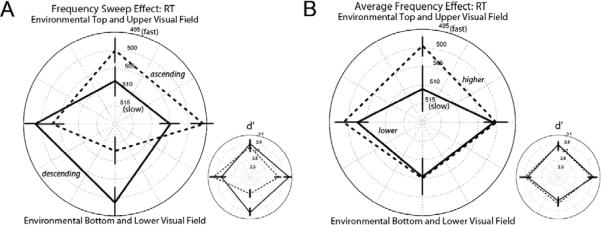
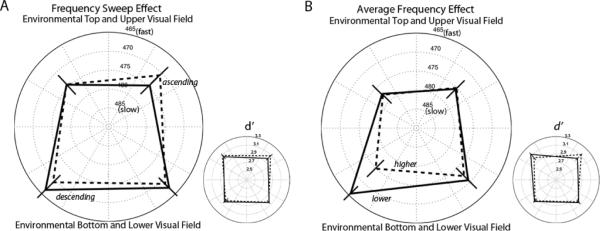
How do the characteristics of sounds influence the allocation of visual-spatial attention? Natural sounds typically change in frequency. Here we demonstrate that the direction of frequency change guides visual-spatial attention more strongly than the average or ending frequency, and provide evidence suggesting that this cross-modal effect may be mediated by perceptual experience. We used a Go/No-Go color-matching task to avoid response compatibility confounds. Participants performed the task either with their heads upright or tilted by 90°, misaligning the head-centered and environmental axes. The first of two colored circles was presented at fixation and the second was presented in one of four surrounding positions in a cardinal or diagonal direction. Either an ascending or descending auditory-frequency sweep was presented coincident with the first circle. Participants were instructed to respond to the color match between the two circles and to ignore the uninformative sounds. Ascending frequency sweeps facilitated performance (response time and/or sensitivity) when the second circle was presented at the cardinal top position and descending sweeps facilitated performance when the second circle was presented at the cardinal bottom position; there were no effects of the average or ending frequency. The sweeps had no effects when circles were presented at diagonal locations, and head tilt entirely eliminated the effect. Thus, visual-spatial cueing by pitch change is narrowly tuned to vertical directions and dominates any effect of average or ending frequency. Because this cross-modal cueing is dependent on the alignment of head-centered and environmental axes, it may develop through associative learning during waking upright experience.
声音的特征如何影响视觉空间注意的分配?自然声音的频率通常会发生变化。在这里,我们证明了频率变化的方向比平均频率或结束频率更能引导视觉空间注意,并且提供的证据表明这种跨模态效应可能是通过感知经验介导的。我们使用 Go/No-Go 颜色匹配任务来避免反应兼容性混淆。参与者要么以头部直立的姿势,要么以头部倾斜 90 度的姿势进行任务,从而使头部中心和环境轴不对齐。两个彩色圆圈中的第一个出现在注视位置,第二个出现在四个周围位置之一,呈 cardinal 或 diagonal 方向。在第一个圆圈出现的同时,会出现一个上升或下降的听觉频率扫描。参与者被指示响应两个圆圈之间的颜色匹配,忽略无关声音。当第二个圆圈出现在 cardinal top 位置时,上升频率扫描会促进表现(反应时间和/或敏感性),而当第二个圆圈出现在 cardinal bottom 位置时,下降频率扫描会促进表现;平均或结束频率没有影响。当圆圈出现在 diagonal 位置时,扫描没有影响,而头部倾斜完全消除了这种影响。因此,由音高变化引起的视觉空间提示对垂直方向具有高度的选择性,并且主导着平均或结束频率的任何影响。由于这种跨模态提示依赖于头部中心和环境轴的对齐,因此它可能会在清醒直立经验中通过联想学习发展而来。