Thywißen Andreas, Heinekamp Thorsten, Dahse Hans-Martin, Schmaler-Ripcke Jeannette, Nietzsche Sandor, Zipfel Peter F, Brakhage Axel A
Department of Molecular and Applied Microbiology, Leibniz Institute for Natural Product Research and Infection Biology - Hans Knöll Institute Jena, Germany.
Front Microbiol. 2011 May 3;2:96. doi: 10.3389/fmicb.2011.00096. eCollection 2011.
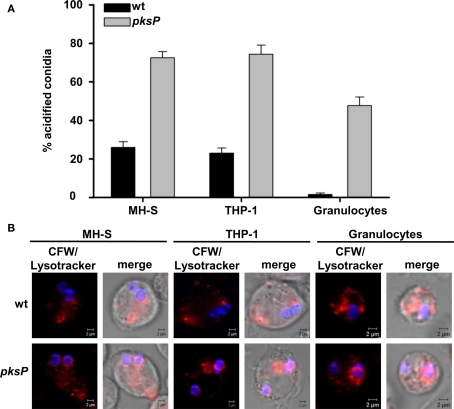
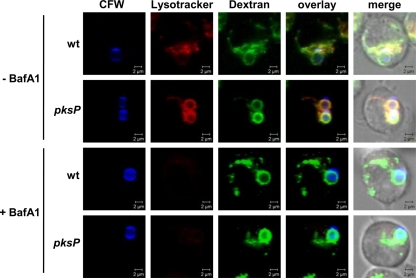
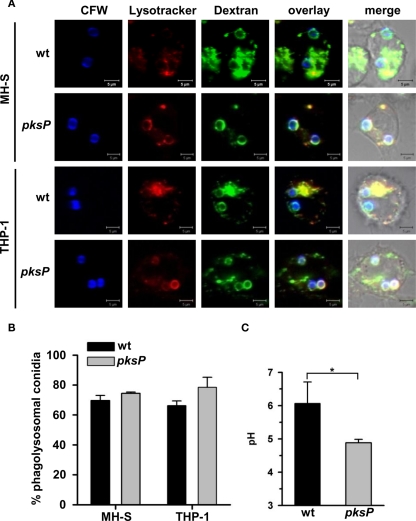
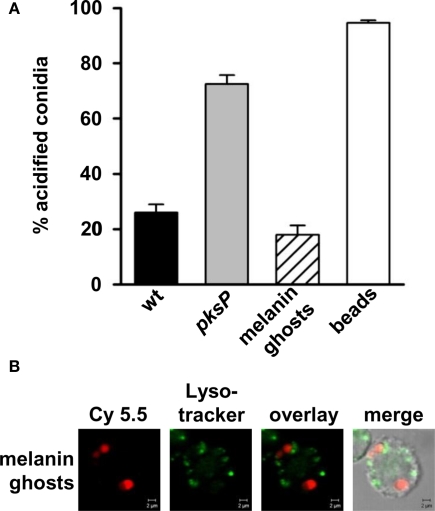
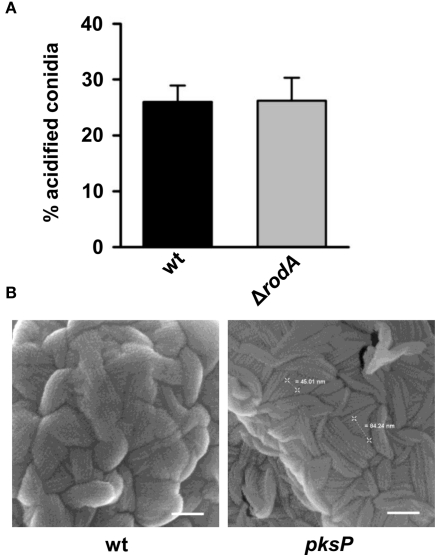
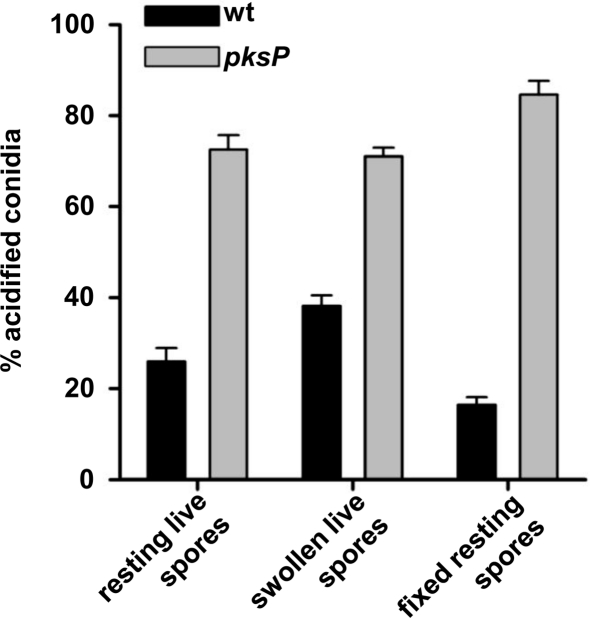
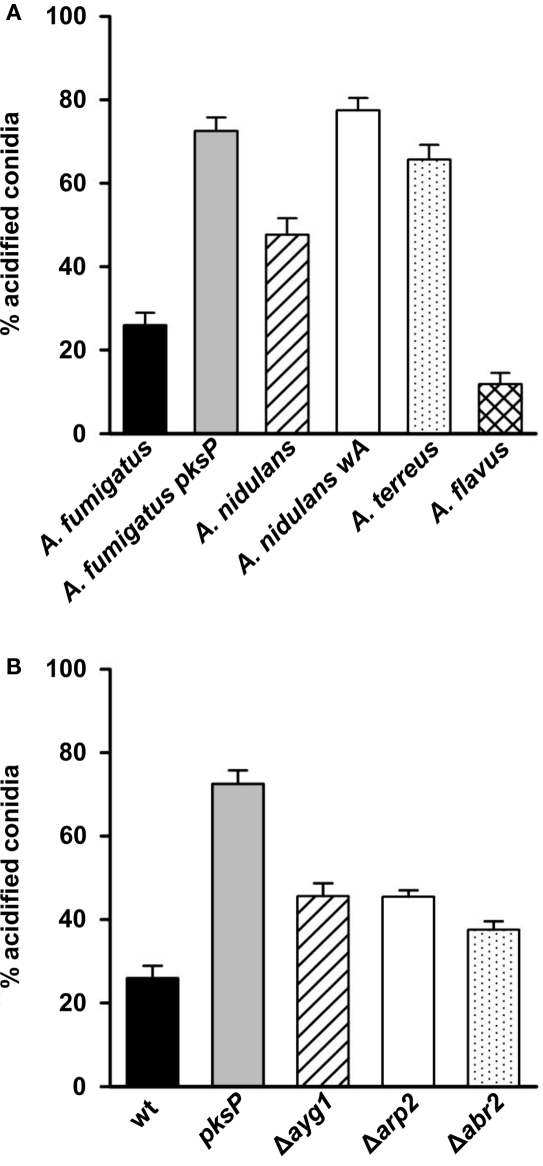
Aspergillus fumigatus is the most important air-borne fungal pathogen of humans. The interaction of the pathogen with the host's immune system represents a key process to understand pathogenicity. For elimination of invading microorganisms, they need to be efficiently phagocytosed and located in acidified phagolysosomes. However, as shown previously, A. fumigatus is able to manipulate the formation of functional phagolysosomes. Here, we demonstrate that in contrast to pigmentless pksP mutant conidia of A. fumigatus, the gray-green wild-type conidia inhibit the acidification of phagolysosomes of alveolar macrophages, monocyte-derived macrophages, and human neutrophil granulocytes. Therefore, this inhibition is independent of the cell type and applies to the major immune effector cells required for defense against A. fumigatus. Studies with melanin ghosts indicate that the inhibitory effect of wild-type conidia is due to their dihydroxynaphthalene (DHN)-melanin covering the conidia, whereas the hydrophobin RodA rodlet layer plays no role in this process. This is also supported by the observation that pksP conidia still exhibit the RodA hydrophobin layer, as shown by scanning electron microscopy. Mutants defective in different steps of the DHN-melanin biosynthesis showed stronger inhibition than pksP mutant conidia but lower inhibition than wild-type conidia. Moreover, A. fumigatus and A. flavus led to a stronger inhibition of phagolysosomal acidification than A. nidulans and A. terreus. These data indicate that a certain type of DHN-melanin that is different in the various Aspergillus species, is required for maximal inhibition of phagolysosomal acidification. Finally, we identified the vacuolar ATPase (vATPase) as potential target for A. fumigatus based on the finding that addition of bafilomycin which inhibits vATPase, led to complete inhibition of the acidification whereas the fusion of phagosomes containing wild-type conidia and lysosomes was not affected.
烟曲霉是人类最重要的空气传播真菌病原体。该病原体与宿主免疫系统的相互作用是理解其致病性的关键过程。为了清除入侵的微生物,它们需要被有效地吞噬并定位在酸化的吞噬溶酶体中。然而,如先前所示,烟曲霉能够操纵功能性吞噬溶酶体的形成。在此,我们证明,与烟曲霉无色素的pksP突变体分生孢子相比,灰绿色的野生型分生孢子会抑制肺泡巨噬细胞、单核细胞衍生巨噬细胞和人类中性粒细胞的吞噬溶酶体酸化。因此,这种抑制作用与细胞类型无关,适用于抵御烟曲霉所需的主要免疫效应细胞。对黑色素空壳的研究表明,野生型分生孢子的抑制作用是由于其覆盖分生孢子的二羟基萘(DHN)-黑色素,而疏水蛋白RodA小杆层在此过程中不起作用。扫描电子显微镜显示pksP分生孢子仍具有RodA疏水蛋白层,这一观察结果也支持了这一点。在DHN-黑色素生物合成不同步骤中存在缺陷的突变体表现出比pksP突变体分生孢子更强的抑制作用,但比野生型分生孢子的抑制作用弱。此外,烟曲霉和黄曲霉对吞噬溶酶体酸化的抑制作用比构巢曲霉和土曲霉更强。这些数据表明,不同曲霉物种中某种类型的DHN-黑色素对于最大程度抑制吞噬溶酶体酸化是必需的。最后,基于添加抑制液泡ATP酶(vATPase)的巴弗洛霉素会导致酸化完全被抑制,而含有野生型分生孢子的吞噬体与溶酶体的融合不受影响这一发现,我们确定vATPase是烟曲霉的潜在靶点。