Division of Cardiovascular Medicine, Brigham and Women's Hospital, Harvard Medical School, Boston, Massachusetts, United States of America.
PLoS One. 2011;6(7):e21209. doi: 10.1371/journal.pone.0021209. Epub 2011 Jul 5.
PPARs (α,γ,δ) are a family of ligand-activated transcription factors that regulate energy balance, including lipid metabolism. Despite these critical functions, the integration between specific pathways of lipid metabolism and distinct PPAR responses remains obscure. Previous work has revealed that lipolytic pathways can activate PPARs. Whether hepatic lipase (HL), an enzyme that regulates VLDL and HDL catabolism, participates in PPAR responses is unknown.
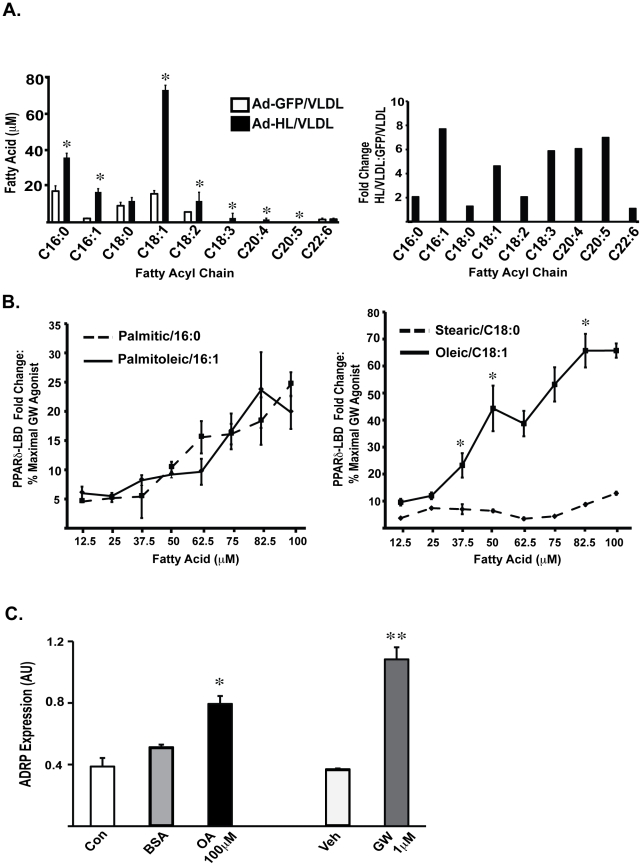
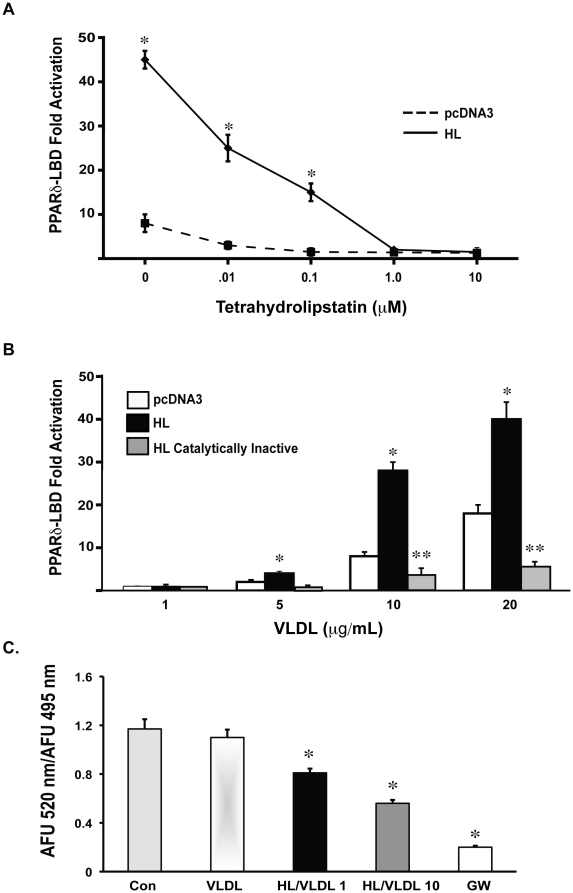
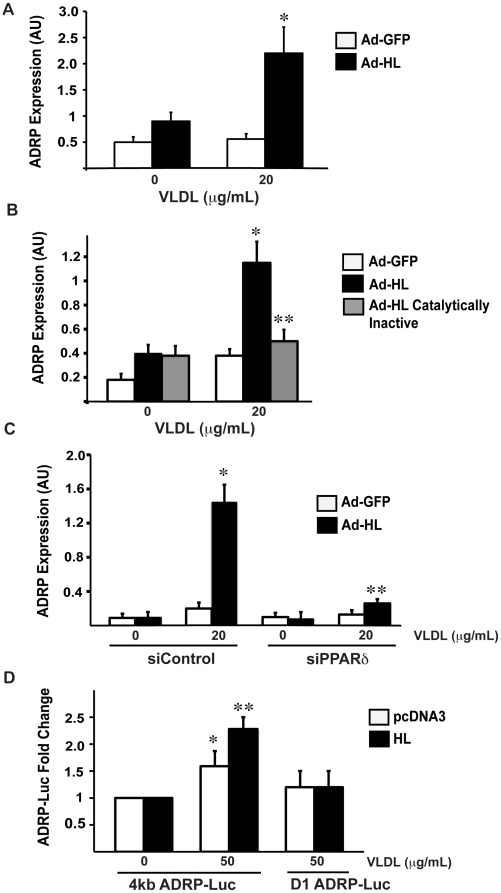
METHODS/PRINCIPAL FINDINGS: Using PPAR ligand binding domain transactivation assays, we found that HL interacted with triglyceride-rich VLDL (>HDL≫LDL, IDL) to activate PPARδ preferentially over PPARα or PPARγ, an effect dependent on HL catalytic activity. In cell free ligand displacement assays, VLDL hydrolysis by HL activated PPARδ in a VLDL-concentration dependent manner. Extended further, VLDL stimulation of HL-expressing HUVECs and FAO hepatoma cells increased mRNA expression of canonical PPARδ target genes, including adipocyte differentiation related protein (ADRP), angiopoietin like protein 4 and pyruvate dehydrogenase kinase-4. HL/VLDL regulated ADRP through a PPRE in the promoter region of this gene. In vivo, adenoviral-mediated hepatic HL expression in C57BL/6 mice increased hepatic ADRP mRNA levels by 30%. In ob/ob mice, a model with higher triglycerides than C57BL/6 mice, HL overexpression increased ADRP expression by 70%, demonstrating the importance of triglyceride substrate for HL-mediated PPARδ activation. Global metabolite profiling identified HL/VLDL released fatty acids including oleic acid and palmitoleic acid that were capable of recapitulating PPARδ activation and ADRP gene regulation in vitro.
These data define a novel pathway involving HL hydrolysis of VLDL that activates PPARδ through generation of specific monounsaturated fatty acids. These data also demonstrate how integrating cell biology with metabolomic approaches provides insight into specific lipid mediators and pathways of lipid metabolism that regulate transcription.
过氧化物酶体增殖物激活受体(PPARs)(α、γ、δ)是一组配体激活的转录因子,可调节包括脂质代谢在内的能量平衡。尽管这些功能至关重要,但脂质代谢特定途径与不同的 PPAR 反应之间的整合仍不清楚。先前的工作表明,脂肪分解途径可以激活 PPAR。尚不清楚调节 VLDL 和 HDL 分解代谢的肝脂肪酶(HL)是否参与 PPAR 反应。
方法/主要发现:使用 PPAR 配体结合域转录激活测定,我们发现 HL 与富含甘油三酯的 VLDL(>HDL> LDL、IDL)相互作用,优先激活 PPARδ,而不是 PPARα 或 PPARγ,这种作用依赖于 HL 的催化活性。在无细胞配体置换测定中,HL 水解 VLDL 以 VLDL 浓度依赖的方式激活 PPARδ。进一步扩展,HL 刺激表达 HL 的 HUVEC 和 FAO 肝癌细胞增加了经典的 PPARδ 靶基因的 mRNA 表达,包括脂肪分化相关蛋白(ADRP)、血管生成素样蛋白 4 和丙酮酸脱氢酶激酶-4。HL/VLDL 通过该基因启动子区域的 PPRE 调节 ADRP。在体内,在 C57BL/6 小鼠中通过腺病毒介导的肝 HL 表达增加了 30%的肝 ADRP mRNA 水平。在 ob/ob 小鼠中,一种甘油三酯水平高于 C57BL/6 小鼠的模型,HL 过表达使 ADRP 表达增加了 70%,表明甘油三酯底物对 HL 介导的 PPARδ 激活的重要性。全局代谢物分析鉴定出 HL/VLDL 释放的脂肪酸,包括油酸和棕榈油酸,这些脂肪酸能够在体外重新激活 PPARδ 并调节 ADRP 基因表达。
这些数据定义了一种涉及 HL 水解 VLDL 的新途径,该途径通过产生特定的单不饱和脂肪酸来激活 PPARδ。这些数据还表明,如何将细胞生物学与代谢组学方法相结合,为调节转录的特定脂质介质和脂质代谢途径提供了深入了解。