Division of Neonatology and Pulmonary Biology, Department of Pediatrics, Cincinnati Children's Hospital Medical Center, OH 45229, USA.
Am J Obstet Gynecol. 2011 Jun;204(6):518.e1-8. doi: 10.1016/j.ajog.2011.03.038. Epub 2011 Mar 26.
Fetal lung maturity often is used as the sole criterion that late preterm infants are ready for postnatal life. We therefore tested the hypothesis that fetal lung maturity testing does not predict the absence of morbidity in late preterm infants.
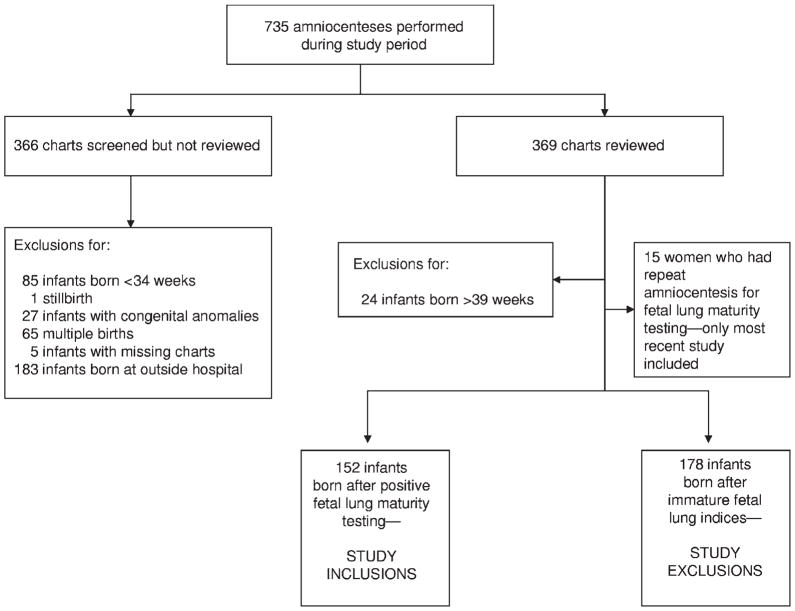
We performed a retrospective cohort study to examine 152 infants who were born in the late preterm (34 0/7 to 36 6/7 weeks) and early term (37 0/7 to 38 6/7 weeks) periods after mature fetal lung indices and compared them with 262 infants who were born at ≥39 weeks' gestation and who were matched by mode of delivery.
Despite documented fetal lung maturity, infants who were born at <39 weeks had significantly higher rates of neonatal morbidities compared with infants who were born at ≥39 weeks' gestation. After adjustment for significant covariates, we found that infants who were born at <39 weeks' gestation had an increased risk of composite adverse outcome (odds ratio, 3.66; 95% confidence interval, 1.48-9.09; P < .01).
Fetal lung maturity testing is insufficient to determine an infant's readiness for postnatal life.
胎儿肺成熟度常被用作判断晚期早产儿是否为适应产后生活的唯一标准。因此,我们检验了一个假设,即胎儿肺成熟度测试并不能预测晚期早产儿无发病。
我们进行了一项回顾性队列研究,对 152 名在晚期早产儿(34 0/7 至 36 6/7 周)和早期足月(37 0/7 至 38 6/7 周)出生的婴儿进行了检查,他们的胎儿肺指数成熟,并与 262 名在≥39 周分娩且通过分娩方式相匹配的婴儿进行了比较。
尽管胎儿肺成熟度已经确定,但与在≥39 周分娩的婴儿相比,在<39 周分娩的婴儿的新生儿发病率明显更高。在对显著协变量进行调整后,我们发现<39 周分娩的婴儿发生复合不良结局的风险增加(比值比,3.66;95%置信区间,1.48-9.09;P<.01)。
胎儿肺成熟度测试不足以确定婴儿是否为适应产后生活。