INSERM, UMR S953, IFR 69, Epidemiological Research on Perinatal Health and Women's and Children's Health, Paris, France.
PLoS One. 2011;6(7):e21361. doi: 10.1371/journal.pone.0021361. Epub 2011 Jul 8.
To investigate school difficulties, special care and behavioral problems in 8 year-old very preterm (VPT) children.
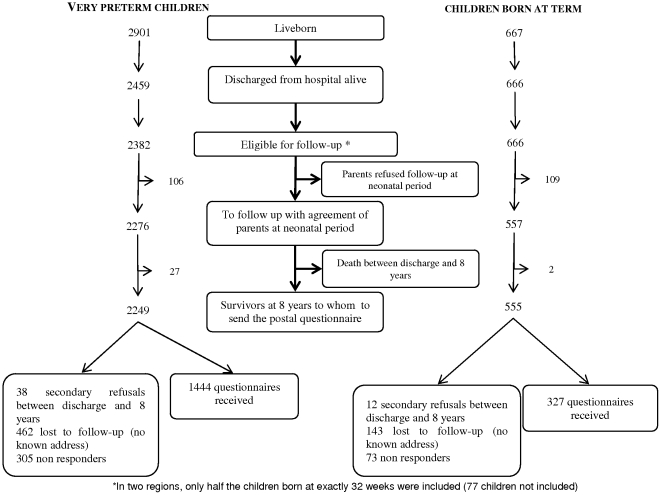
Longitudinal population-based cohort in nine regions of France of VPT children and a reference group born at 39-40 weeks of gestation (WG). The main outcome measures were information about school, special care and behavioral problems using Strengths and Difficulties Questionnaire from a questionnaire to parents.
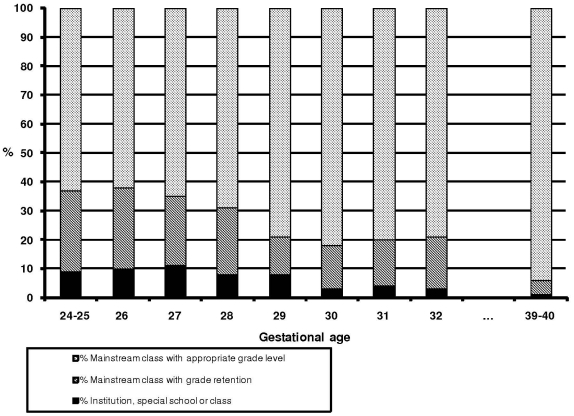
Among the 1439 VPT children, 5% (75/1439) were in a specialised school or class, 18% (259/1439) had repeated a grade in a mainstream class and 77% (1105/1439) were in the appropriate grade-level in mainstream class; these figures were 1% (3/327) , 5% (16/327) and 94% (308/327) , respectively, for the reference group. Also, 15% (221/1435) of VPT children in a mainstream class received support at school versus 5% (16/326) of reference group. More VPT children between the ages of five and eight years received special care (55% (794/1436)) than children born at term (38% (124/325)); more VPT children (21% (292/1387)) had behavioral difficulties than the reference group (11% (35/319)). School difficulties, support at school, special care and behavioral difficulties in VPT children without neuromotor or sensory deficits varied with gestational age, socioeconomic status, and cognitive score at the age of five.
Most 8-year-old VPT children are in mainstream schools. However, they have a high risk of difficulty in school, with more than half requiring additional support at school and/or special care. Referral to special services has increased between the ages of 5 and 8 years, but remained insufficient for those with borderline cognitive scores.
调查 8 岁极早产儿(VPT)儿童的学业困难、特殊照顾和行为问题。
这是一项在法国 9 个地区进行的基于人群的 VPT 儿童纵向队列研究,以及一个出生于 39-40 孕周(WG)的参考组。主要结局指标是通过家长问卷使用长处和困难问卷(SDQ)获得的有关学校、特殊照顾和行为问题的信息。
在 1439 名 VPT 儿童中,5%(75/1439)在特殊学校或班级就读,18%(259/1439)在主流班级重读,77%(1105/1439)在主流班级中处于适当年级;这些数字分别为 1%(3/327)、5%(16/327)和 94%(308/327),参考组为 5%(16/327)。此外,在主流班级中,15%(221/1435)的 VPT 儿童在学校接受支持,而参考组为 5%(16/326)。与足月出生的儿童(38%(124/325))相比,5 至 8 岁的 VPT 儿童中接受特殊照顾的儿童(55%(794/1436))更多;与参考组(11%(35/319))相比,VPT 儿童(21%(292/1387))的行为问题更多。无神经运动或感觉缺陷的 VPT 儿童的学业困难、学校支持、特殊照顾和行为问题随胎龄、社会经济地位和 5 岁时的认知评分而变化。
大多数 8 岁的 VPT 儿童在主流学校就读。然而,他们在学业上有很高的困难风险,超过一半的人需要额外的学校支持和/或特殊照顾。从 5 岁到 8 岁,转介到特殊服务的人数有所增加,但对于认知得分接近临界值的儿童来说,仍然不足。