Department of Movement and Sport Sciences, Ghent University, Ghent, Belgium.
PLoS One. 2011;6(7):e21956. doi: 10.1371/journal.pone.0021956. Epub 2011 Jul 7.
It has been established that excellence in sports with short and long exercise duration requires a high proportion of fast-twitch (FT) or type-II fibers and slow-twitch (ST) or type-I fibers, respectively. Until today, the muscle biopsy method is still accepted as gold standard to measure muscle fiber type composition. Because of its invasive nature and high sampling variance, it would be useful to develop a non-invasive alternative.
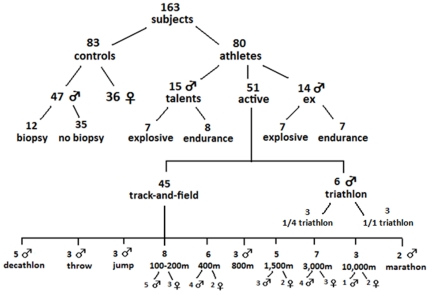
Eighty-three control subjects, 15 talented young track-and-field athletes, 51 elite athletes and 14 ex-athletes volunteered to participate in the current study. The carnosine content of all 163 subjects was measured in the gastrocnemius muscle by proton magnetic resonance spectroscopy ((1)H-MRS). Muscle biopsies for fiber typing were taken from 12 untrained males.
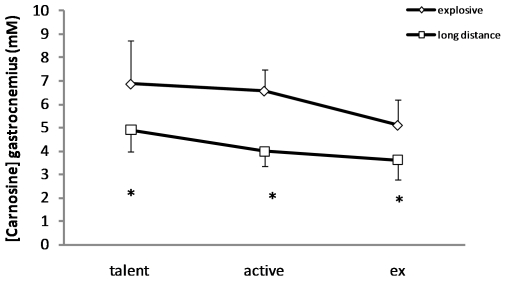
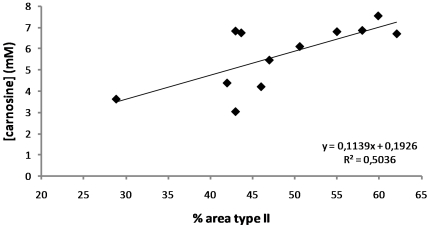
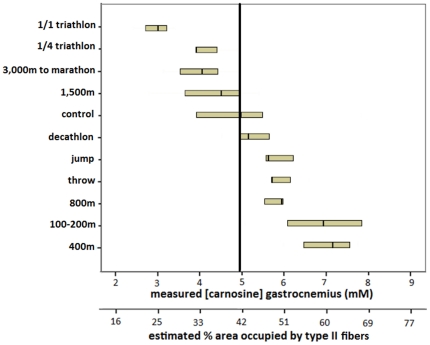
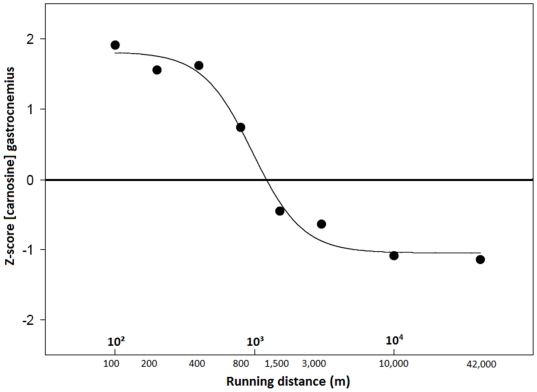
A significant positive correlation was found between muscle carnosine, measured by (1)H-MRS, and percentage area occupied by type II fibers. Explosive athletes had ∼30% higher carnosine levels compared to a reference population, whereas it was ∼20% lower than normal in typical endurance athletes. Similar results were found in young talents and ex-athletes. When active elite runners were ranked according to their best running distance, a negative sigmoidal curve was found between logarithm of running distance and muscle carnosine.
Muscle carnosine content shows a good reflection of the disciplines of elite track-and-field athletes and is able to distinguish between individual track running distances. The differences between endurance and sprint muscle types is also observed in young talents and former athletes, suggesting this characteristic is genetically determined and can be applied in early talent identification. This quick method provides a valid alternative for the muscle biopsy method. In addition, this technique may also contribute to the diagnosis and monitoring of many conditions and diseases that are characterized by an altered muscle fiber type composition.
已经证实,无论是短时间还是长时间的运动,要想在体育方面表现出色,都需要高比例的快肌纤维(FT)或 II 型纤维和慢肌纤维(ST)或 I 型纤维。直到今天,肌肉活检仍然被认为是测量肌肉纤维类型组成的金标准。由于其具有侵入性和高采样方差,因此开发一种非侵入性的替代方法将是有用的。
83 名对照受试者、15 名有天赋的年轻田径运动员、51 名精英运动员和 14 名前运动员自愿参加了当前的研究。通过质子磁共振波谱(1H-MRS)测量了所有 163 名受试者腓肠肌中的肉碱含量。从 12 名未经训练的男性中取出肌肉活检进行纤维分型。
通过 1H-MRS 测量的肌肉肉碱与 II 型纤维所占面积百分比之间存在显著正相关。爆发力运动员的肉碱水平比参考人群高约 30%,而典型耐力运动员的肉碱水平比正常水平低约 20%。在年轻的运动员和前运动员中也发现了类似的结果。当根据最佳跑步距离对活跃的精英跑步者进行排名时,在对数跑步距离和肌肉肉碱之间发现了一个负的 S 型曲线。
肌肉肉碱含量很好地反映了优秀田径运动员的运动项目,并且能够区分个体的跑步距离。在年轻的运动员和前运动员中,也观察到了耐力和短跑肌肉类型之间的差异,这表明这种特征是由遗传决定的,可以应用于早期的人才识别。这种快速方法为肌肉活检方法提供了有效的替代方法。此外,该技术还可能有助于诊断和监测许多以肌肉纤维类型组成改变为特征的疾病。