Arthritis Research UK Epidemiology Unit, The University of Manchester, Manchester Academic Health Science Centre, Manchester, United Kingdom.
PLoS One. 2011;6(7):e22037. doi: 10.1371/journal.pone.0022037. Epub 2011 Jul 7.
Genome-wide association studies (GWAS) have identified 6q25, which incorporates the oestrogen receptor α gene (ESR1), as a quantitative trait locus for areal bone mineral density (BMD(a)) of the hip and lumbar spine. The aim of this study was to determine the influence of this locus on other bone health outcomes; calcaneal ultrasound (QUS) parameters, radial peripheral quantitative computed tomography (pQCT) parameters and markers of bone turnover in a population sample of European men.
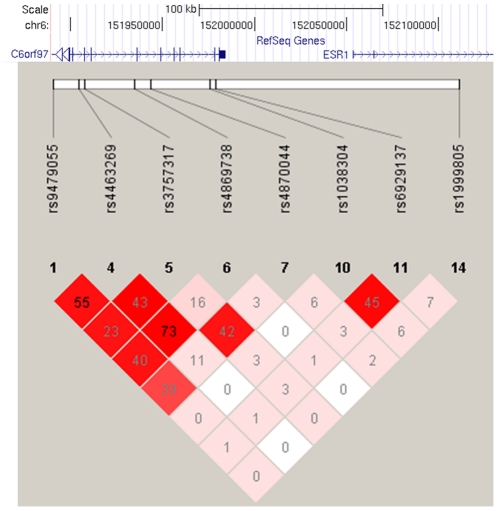
Eight single nucleotide polymorphisms (SNP) in the 6q25 locus were genotyped in men aged 40-79 years from 7 European countries, participating in the European Male Ageing Study (EMAS). The associations between SNPs and measured bone parameters were tested under an additive genetic model adjusting for centre using linear regression.
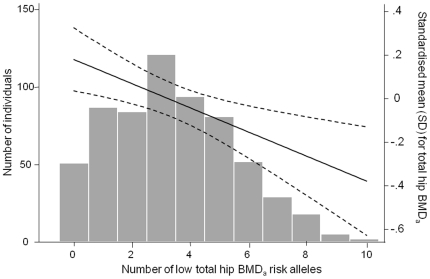
2468 men, mean (SD) aged 59.9 (11.1) years had QUS measurements performed and bone turnover marker levels measured. A subset of 628 men had DXA and pQCT measurements. Multiple independent SNPs showed significant associations with BMD using all three measurement techniques. Most notably, rs1999805 was associated with a 0.10 SD (95%CI 0.05, 0.16; p = 0.0001) lower estimated BMD at the calcaneus, a 0.14 SD (95%CI 0.05, 0.24; p = 0.004) lower total hip BMD(a), a 0.12 SD (95%CI 0.02, 0.23; p = 0.026) lower lumbar spine BMD(a) and a 0.18 SD (95%CI 0.06, 0.29; p = 0.003) lower trabecular BMD at the distal radius for each copy of the minor allele. There was no association with serum levels of bone turnover markers and a single SNP which was associated with cortical density was also associated with cortical BMC and thickness.
Our data replicate previous associations found between SNPs in the 6q25 locus and BMD(a) at the hip and extend these data to include associations with calcaneal ultrasound parameters and radial volumetric BMD.
全基因组关联研究(GWAS)已经确定了包含雌激素受体α基因(ESR1)的 6q25 是髋部和腰椎骨矿物质密度(BMD(a))的数量性状基因座。本研究旨在确定该基因座对其他骨骼健康结果的影响;在欧洲男性的人群样本中,测定跟骨超声(QUS)参数、桡骨外周定量计算机断层扫描(pQCT)参数和骨转换标志物。
在来自 7 个欧洲国家的年龄在 40-79 岁的欧洲男性衰老研究(EMAS)中,对 6q25 基因座中的 8 个单核苷酸多态性(SNP)进行了基因分型。采用线性回归法,在调整中心的基础上,根据加性遗传模型,检测 SNP 与测量骨参数之间的关联。
2468 名男性,平均(SD)年龄 59.9(11.1)岁,进行了 QUS 测量和骨转换标志物水平测量。628 名男性的一部分进行了 DXA 和 pQCT 测量。多个独立的 SNP 与所有三种测量技术的 BMD 均有显著关联。最值得注意的是,rs1999805 与跟骨的估计 BMD 降低 0.10 SD(95%CI 0.05, 0.16;p=0.0001)、全髋部 BMD(a)降低 0.14 SD(95%CI 0.05, 0.24;p=0.004)、腰椎 BMD(a)降低 0.12 SD(95%CI 0.02, 0.23;p=0.026)和桡骨远端小梁 BMD 降低 0.18 SD(95%CI 0.06, 0.29;p=0.003)显著相关。每个次要等位基因的拷贝数与血清骨转换标志物水平无相关性,与皮质密度相关的单个 SNP 也与皮质骨 BMC 和厚度相关。
我们的数据复制了之前在 6q25 基因座的 SNP 与髋关节 BMD(a)之间发现的关联,并将这些数据扩展到包括与跟骨超声参数和桡骨容积 BMD 的关联。