Chemical Biology Laboratory, Molecular Discovery Program, Center for Cancer Research, National Cancer Institute-Frederick, Frederick, Maryland, USA.
Nat Chem Biol. 2011 Jul 17;7(9):595-601. doi: 10.1038/nchembio.614.
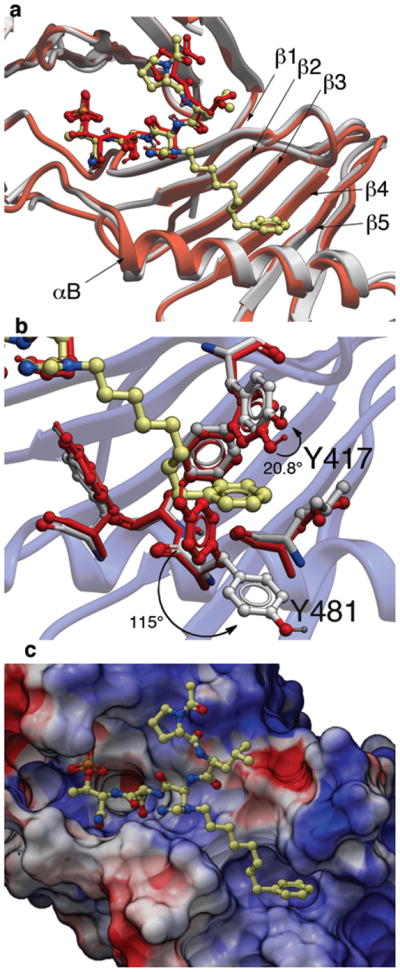
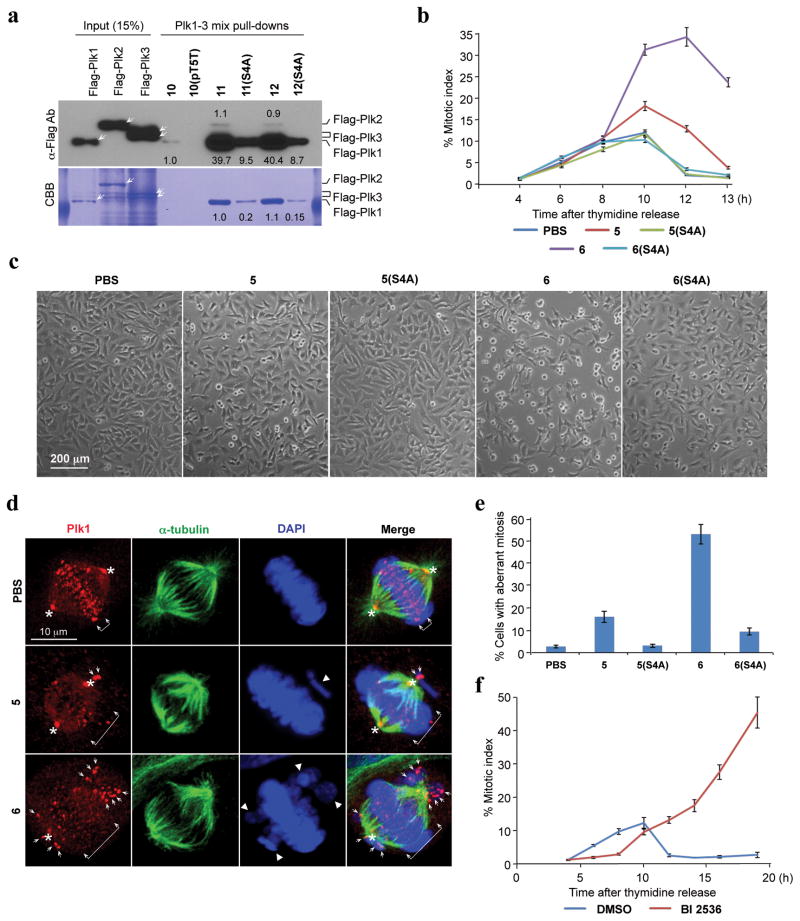
We obtained unanticipated synthetic byproducts from alkylation of the δ(1) nitrogen (N3) of the histidine imidazole ring of the polo-like kinase-1 (Plk1) polo-box domain (PBD)-binding peptide PLHSpT. For the highest-affinity byproduct, bearing a C(6)H(5)(CH(2))(8)- group, a Plk1 PBD cocrystal structure revealed a new binding channel that had previously been occluded. An N-terminal PEGylated version of this peptide containing a hydrolytically stable phosphothreonyl residue (pT) bound the Plk1 PBD with affinity equal to that of the non-PEGylated parent but showed markedly less interaction with the PBDs of the two closely related proteins Plk2 and Plk3. Treatment of cultured cells with this PEGylated peptide resulted in delocalization of Plk1 from centrosomes and kinetochores and in chromosome misalignment that effectively induced mitotic block and apoptotic cell death. This work provides insights that might advance efforts to develop Plk1 PBD-binding inhibitors as potential Plk1-specific anticancer agents.
我们从 polo 样激酶-1(Plk1)的 polo -box 结构域(PBD)结合肽 PLHSpT 的δ(1)氮(N3)的烷基化反应中得到了意想不到的合成副产物。对于最高亲和力的副产物,带有 C(6)H(5)(CH(2))(8)-基团,一个 Plk1 PBD 共晶结构揭示了一个以前被阻塞的新结合通道。该肽的 N 端聚乙二醇化版本含有一个可水解稳定的磷酸苏氨酸残基(pT),与 Plk1 PBD 的亲和力与非聚乙二醇化的母体相同,但与两个密切相关的蛋白质 Plk2 和 Plk3 的 PBD 相互作用明显减少。用这种聚乙二醇化的肽处理培养的细胞会导致 Plk1 从中心体和动粒上解定位,并导致染色体错位,有效地诱导有丝分裂阻断和细胞凋亡。这项工作提供了一些见解,可能会推动开发 Plk1 PBD 结合抑制剂作为潜在的 Plk1 特异性抗癌药物的努力。