Department of Biology, Johns Hopkins University, Baltimore, Maryland 21218, USA.
Nature. 2011 Jul 17;476(7358):92-5. doi: 10.1038/nature10206.
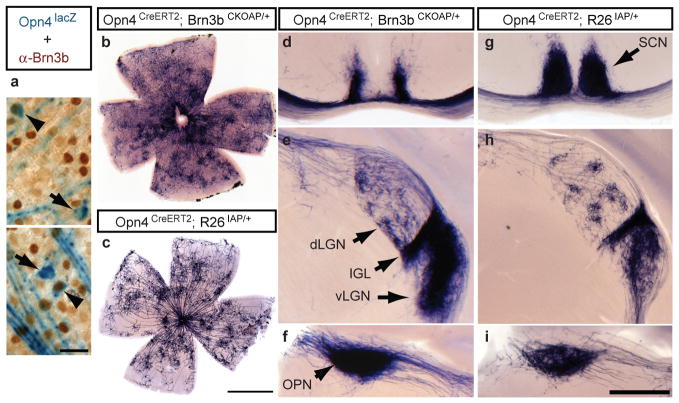
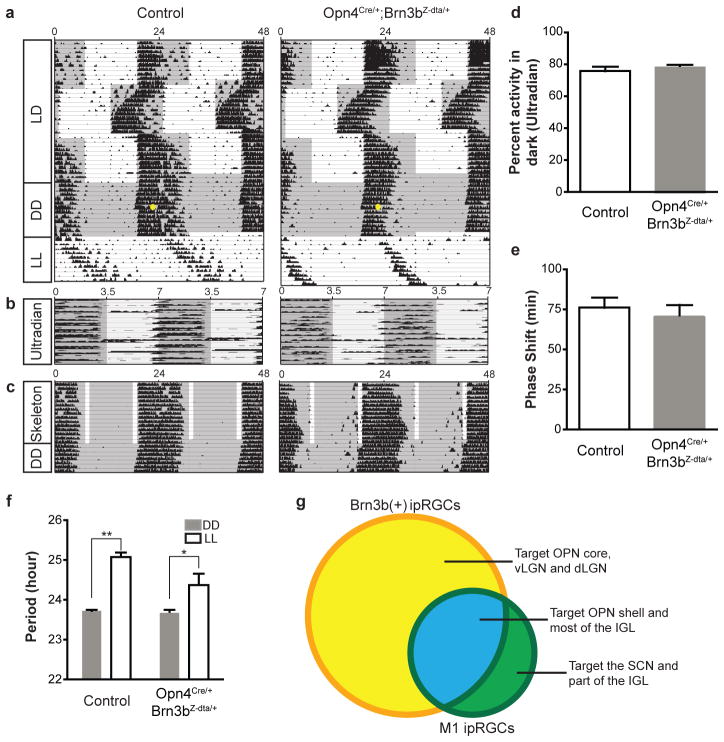
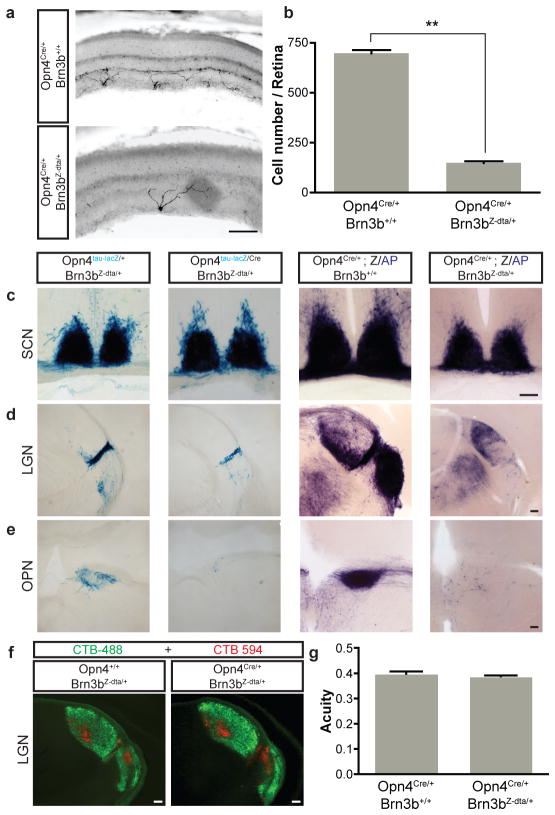
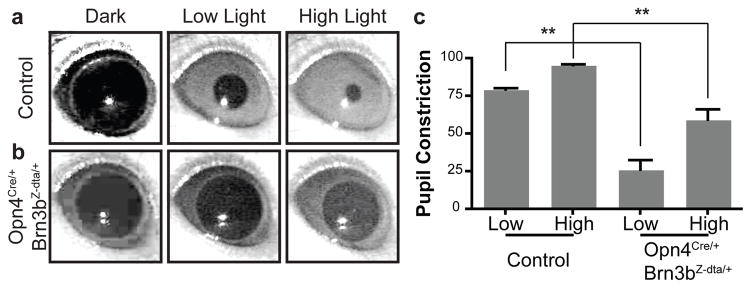
Intrinsically photosensitive retinal ganglion cells (ipRGCs) express the photopigment melanopsin and regulate a wide array of light-dependent physiological processes. Genetic ablation of ipRGCs eliminates circadian photoentrainment and severely disrupts the pupillary light reflex (PLR). Here we show that ipRGCs consist of distinct subpopulations that differentially express the Brn3b transcription factor, and can be functionally distinguished. Brn3b-negative M1 ipRGCs innervate the suprachiasmatic nucleus (SCN) of the hypothalamus, whereas Brn3b-positive ipRGCs innervate all other known brain targets, including the olivary pretectal nucleus. Consistent with these innervation patterns, selective ablation of Brn3b-positive ipRGCs severely disrupts the PLR, but does not impair circadian photoentrainment. Thus, we find that molecularly distinct subpopulations of M1 ipRGCs, which are morphologically and electrophysiologically similar, innervate different brain regions to execute specific light-induced functions.
内在光敏视网膜神经节细胞(ipRGCs)表达光色素黑视素,并调节广泛的光依赖生理过程。ipRGCs 的基因缺失消除了昼夜节律的光适应,并严重破坏了瞳孔光反射(PLR)。在这里,我们表明 ipRGCs 由不同的亚群组成,这些亚群差异表达 Brn3b 转录因子,并可以在功能上区分开来。Brn3b 阴性 M1 ipRGCs 支配下丘脑的视交叉上核(SCN),而 Brn3b 阳性 ipRGCs 支配所有其他已知的大脑靶标,包括橄榄状小脑前核。与这些神经支配模式一致,选择性地破坏 Brn3b 阳性 ipRGCs 严重破坏了 PLR,但不损害昼夜节律的光适应。因此,我们发现,形态和电生理上相似的 M1 ipRGCs 的分子上不同的亚群支配不同的脑区以执行特定的光诱导功能。