Telethon Institute of Genetics and Medicine, Naples, Italy.
PLoS Comput Biol. 2011 Jun;7(6):e1002074. doi: 10.1371/journal.pcbi.1002074. Epub 2011 Jun 30.
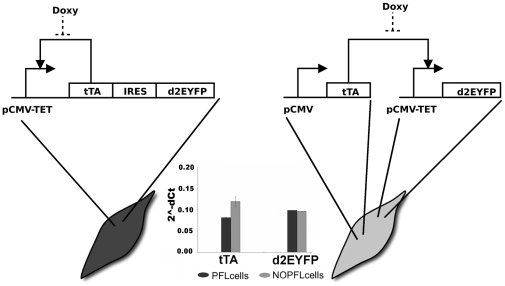
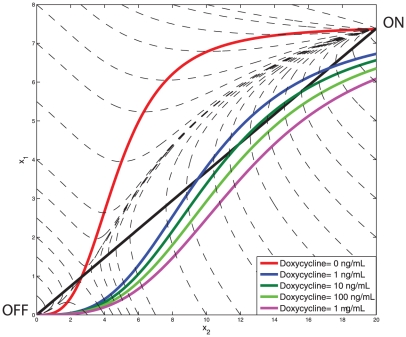
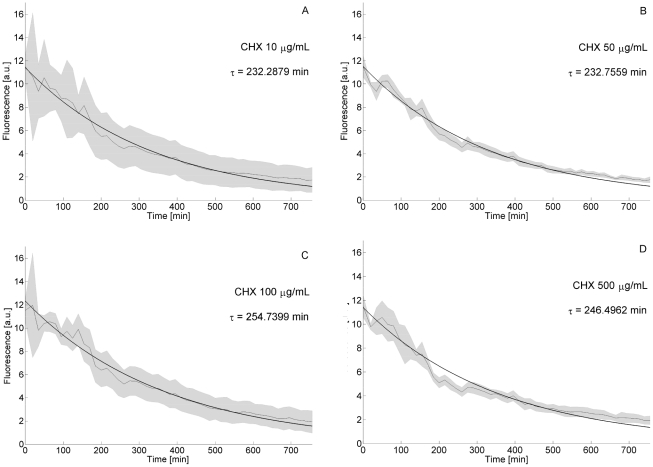
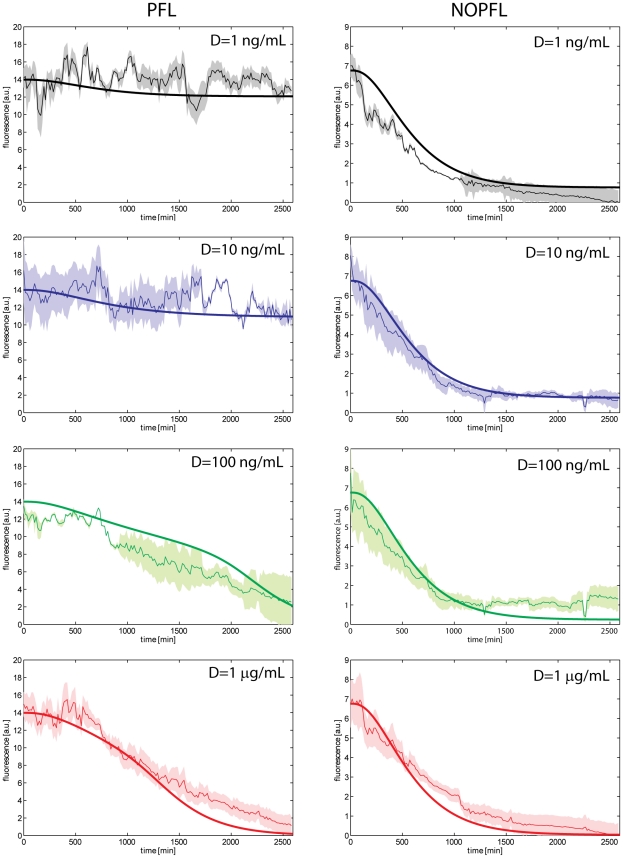
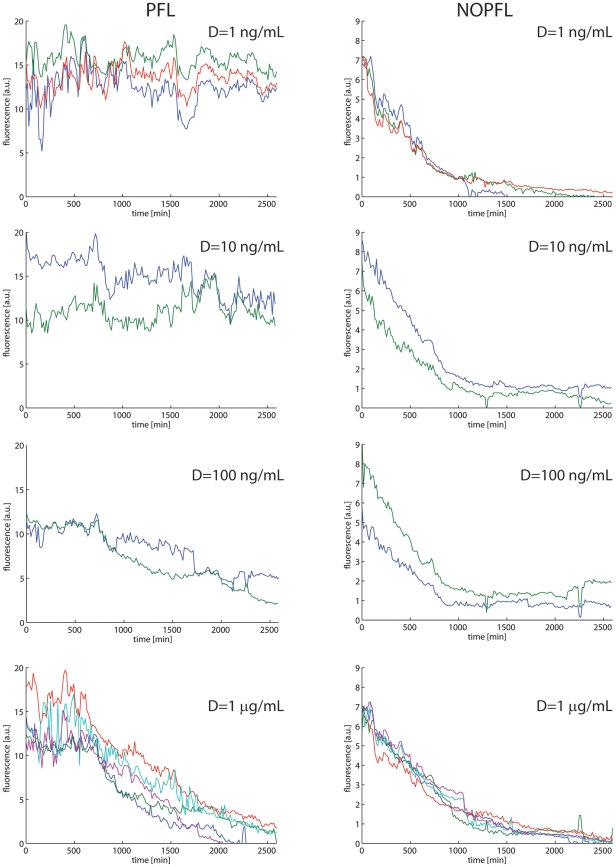
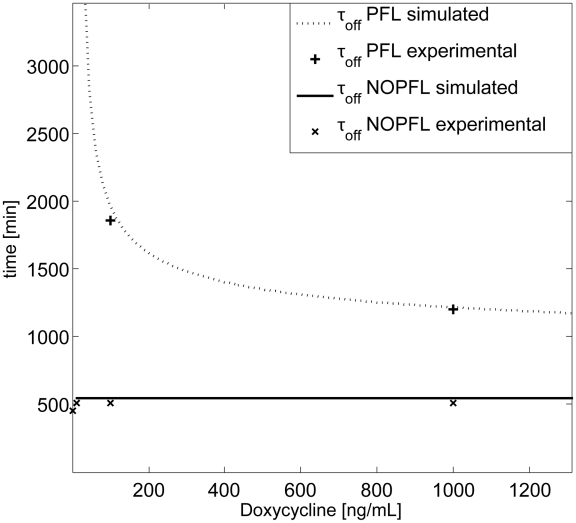
Understanding the relationship between topology and dynamics of transcriptional regulatory networks in mammalian cells is essential to elucidate the biology of complex regulatory and signaling pathways. Here, we characterised, via a synthetic biology approach, a transcriptional positive feedback loop (PFL) by generating a clonal population of mammalian cells (CHO) carrying a stable integration of the construct. The PFL network consists of the Tetracycline-controlled transactivator (tTA), whose expression is regulated by a tTA responsive promoter (CMV-TET), thus giving rise to a positive feedback. The same CMV-TET promoter drives also the expression of a destabilised yellow fluorescent protein (d2EYFP), thus the dynamic behaviour can be followed by time-lapse microscopy. The PFL network was compared to an engineered version of the network lacking the positive feedback loop (NOPFL), by expressing the tTA mRNA from a constitutive promoter. Doxycycline was used to repress tTA activation (switch off), and the resulting changes in fluorescence intensity for both the PFL and NOPFL networks were followed for up to 43 h. We observed a striking difference in the dynamics of the PFL and NOPFL networks. Using non-linear dynamical models, able to recapitulate experimental observations, we demonstrated a link between network topology and network dynamics. Namely, transcriptional positive autoregulation can significantly slow down the "switch off" times, as compared to the non-autoregulated system. Doxycycline concentration can modulate the response times of the PFL, whereas the NOPFL always switches off with the same dynamics. Moreover, the PFL can exhibit bistability for a range of Doxycycline concentrations. Since the PFL motif is often found in naturally occurring transcriptional and signaling pathways, we believe our work can be instrumental to characterise their behaviour.
理解哺乳动物细胞中转录调控网络的拓扑结构和动力学之间的关系对于阐明复杂调控和信号通路的生物学机制至关重要。在这里,我们通过合成生物学方法,通过生成携带稳定整合构建体的哺乳动物细胞(CHO)的克隆群体,对转录正反馈环(PFL)进行了表征。PFL 网络由 Tetracycline-controlled transactivator(tTA)组成,其表达受 tTA 响应启动子(CMV-TET)的调节,从而产生正反馈。相同的 CMV-TET 启动子也驱动不稳定的黄色荧光蛋白(d2EYFP)的表达,因此可以通过延时显微镜观察动态行为。通过从组成型启动子表达 tTA mRNA,将 PFL 网络与缺少正反馈环的工程化网络版本(NOPFL)进行了比较。使用强力霉素抑制 tTA 激活(关闭),并在长达 43 小时的时间内观察 PFL 和 NOPFL 网络的荧光强度变化。我们观察到 PFL 和 NOPFL 网络的动力学存在显著差异。使用能够重现实验观察的非线性动力学模型,我们证明了网络拓扑结构和网络动力学之间的联系。即,转录自激活可以显著减缓“关闭”时间,与非自激活系统相比。强力霉素浓度可以调节 PFL 的响应时间,而 NOPFL 始终以相同的动力学关闭。此外,PFL 可以在一定范围内的强力霉素浓度下表现出双稳性。由于 PFL 基序经常在天然发生的转录和信号通路中发现,我们相信我们的工作可以有助于表征它们的行为。