ETH Zurich, Department of Biosystems Science and Bioengineering (D-BSSE), Mattenstrasse 26, CH-4058 Basel, Switzerland.
Nucleic Acids Res. 2011 Dec;39(22):e155. doi: 10.1093/nar/gkr829. Epub 2011 Oct 8.
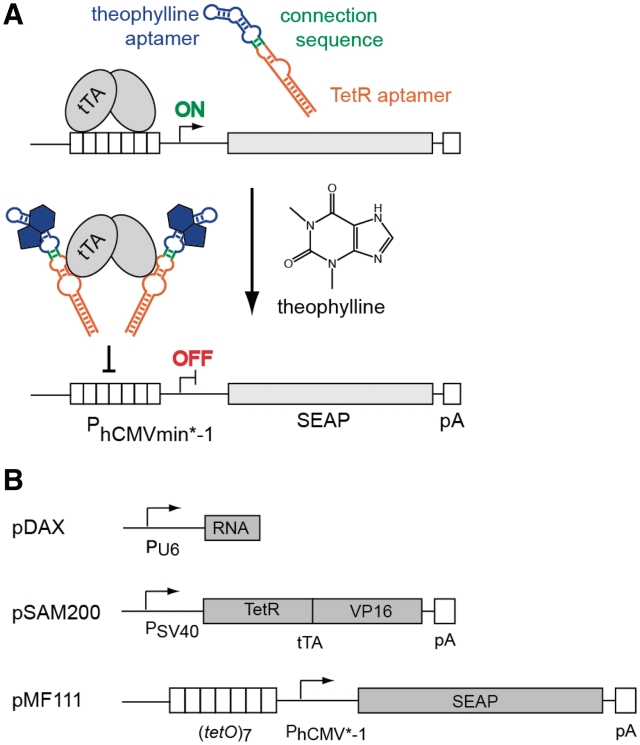
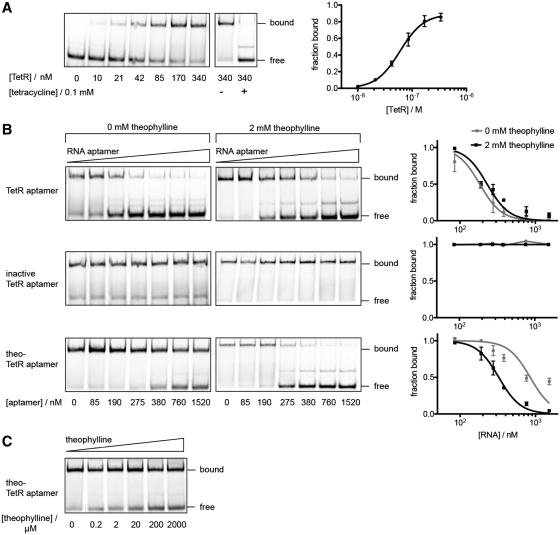
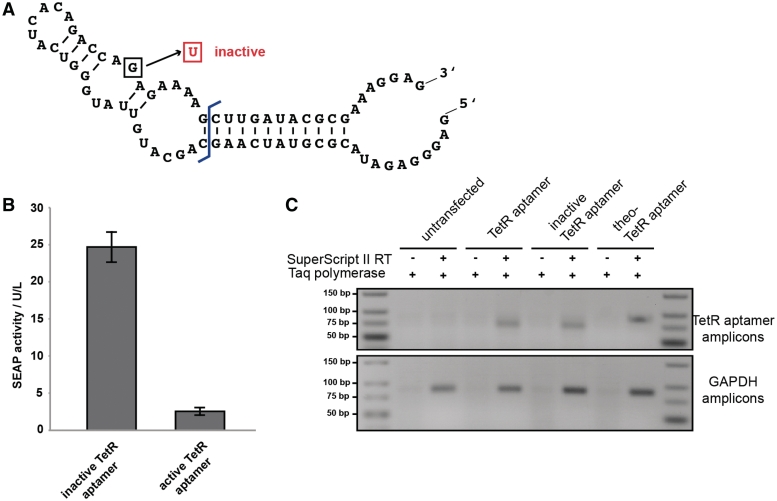
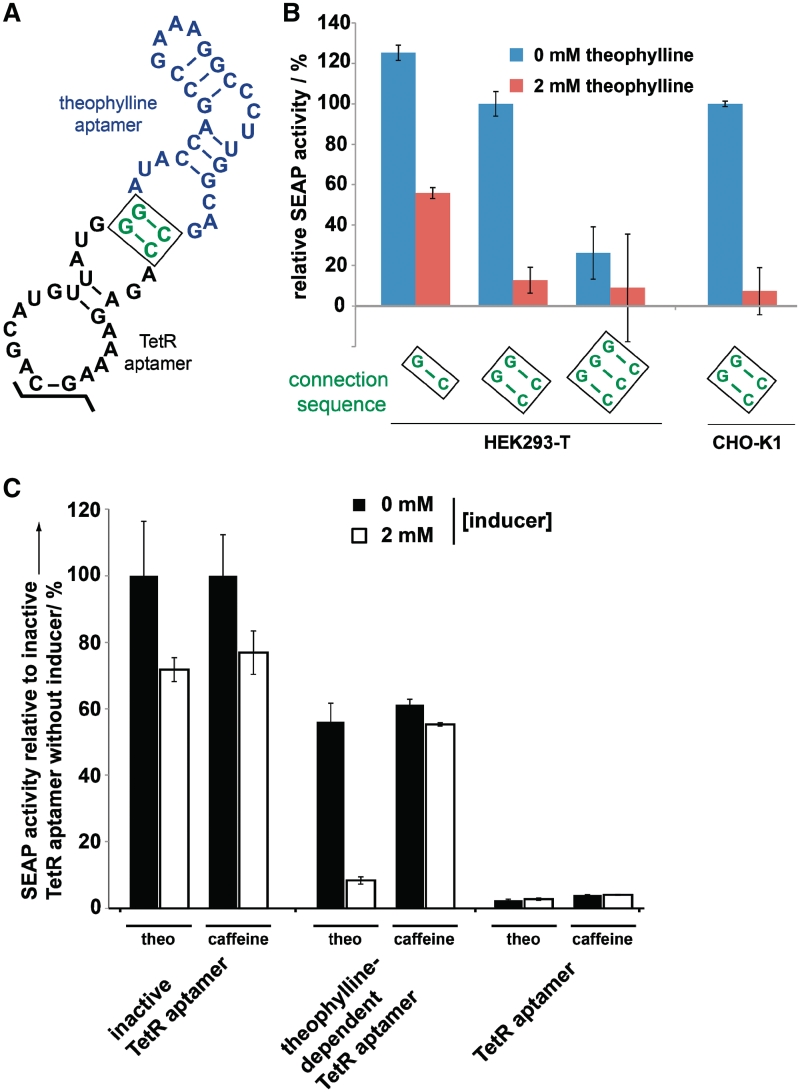
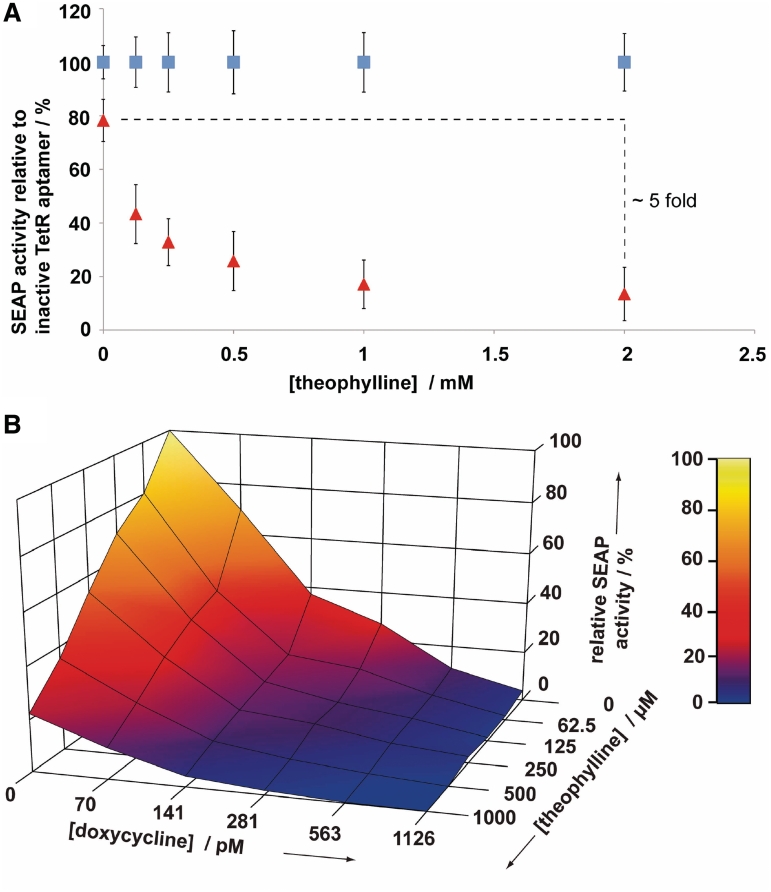
Aptamers binding proteins or small molecules have been shown to be versatile and powerful building blocks for the construction of artificial genetic switches. In this study, we present a novel aptamer-based construct regulating the Tet Off system in a tetracycline-independent manner thus achieving control of transgene expression. For this purpose, a TetR protein-inhibiting aptamer was engineered for use in mammalian cells, enabling the RNA-responsive control of the tetracycline-dependent transactivator (tTA). By rationally attaching the theophylline aptamer as a sensor, the inhibitory TetR aptamer and thus tTA activity became dependent on the ligand of the sensor aptamer. Addition of the small molecule theophylline resulted in enhanced binding to the corresponding protein in vitro and in inhibition of reporter gene expression in mammalian cell lines. By using aptamers as adaptors in order to control protein activity by a predetermined small molecule, we present a simple and straightforward approach for future applications in the field of Chemical Biology. Moreover, aptamer-based control of the widely used Tet system introduces a new layer of regulation thereby facilitating the construction of more complex gene networks.
适体结合蛋白或小分子已被证明是构建人工遗传开关的多功能和强大构建块。在这项研究中,我们提出了一种基于适体的新型构建体,以四环素非依赖性方式调节 Tet Off 系统,从而实现转基因表达的控制。为此,设计了一种用于哺乳动物细胞的 TetR 蛋白抑制适体,从而能够实现 RNA 响应控制四环素依赖性转录激活剂(tTA)。通过合理地连接茶碱适体作为传感器,抑制 TetR 适体的活性和 tTA 活性变得依赖于传感器适体的配体。添加小分子茶碱会导致体外与相应蛋白的结合增强,并抑制哺乳动物细胞系中的报告基因表达。通过将适体用作适配器,通过预定的小分子控制蛋白质活性,我们为化学生物学领域的未来应用提供了一种简单直接的方法。此外,基于适体的对广泛使用的 Tet 系统的控制引入了新的调节层,从而促进了更复杂基因网络的构建。