Department of Biotechnology and Dr. B. C. Guha Centre for Genetic Engineering and Biotechnology, Calcutta University College of Science, 35 Ballygunge Circular Road, Kolkata 700019, India.
J Oncol. 2011;2011:561862. doi: 10.1155/2011/561862. Epub 2011 May 31.
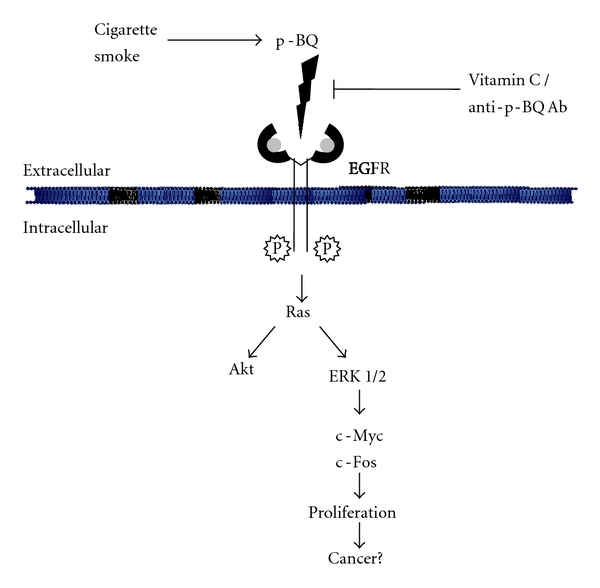
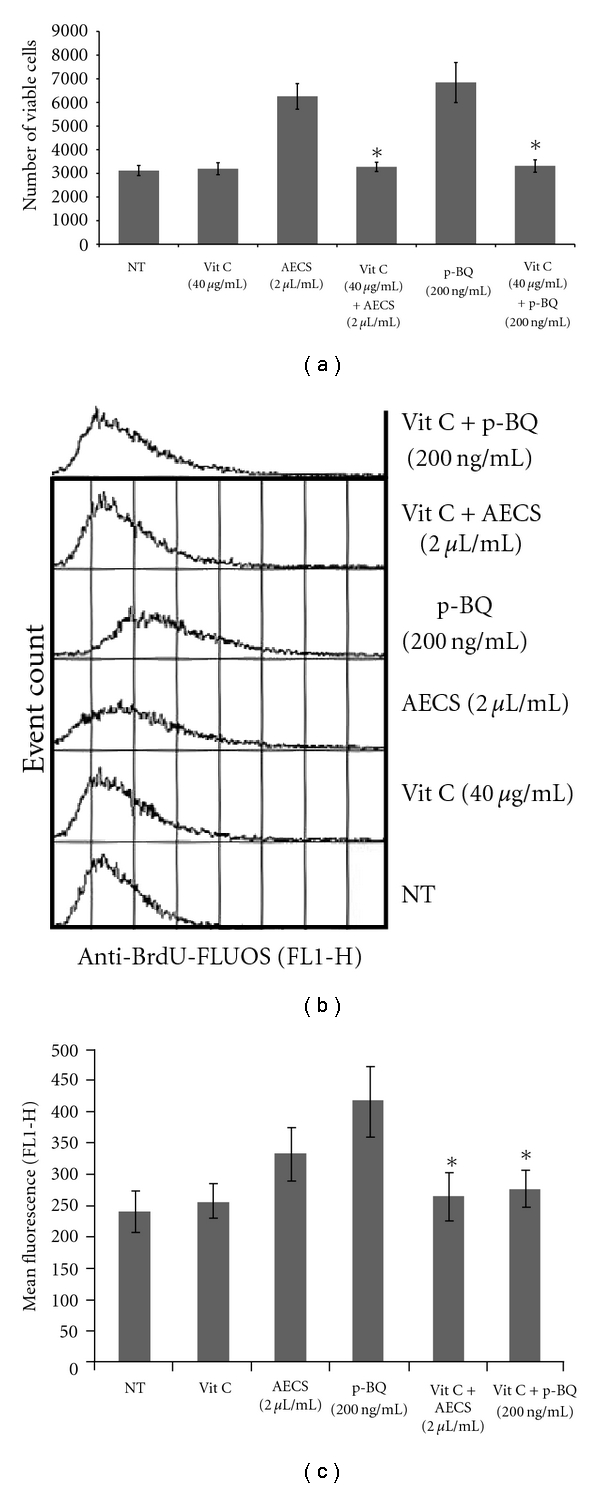
Lung cancer is the leading cause of cancer dearth. Cigarette smoking is the strongest risk factor for developing lung cancer, which is conceivably initiated by proliferation. Here, we show that low concentration of aqueous extract of cigarette smoke (AECS) causes excessive proliferation of human lung epithelial cells (A549) without any apoptotic cell death. The causative factor responsible for AECS-induced proliferation has been identified as p-benzoquinone (p-BQ). Coimmunoprecipitation and immunoblot experiments indicate that p-BQ binds with epidermal growth factor receptor (EGFR). However, in contrast to EGF, it causes aberrant phosphorylation of EGFR that lacks c-Cbl-mediated ubiquitination and degradation resulting in persistent activation of EGFR. This is followed by activation of Hras + Kras and the downstream survival and proliferative signaling molecules Akt and ERK1/2, as well as the nuclear transcription factors c-Myc and c-Fos. Vitamin C and/or antibody to p-BQ prevents AECS/p-BQ-induced proliferation of lung cells apparently by inactivating p-BQ and thereby preventing activation of EGFR and the downstream signaling molecules. The results suggest that vitamin C and/or antibody to p-BQ may provide a novel intervention for preventing initiation of lung cancer in smokers.
肺癌是癌症死亡的主要原因。吸烟是导致肺癌的最强危险因素,肺癌可能是由增殖引起的。在这里,我们表明,低浓度的香烟烟雾水提取物(AECS)会导致人肺上皮细胞(A549)过度增殖,而不会导致任何细胞凋亡。导致 AECS 诱导增殖的原因已被确定为对苯醌(p-BQ)。共免疫沉淀和免疫印迹实验表明,p-BQ 与表皮生长因子受体(EGFR)结合。然而,与 EGF 不同的是,它导致 EGFR 的异常磷酸化,缺乏 c-Cbl 介导的泛素化和降解,导致 EGFR 的持续激活。随后,Hras + Kras 以及下游存活和增殖信号分子 Akt 和 ERK1/2 以及核转录因子 c-Myc 和 c-Fos 被激活。维生素 C 和/或 p-BQ 抗体显然可以通过使 p-BQ 失活来预防 AECS/p-BQ 诱导的肺细胞增殖,从而防止 EGFR 和下游信号分子的激活。结果表明,维生素 C 和/或 p-BQ 抗体可能为预防吸烟者肺癌的发生提供一种新的干预措施。