Department of Cell Physiology and Metabolism, University of Geneva, rue Michel-Servet, 1, CH-1211 Genève, Switzerland.
J Biol Chem. 2011 Sep 16;286(37):32533-41. doi: 10.1074/jbc.M110.216044. Epub 2011 Jul 20.
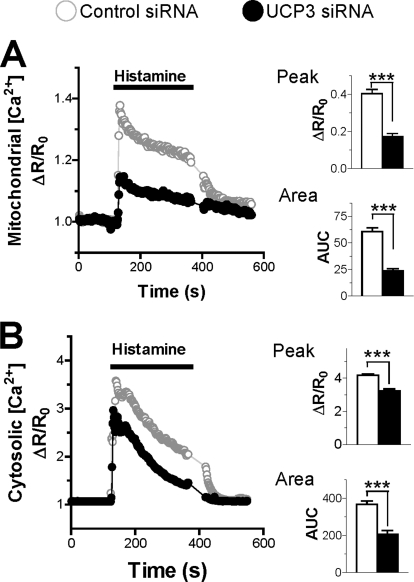
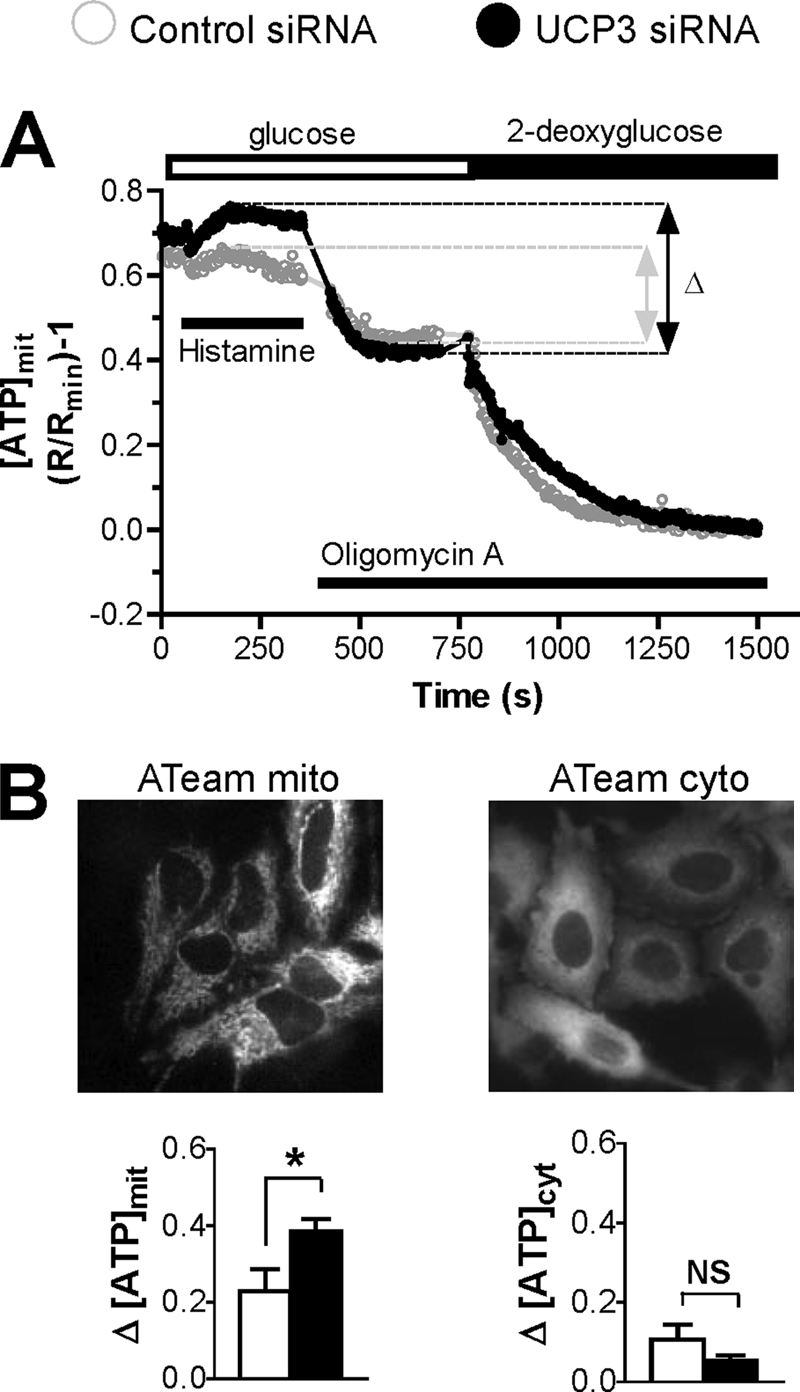
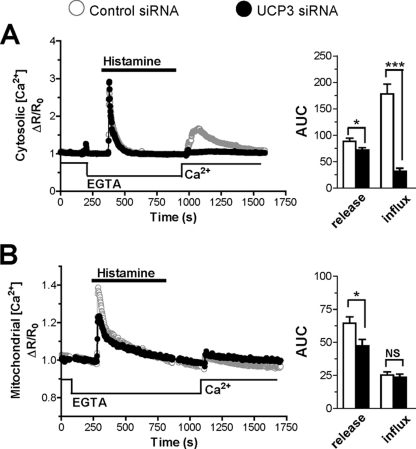
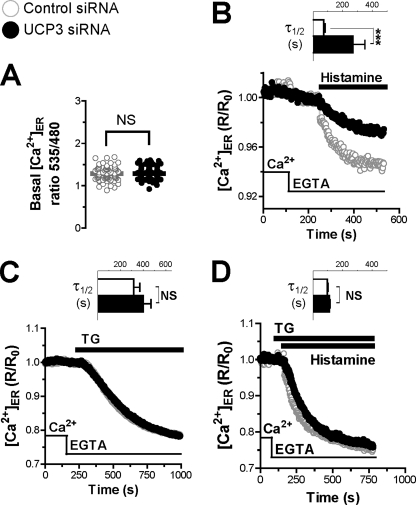
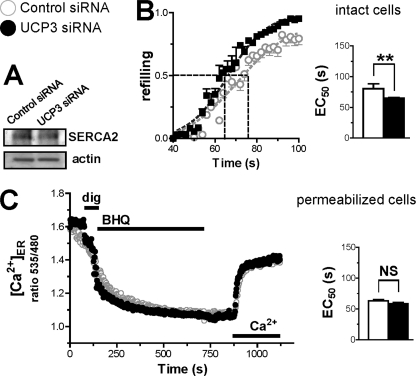
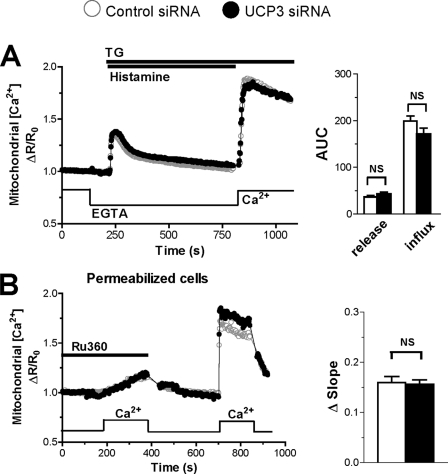
The uncoupling proteins UCP2 and UCP3 have been postulated to catalyze Ca(2+) entry across the inner membrane of mitochondria, but this proposal is disputed, and other, unrelated proteins have since been identified as the mitochondrial Ca(2+) uniporter. To clarify the role of UCPs in mitochondrial Ca(2+) handling, we down-regulated the expression of the only uncoupling protein of HeLa cells, UCP3, and measured Ca(2+) and ATP levels in the cytosol and in organelles with genetically encoded probes. UCP3 silencing did not alter mitochondrial Ca(2+) uptake in permeabilized cells. In intact cells, however, UCP3 depletion increased mitochondrial ATP production and strongly reduced the cytosolic and mitochondrial Ca(2+) elevations evoked by histamine. The reduced Ca(2+) elevations were due to inhibition of store-operated Ca(2+) entry and reduced depletion of endoplasmic reticulum (ER) Ca(2+) stores. UCP3 depletion accelerated the ER Ca(2+) refilling kinetics, indicating that the activity of sarco/endoplasmic reticulum Ca(2+) (SERCA) pumps was increased. Accordingly, SERCA inhibitors reversed the effects of UCP3 depletion on cytosolic, ER, and mitochondrial Ca(2+) responses. Our results indicate that UCP3 is not a mitochondrial Ca(2+) uniporter and that it instead negatively modulates the activity of SERCA by limiting mitochondrial ATP production. The effects of UCP3 on mitochondrial Ca(2+) thus reflect metabolic alterations that impact on cellular Ca(2+) homeostasis. The sensitivity of SERCA to mitochondrial ATP production suggests that mitochondria control the local ATP availability at ER Ca(2+) uptake and release sites.
解偶联蛋白 UCP2 和 UCP3 被推测为催化 Ca(2+)穿过线粒体内膜的进入,但这一假说存在争议,此后其他不相关的蛋白已被鉴定为线粒体 Ca(2+)单向转运体。为了澄清 UCPs 在线粒体 Ca(2+)处理中的作用,我们下调了 HeLa 细胞中唯一的解偶联蛋白 UCP3 的表达,并使用遗传编码探针测量了细胞质和细胞器中的 Ca(2+)和 ATP 水平。UCP3 沉默并没有改变通透细胞中线粒体 Ca(2+)的摄取。然而,在完整的细胞中,UCP3 的耗竭增加了线粒体 ATP 的产生,并强烈降低了组胺引起的细胞质和线粒体 Ca(2+)的升高。Ca(2+)的降低是由于抑制了储存操作的 Ca(2+)进入和内质网(ER)Ca(2+)储存的减少。UCP3 耗竭加速了 ER Ca(2+)再填充动力学,表明肌浆/内质网 Ca(2+)(SERCA)泵的活性增加。因此,SERCA 抑制剂逆转了 UCP3 耗竭对细胞质、ER 和线粒体 Ca(2+)反应的影响。我们的结果表明,UCP3 不是线粒体 Ca(2+)单向转运体,而是通过限制线粒体 ATP 的产生来负调节 SERCA 的活性。因此,UCP3 对线粒体 Ca(2+)的影响反映了代谢改变,影响细胞 Ca(2+)稳态。SERCA 对线粒体 ATP 产生的敏感性表明,线粒体控制 ER Ca(2+)摄取和释放位点的局部 ATP 可用性。