Department of Orthopaedics and Rheumatology, University Hospital Marburg, Baldingerstrasse, 35033 Marburg, Germany.
BMC Musculoskelet Disord. 2011 Jul 21;12:168. doi: 10.1186/1471-2474-12-168.
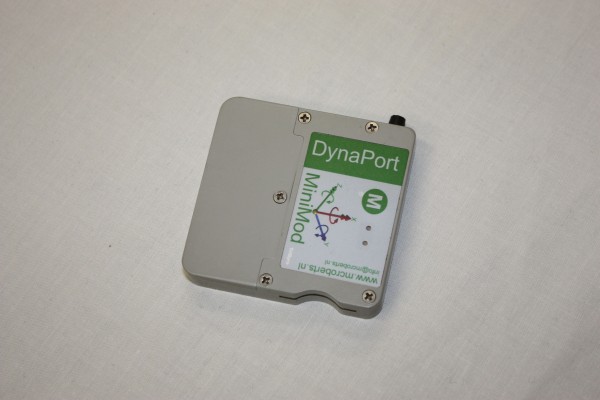
Assessment of shoulder mobility is essential for clinical follow-up of shoulder treatment. Only a few high sophisticated instruments for objective measurements of shoulder mobility are available. The interobserver dependency of conventional goniometer measurements is high. In the 1990s an isokinetic measuring system of BIODEX Inc. was introduced, which is a very complex but valid instrument. Since 2008 a new user-friendly system called DynaPort MiniMod TriGyro ShoulderTest-System (DP) is available. Aim of this study is the validation of this measuring instrument using the BIODEX-System.
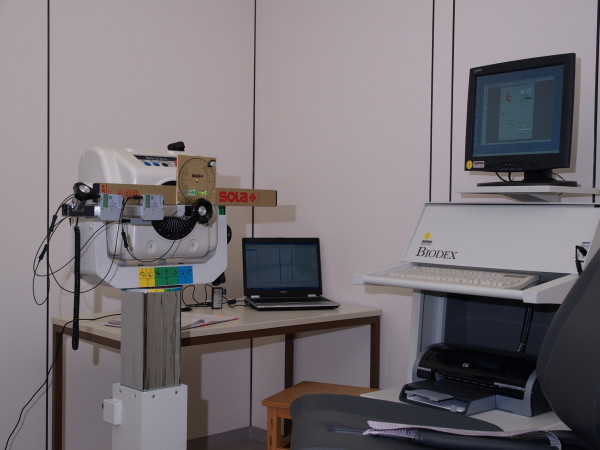
The BIODEX is a computerized robotic dynamometer used for isokinetic testing and training of athletes. Because of its size the system needs to be installed in a separated room. The DP is a small, light-weighted three-dimensional gyroscope that is fixed on the distal upper patient arm, recording abduction, flexion and rotation. For direct comparison we fixed the DP on the lever arm of the BIODEX. The accuracy of measurement was determined at different positions, angles and distances from the centre of rotation (COR) as well as different velocities in a radius between 0° - 180° in steps of 20°. All measurements were repeated 10 times. As satisfactory accuracy a difference between both systems below 5° was defined. The statistical analysis was performed with a linear regression model.
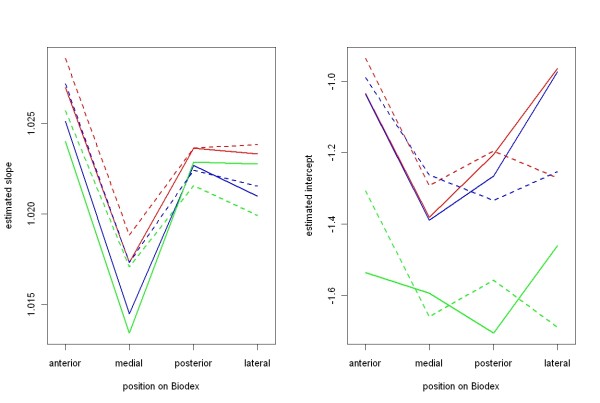
The evaluation shows very high accuracy of measurements. The maximum average deviation is below 2.1°. For a small range of motion the DP is slightly underestimating comparing the BIODEX, whereas for higher angles increasing positive differences are observed. The distance to the COR as well as the position of the DP on the lever arm have no significant influence. Concerning different motion speeds significant but not relevant influence is detected. Unfortunately device related effects are observed, leading to differences between repeated measurements with any two different devices up to 8° at maximal range of motion (180°).
In summary the results shows high correlation and good reproducibility of measurements. All deviations are inside the tolerance interval of 5°, if one device is used. An unlikely systematic device effect is detected. These laboratory trials are promising for the validation of this system in humans. The challenge for both systems will be the changing of the COR in the shoulder joint at elevations higher than 90°.
评估肩部活动度对于肩部治疗的临床随访至关重要。只有少数几种用于客观测量肩部活动度的高精密度仪器。传统量角器测量的观察者间依赖性较高。20 世纪 90 年代,BIODEX Inc. 推出了一种等速测量系统,这是一种非常复杂但有效的仪器。自 2008 年以来,一种新的用户友好型系统,即 DynaPort MiniMod TriGyro 肩部测试系统(DP)已经面世。本研究的目的是使用 BIODEX 系统验证该测量仪器。
BIODEX 是一种用于运动员等速测试和训练的计算机化机器人测力计。由于其体积较大,该系统需要安装在单独的房间内。DP 是一种小型、轻便的三维陀螺仪,固定在患者手臂的远端,记录外展、屈曲和旋转。为了直接比较,我们将 DP 固定在 BIODEX 的杠杆臂上。在从旋转中心(COR)不同位置、角度和距离以及半径为 0°-180°之间不同速度的情况下,测量了不同位置、角度和距离的测量精度,每步 20°。所有测量均重复 10 次。如果两种系统之间的差异小于 5°,则认为测量精度令人满意。统计分析采用线性回归模型进行。
评估结果显示,测量精度非常高。最大平均偏差低于 2.1°。在小运动范围中,DP 与 BIODEX 相比略低估,而在更高角度下,观察到正差异增加。COR 的距离以及 DP 在杠杆臂上的位置没有显著影响。对于不同的运动速度,观察到显著但不相关的影响。遗憾的是,设备相关的影响会导致任何两个不同设备之间的重复测量结果存在差异,最大运动范围(180°)时可达 8°。
总之,结果显示测量具有高度相关性和良好的可重复性。如果使用一个设备,所有偏差都在 5°的容差范围内。检测到一种不太可能的系统偏差。这些实验室试验为该系统在人体中的验证提供了希望。两个系统的挑战将是在肩部关节的抬高角度超过 90°时改变 COR。