Institute of Medical Microbiology and Hygiene, University of Lübeck, Lübeck, Germany.
PLoS Pathog. 2011 Jul;7(7):e1002108. doi: 10.1371/journal.ppat.1002108. Epub 2011 Jul 14.
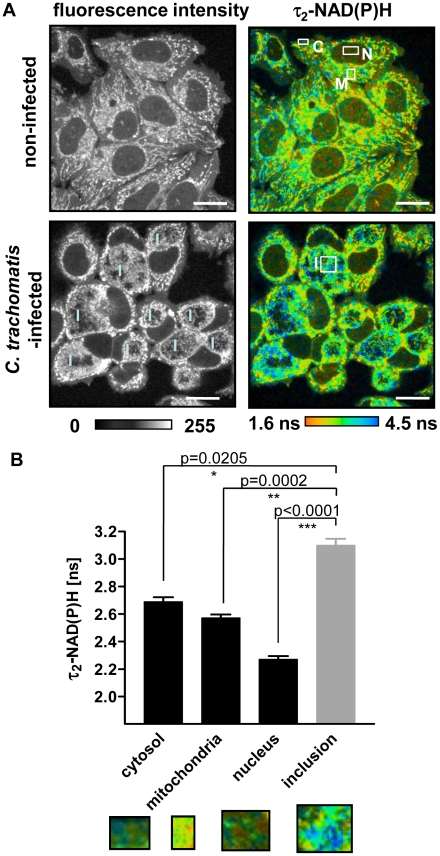
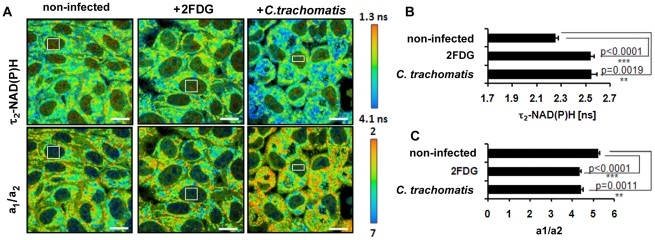
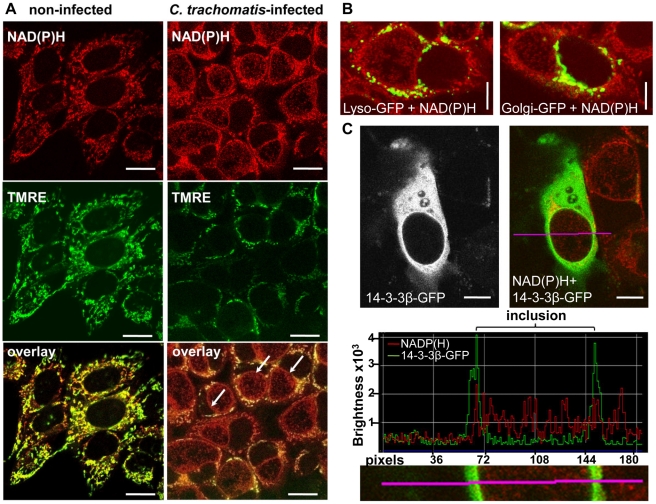
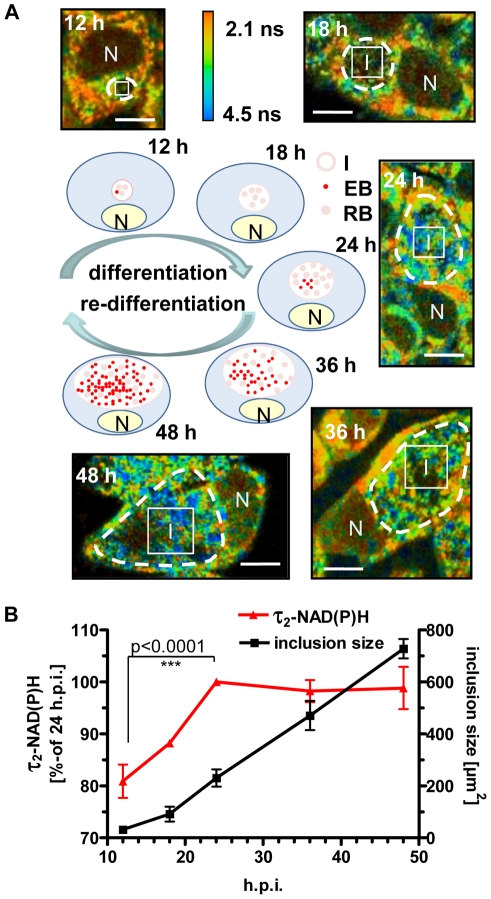
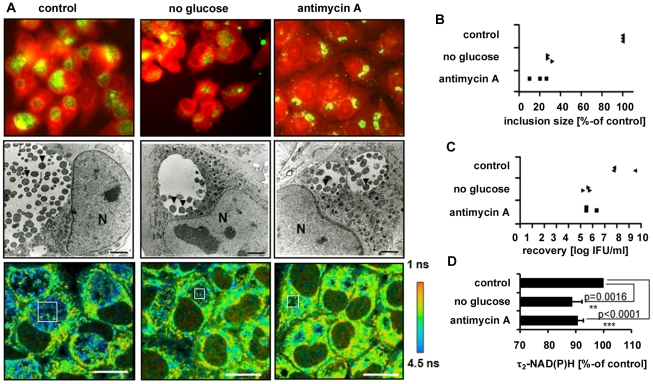
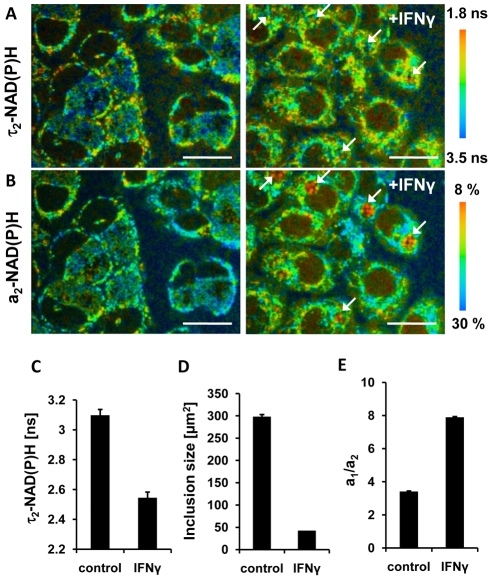
Chlamydia trachomatis is an obligate intracellular bacterium that alternates between two metabolically different developmental forms. We performed fluorescence lifetime imaging (FLIM) of the metabolic coenzymes, reduced nicotinamide adenine dinucleotides [NAD(P)H], by two-photon microscopy for separate analysis of host and pathogen metabolism during intracellular chlamydial infections. NAD(P)H autofluorescence was detected inside the chlamydial inclusion and showed enhanced signal intensity on the inclusion membrane as demonstrated by the co-localization with the 14-3-3β host cell protein. An increase of the fluorescence lifetime of protein-bound NAD(P)H [τ₂-NAD(P)H] inside the chlamydial inclusion strongly correlated with enhanced metabolic activity of chlamydial reticulate bodies during the mid-phase of infection. Inhibition of host cell metabolism that resulted in aberrant intracellular chlamydial inclusion morphology completely abrogated the τ₂-NAD(P)H increase inside the chlamydial inclusion. τ₂-NAD(P)H also decreased inside chlamydial inclusions when the cells were treated with IFNγ reflecting the reduced metabolism of persistent chlamydiae. Furthermore, a significant increase in τ₂-NAD(P)H and a decrease in the relative amount of free NAD(P)H inside the host cell nucleus indicated cellular starvation during intracellular chlamydial infection. Using FLIM analysis by two-photon microscopy we could visualize for the first time metabolic pathogen-host interactions during intracellular Chlamydia trachomatis infections with high spatial and temporal resolution in living cells. Our findings suggest that intracellular chlamydial metabolism is directly linked to cellular NAD(P)H signaling pathways that are involved in host cell survival and longevity.
沙眼衣原体是一种专性细胞内细菌,在两种代谢方式不同的发育形式之间交替。我们通过双光子显微镜对代谢辅酶还原型烟酰胺腺嘌呤二核苷酸(NAD(P)H)进行荧光寿命成像(FLIM),以分别分析细胞内沙眼衣原体感染期间宿主和病原体的代谢。NAD(P)H 自发荧光在衣原体包涵体内被检测到,并通过与宿主细胞蛋白 14-3-3β的共定位显示出包涵体膜上的信号强度增强。包涵体内蛋白结合的 NAD(P)H [τ₂-NAD(P)H]荧光寿命的增加与感染中期衣原体网状体代谢活性的增强强烈相关。宿主细胞代谢的抑制导致异常的细胞内衣原体包涵体形态,完全消除了包涵体内 τ₂-NAD(P)H 的增加。当用 IFNγ 处理细胞时,τ₂-NAD(P)H 也会在衣原体包涵体内减少,这反映了持续衣原体的代谢减少。此外,τ₂-NAD(P)H 在宿主细胞核内的增加和游离 NAD(P)H 的相对含量减少表明细胞在细胞内沙眼衣原体感染期间处于饥饿状态。通过双光子显微镜的 FLIM 分析,我们首次在活细胞中以高时空分辨率可视化了细胞内沙眼衣原体感染期间的代谢病原体-宿主相互作用。我们的研究结果表明,细胞内沙眼衣原体的代谢与涉及宿主细胞存活和寿命的细胞内 NAD(P)H 信号通路直接相关。