Laboratory of Bioinorganic Chemistry, Department of Chemistry, University of Florence Florence, Italy.
Front Pharmacol. 2011 Jul 5;2:34. doi: 10.3389/fphar.2011.00034. eCollection 2011.
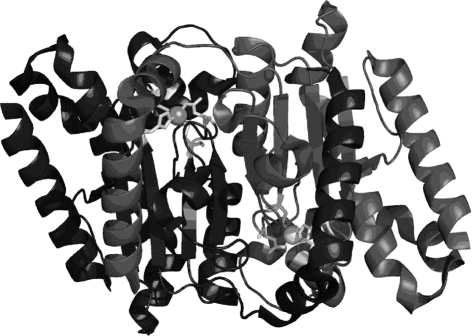
Carbonic anhydrases (CAs, EC 4.2.1.1) are metalloenzymes which catalyze the hydration of carbon dioxide to bicarbonate and protons. Many pathogenic bacteria encode such enzymes belonging to the α-, β-, and/or γ-CA families. In the last decade, the α-CAs from Neisseria spp. and Helicobacter pylori as well as the β-class enzymes from Escherichia coli, H. pylori,Mycobacterium tuberculosis, Brucella spp., Streptococcus pneumoniae, Salmonella enterica, and Haemophilus influenzae have been cloned and characterized in detail. For some of these enzymes the X-ray crystal structures were determined, and in vitro and in vivo inhibition studies with various classes of inhibitors, such as anions, sulfonamides and sulfamates reported. Although efficient inhibitors have been reported for many such enzymes, only for Neisseria spp., H. pylori, B. suis, and S. pneumoniae enzymes it has been possible to evidence inhibition of bacterial growth in vivo. Thus, bacterial CAs represent promising targets for obtaining antibacterials devoid of the resistance problems of the clinically used such agents but further studies are needed to validate these and other less investigated enzymes as novel drug targets.
碳酸酐酶(CA,EC 4.2.1.1)是一类金属酶,可催化二氧化碳水合生成碳酸氢根和质子。许多致病菌编码属于α、β和/或γ-CA 家族的此类酶。在过去十年中,来自淋病奈瑟氏球菌和幽门螺杆菌的α-CA 以及来自大肠杆菌、幽门螺杆菌、结核分枝杆菌、布鲁氏菌属、肺炎链球菌、沙门氏菌 enterica 和流感嗜血杆菌的β 类酶已被详细克隆和表征。其中一些酶的 X 射线晶体结构已被确定,并且已经报道了各种抑制剂(如阴离子、磺胺类和磺胺酸盐)的体外和体内抑制研究。尽管已经报道了许多此类酶的有效抑制剂,但只有淋病奈瑟氏球菌、幽门螺杆菌、猪霍乱沙门氏菌和肺炎链球菌的酶才能在体内证明抑制细菌生长。因此,细菌 CA 是获得无临床使用此类药物耐药问题的抗菌药物的有希望的靶标,但需要进一步研究来验证这些和其他研究较少的酶作为新的药物靶标。