Department of Health Policy and Management, Gillings School of Global Public Health, University of North Carolina at Chapel Hill, North Carolina, USA.
Implement Sci. 2011 Jul 22;6:78. doi: 10.1186/1748-5908-6-78.
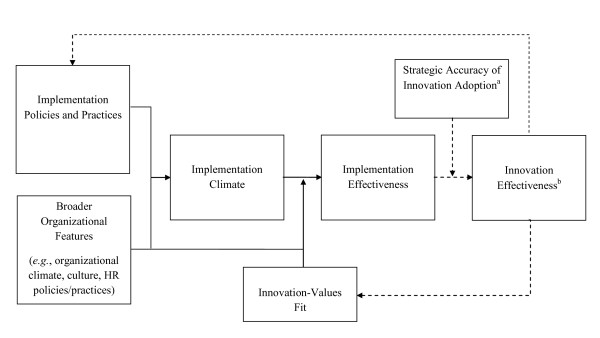
Climate has a long history in organizational studies, but few theoretical models integrate the complex effects of climate during innovation implementation. In 1996, a theoretical model was proposed that organizations could develop a positive climate for implementation by making use of various policies and practices that promote organizational members' means, motives, and opportunities for innovation use. The model proposes that implementation climate--or the extent to which organizational members perceive that innovation use is expected, supported, and rewarded--is positively associated with implementation effectiveness. The implementation climate construct holds significant promise for advancing scientific knowledge about the organizational determinants of innovation implementation. However, the construct has not received sufficient scholarly attention, despite numerous citations in the scientific literature. In this article, we clarify the meaning of implementation climate, discuss several measurement issues, and propose guidelines for empirical study.
Implementation climate differs from constructs such as organizational climate, culture, or context in two important respects: first, it has a strategic focus (implementation), and second, it is innovation-specific. Measuring implementation climate is challenging because the construct operates at the organizational level, but requires the collection of multi-dimensional perceptual data from many expected innovation users within an organization. In order to avoid problems with construct validity, assessments of within-group agreement of implementation climate measures must be carefully considered. Implementation climate implies a high degree of within-group agreement in climate perceptions. However, researchers might find it useful to distinguish implementation climate level (the average of implementation climate perceptions) from implementation climate strength (the variability of implementation climate perceptions). It is important to recognize that the implementation climate construct applies most readily to innovations that require collective, coordinated behavior change by many organizational members both for successful implementation and for realization of anticipated benefits. For innovations that do not possess these attributes, individual-level theories of behavior change could be more useful in explaining implementation effectiveness.
This construct has considerable value in implementation science, however, further debate and development is necessary to refine and distinguish the construct for empirical use.
气候在组织研究中有着悠久的历史,但很少有理论模型能整合创新实施过程中气候的复杂影响。1996 年,提出了一个理论模型,即组织可以通过利用各种促进组织成员创新使用的手段、动机和机会的政策和实践,为实施创造积极的氛围。该模型提出,实施氛围——即组织成员感知到创新使用是被期望、支持和奖励的程度——与实施效果呈正相关。实施氛围这一概念为推进关于创新实施的组织决定因素的科学知识具有重要意义。然而,尽管在科学文献中被多次引用,该概念并未得到足够的学术关注。在本文中,我们澄清了实施氛围的含义,讨论了几个测量问题,并提出了实证研究的指导方针。
实施氛围在两个重要方面不同于组织氛围、文化或背景等概念:首先,它具有战略重点(实施),其次,它是特定于创新的。衡量实施氛围具有挑战性,因为该概念在组织层面运作,但需要从组织内的许多预期创新使用者那里收集多维感知数据。为了避免构念有效性的问题,必须仔细考虑实施氛围措施的组内一致性评估。实施氛围意味着在气候感知方面具有高度的组内一致性。然而,研究人员可能会发现区分实施氛围水平(实施氛围感知的平均值)和实施氛围强度(实施氛围感知的可变性)是有用的。重要的是要认识到,实施氛围概念最适用于需要许多组织成员集体、协调行为改变的创新,以便成功实施并实现预期的效益。对于不具备这些属性的创新,个体层面的行为改变理论可能更有助于解释实施效果。
该概念在实施科学中具有很大的价值,然而,为了进一步完善和区分该概念以进行实证使用,还需要进行进一步的辩论和发展。