Department of Medicine, Division of Diabetes, Metabolism, and Endocrinology, Showa University School of Medicine, 1-5-8 Hatanodai, Shinagawa-ku, Tokyo 142-8666, Japan.
Diabetologia. 2011 Oct;54(10):2649-59. doi: 10.1007/s00125-011-2241-2. Epub 2011 Jul 24.
AIMS/HYPOTHESIS: Several lines of evidence suggest that incretin-based therapies suppress the development of cardiovascular disease in type 2 diabetes. We investigated the possibility that glucagon-like peptide-1 (GLP-1) and glucose-dependent insulinotropic polypeptide (GIP) can prevent the development of atherosclerosis in Apoe (-/-) mice.
Apoe (-/-) mice (17 weeks old) were administered GLP-1(7-36)amide, GLP-1(9-36)amide, GIP(1-42) or GIP(3-42) for 4 weeks. Aortic atherosclerosis, oxidised LDL-induced foam cell formation and related gene expression in exudate peritoneal macrophages were determined.
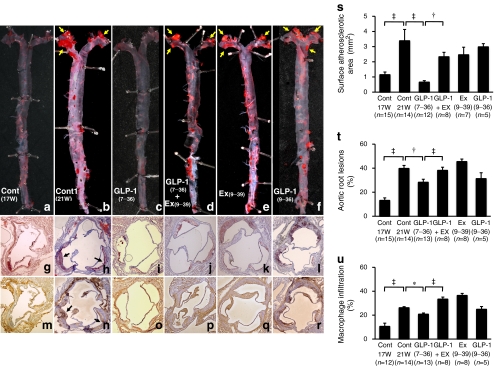
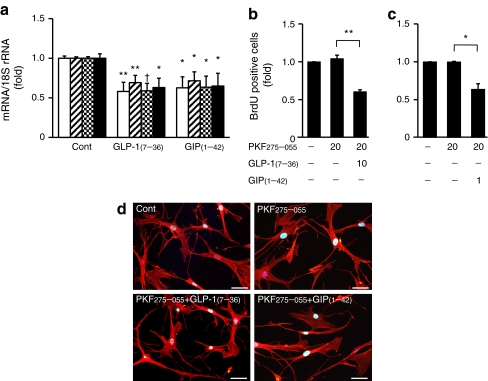
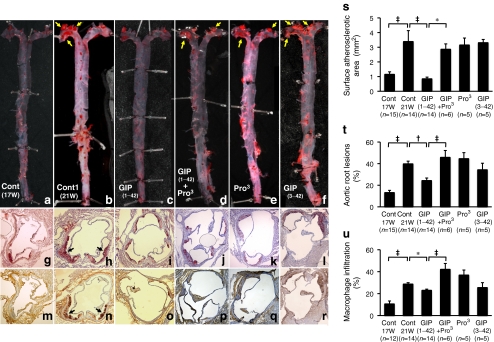
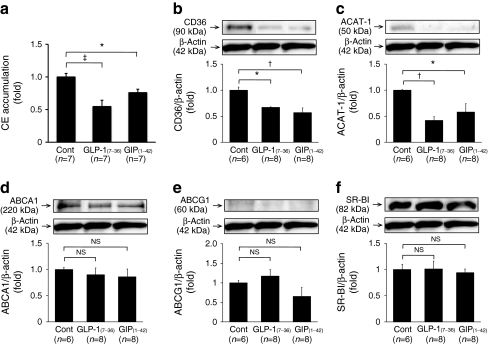
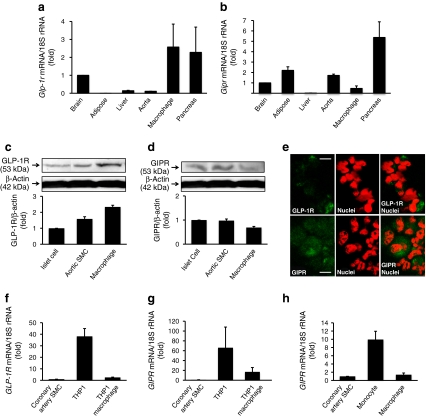
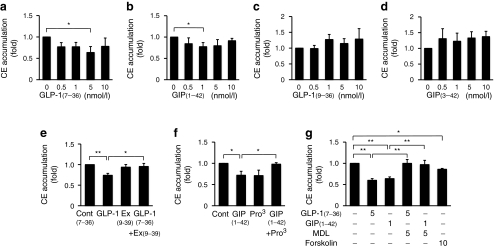
Administration of GLP-1(7-36)amide or GIP(1-42) significantly suppressed atherosclerotic lesions and macrophage infiltration in the aortic wall, compared with vehicle controls. These effects were cancelled by co-infusion with specific antagonists for GLP-1 and GIP receptors, namely exendin(9-39) or Pro(3)(GIP). The anti-atherosclerotic effects of GLP-1(7-36)amide and GIP(1-42) were associated with significant decreases in foam cell formation and downregulation of CD36 and acyl-coenzyme A:cholesterol acyltransferase-1 (ACAT-1) in macrophages. GLP-1 and GIP receptors were both detected in Apoe (-/-) mouse macrophages. Ex vivo incubation of macrophages with GLP-1(7-36)amide or GIP(1-42) for 48 h significantly suppressed foam cell formation. This effect was wholly abolished in macrophages pretreated with exendin(9-39) or (Pro(3))GIP, or with an adenylate cyclase inhibitor, MDL12,330A, and was mimicked by incubation with an adenylate cyclase activator, forskolin. The inactive forms, GLP-1(9-36)amide and GIP(3-42), had no effects on atherosclerosis and macrophage foam cell formation.
CONCLUSIONS/INTERPRETATION: Our study is the first to demonstrate that active forms of GLP-1 and GIP exert anti-atherogenic effects by suppressing macrophage foam cell formation via their own receptors, followed by cAMP activation. Molecular mechanisms underlying these effects are associated with the downregulation of CD36 and ACAT-1 by incretins.
目的/假设:有几条证据表明基于肠促胰岛素的治疗可以抑制 2 型糖尿病患者的心血管疾病的发展。我们研究了胰高血糖素样肽-1(GLP-1)和葡萄糖依赖性胰岛素释放肽(GIP)是否可以预防载脂蛋白 E 基因敲除(Apoe(-/-))小鼠的动脉粥样硬化的发展。
17 周龄的 Apoe(-/-)小鼠给予 GLP-1(7-36)酰胺、GLP-1(9-36)酰胺、GIP(1-42)或 GIP(3-42)4 周。测定主动脉粥样硬化、氧化型 LDL 诱导的泡沫细胞形成和渗出性腹膜巨噬细胞中的相关基因表达。
与载体对照组相比,GLP-1(7-36)酰胺或 GIP(1-42)的给药显著抑制了主动脉壁中的动脉粥样硬化病变和巨噬细胞浸润。这些作用被 GLP-1 和 GIP 受体的特异性拮抗剂,即 exendin(9-39)或 Pro(3)(GIP)共同输注所抵消。GLP-1(7-36)酰胺和 GIP(1-42)的抗动脉粥样硬化作用与泡沫细胞形成的显著减少以及巨噬细胞中 CD36 和酰基辅酶 A:胆固醇酰基转移酶-1(ACAT-1)的下调有关。GLP-1 和 GIP 受体均在 Apoe(-/-)小鼠巨噬细胞中被检测到。用 GLP-1(7-36)酰胺或 GIP(1-42)孵育 48 小时可显著抑制巨噬细胞的泡沫细胞形成。在预先用 exendin(9-39)或(Pro(3))GIP 预处理的巨噬细胞中,或在用腺苷酸环化酶抑制剂 MDL12,330A 预处理的巨噬细胞中,该作用完全被阻断,而用腺苷酸环化酶激活剂 forskolin 孵育则可模拟该作用。无活性形式 GLP-1(9-36)酰胺和 GIP(3-42)对动脉粥样硬化和巨噬细胞泡沫细胞形成没有影响。
结论/解释:我们的研究首次证明,活性形式的 GLP-1 和 GIP 通过其自身受体抑制巨噬细胞泡沫细胞形成来发挥抗动脉粥样硬化作用,随后通过 cAMP 激活。这些作用的分子机制与肠促胰岛素下调 CD36 和 ACAT-1 有关。