Université de Strasbourg, IPHC, Strasbourg, France.
PLoS One. 2011;6(7):e22352. doi: 10.1371/journal.pone.0022352. Epub 2011 Jul 18.
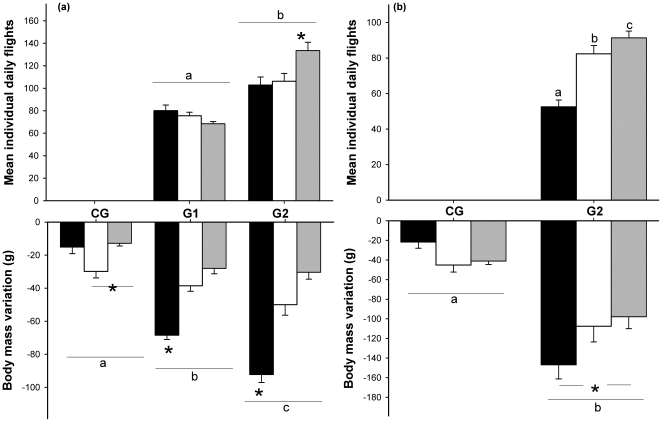
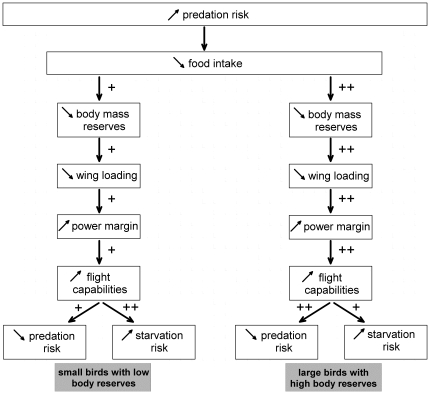
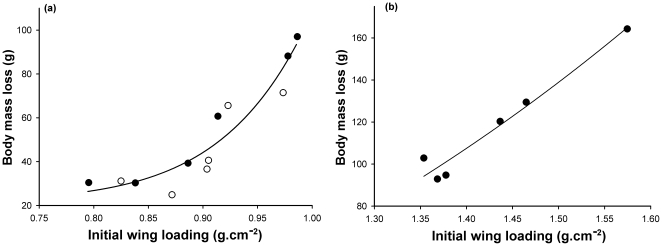
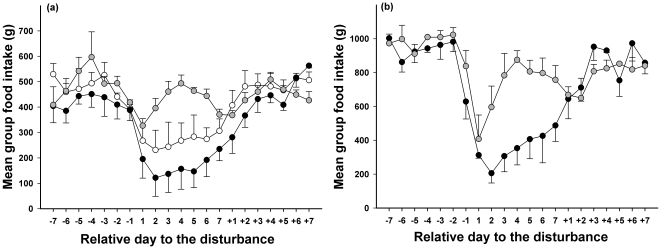
The theory of trade-off between starvation and predation risks predicts a decrease in body mass in order to improve flight performance when facing high predation risk. To date, this trade-off has mainly been validated in passerines, birds that store limited body reserves for short-term use. In the largest avian species in which the trade-off has been investigated (the mallard, Anas platyrhynchos), the slope of the relationship between mass and flight performance was steeper in proportion to lean body mass than in passerines. In order to verify whether the same case can be applied to other birds with large body reserves, we analyzed the response to this trade-off in two other duck species, the common teal (Anas crecca) and the tufted duck (Aythya fuligula). Predation risk was simulated by disturbing birds. Ducks within disturbed groups were compared to non-disturbed control birds. In disturbed groups, both species showed a much greater decrease in food intake and body mass during the period of simulated high risk than those observed in the control group. This loss of body mass allows reaching a more favourable wing loading and increases power for flight, hence enhancing flight performances and reducing predation risk. Moreover, body mass loss and power margin gain in both species were higher than in passerines, as observed in mallards. Our results suggest that the starvation-predation risk trade-off is one of the major life history traits underlying body mass adjustments, and these findings can be generalized to all birds facing predation. Additionally, the response magnitude seems to be influenced by the strategy of body reserve management.
权衡饥饿和被捕食风险的理论预测,当面临高捕食风险时,动物会降低体重以提高飞行性能。迄今为止,这种权衡主要在雀形目鸟类中得到验证,这些鸟类会储存有限的身体储备以供短期使用。在已研究过这种权衡关系的最大的鸟类物种(绿头鸭,Anas platyrhynchos)中,体重与飞行性能之间的关系斜率相对于瘦体重而言,比雀形目鸟类更为陡峭。为了验证这种情况是否也适用于具有较大身体储备的其他鸟类,我们分析了另外两种鸭科鸟类(绿头鸭,Anas crecca 和斑嘴鸭,Aythya fuligula)对这种权衡关系的反应。通过干扰鸟类来模拟捕食风险。与未受干扰的对照组鸟类相比,受干扰组中的鸟类在模拟高风险期间的食物摄入量和体重下降幅度更大。这种体重减轻使鸟类能够达到更有利的翼载和增加飞行动力,从而提高飞行性能并降低捕食风险。此外,与观察到的对照组相比,两种物种在受干扰组中体重减轻和动力储备增加的幅度都高于雀形目鸟类,这与绿头鸭的情况一致。我们的研究结果表明,饥饿-捕食风险权衡是导致体重调整的主要生活史特征之一,这些发现可以推广到所有面临捕食风险的鸟类。此外,响应幅度似乎受到身体储备管理策略的影响。