Suppr超能文献

蚯蚓利用气味线索在土壤中寻找并取食微生物。

Earthworms use odor cues to locate and feed on microorganisms in soil.

机构信息

Functional and Evolutionary Entomology, Gembloux Agro-Bio Tech, University of Liege, Gembloux, Belgium.

出版信息

PLoS One. 2011;6(7):e21927. doi: 10.1371/journal.pone.0021927. Epub 2011 Jul 20.

Abstract

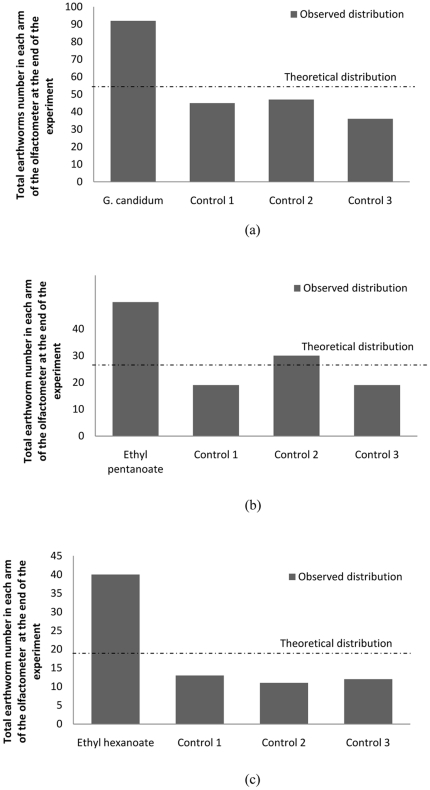
Earthworms are key components of temperate soil ecosystems but key aspects of their ecology remain unexamined. Here we elucidate the role of olfactory cues in earthworm attraction to food sources and document specific chemical cues that attract Eisenia fetida to the soil fungi Geotrichum candidum. Fungi and other microorganisms are major sources of volatile emissions in soil ecosystems as well as primary food sources for earthworms, suggesting the likelihood that earthworms might profitably use olfactory cues to guide foraging behavior. Moreover, previous studies have documented earthworm movement toward microbial food sources. But, the specific olfactory cues responsible for earthworm attraction have not previously been identified. Using olfactometer assays combined with chemical analyses (GC-MS), we documented the attraction of E. fetida individuals to filtrate derived from G. candidum colonies and to two individual compounds tested in isolation: ethyl pentanoate and ethyl hexanoate. Attraction at a distance was observed when barriers prevented the worms from reaching the target stimuli, confirming the role of volatile cues. These findings enhance our understanding of the mechanisms underlying key trophic interactions in soil ecosystems and have potential implications for the extraction and collection of earthworms in vermiculture and other applied activities.

摘要

蚯蚓是温带土壤生态系统的关键组成部分,但它们的生态学的关键方面仍未被研究。在这里,我们阐明了嗅觉线索在蚯蚓对食物源的吸引力中的作用,并记录了特定的化学线索,这些线索吸引赤子爱胜蚓(Eisenia fetida)到土壤真菌地霉(Geotrichum candidum)。真菌和其他微生物是土壤生态系统中挥发性排放的主要来源,也是蚯蚓的主要食物来源,这表明蚯蚓可能会利用嗅觉线索来指导觅食行为。此外,先前的研究已经记录了蚯蚓向微生物食物源的运动。但是,负责蚯蚓吸引力的特定嗅觉线索以前尚未确定。我们使用嗅觉计测定与化学分析(GC-MS)相结合,记录了赤子爱胜蚓个体对来自地霉菌落的滤液和两种单独测试的化合物的吸引力:戊酸乙酯和己酸乙酯。当障碍物阻止蚯蚓到达目标刺激物时,在远处观察到了吸引力,这证实了挥发性线索的作用。这些发现增进了我们对土壤生态系统中关键营养相互作用的机制的理解,并且对于在蚯蚓养殖和其他应用活动中提取和收集蚯蚓具有潜在的意义。
https://cdn.ncbi.nlm.nih.gov/pmc/blobs/3727/3140477/5dd231735a0b/pone.0021927.g001.jpg

相似文献

1
Earthworms use odor cues to locate and feed on microorganisms in soil.
PLoS One. 2011;6(7):e21927. doi: 10.1371/journal.pone.0021927. Epub 2011 Jul 20.
2
avoids ethyl pentanoate and ethyl hexanoate, two compounds produced by the soil fungus .
PeerJ. 2021 Sep 8;9:e12148. doi: 10.7717/peerj.12148. eCollection 2021.
3
Self-assemblage and quorum in the earthworm Eisenia fetida (Oligochaete, Lumbricidae).
PLoS One. 2012;7(3):e32564. doi: 10.1371/journal.pone.0032564. Epub 2012 Mar 1.
4
5
Exposure of earthworm (Eisenia fetida) to bauxite residue: Implications for future rehabilitation programmes.
Sci Total Environ. 2020 May 10;716:137126. doi: 10.1016/j.scitotenv.2020.137126. Epub 2020 Feb 4.
6
Chemosensory cues alter earthworm (Eisenia fetida) avoidance of lead-contaminated soil.
Environ Toxicol Chem. 2017 Apr;36(4):999-1004. doi: 10.1002/etc.3619. Epub 2016 Oct 12.
7
Bioremediation of Cd-spiked soil using earthworms (Eisenia fetida): Enhancement with biochar and Bacillus megatherium application.
Chemosphere. 2021 Feb;264(Pt 2):128517. doi: 10.1016/j.chemosphere.2020.128517. Epub 2020 Oct 7.
8
Study on the microbial community in earthworm and soil under cadmium stress based on contour line analysis.
Environ Sci Pollut Res Int. 2019 Jul;26(20):20989-21000. doi: 10.1007/s11356-019-05207-w. Epub 2019 May 21.
9
Stimulation of earthworms (Eisenia fetida) on soil microbial communities to promote metolachlor degradation.
Environ Pollut. 2019 May;248:219-228. doi: 10.1016/j.envpol.2019.01.058. Epub 2019 Jan 18.

引用本文的文献

1
avoids ethyl pentanoate and ethyl hexanoate, two compounds produced by the soil fungus .
PeerJ. 2021 Sep 8;9:e12148. doi: 10.7717/peerj.12148. eCollection 2021.
2
Volatile organic compounds of influence the efficacy of entomopathogenic nematodes in insect control.
Biol Control. 2021 Apr;155:104527. doi: 10.1016/j.biocontrol.2020.104527.
3
Physiology, ecology and industrial applications of aroma formation in yeast.
FEMS Microbiol Rev. 2017 Aug 1;41(Supp_1):S95-S128. doi: 10.1093/femsre/fux031.
4
Self-assemblage and quorum in the earthworm Eisenia fetida (Oligochaete, Lumbricidae).
PLoS One. 2012;7(3):e32564. doi: 10.1371/journal.pone.0032564. Epub 2012 Mar 1.

本文引用的文献

2
Alarm pheromones-chemical signaling in response to danger.
Vitam Horm. 2010;83:215-39. doi: 10.1016/S0083-6729(10)83009-2.
3
Belowground volatiles facilitate interactions between plant roots and soil organisms.
Planta. 2010 Feb;231(3):499-506. doi: 10.1007/s00425-009-1076-2. Epub 2009 Dec 15.
4
Sensing odorants and pheromones with chemosensory receptors.
Annu Rev Physiol. 2009;71:307-32. doi: 10.1146/annurev.physiol.010908.163209.
5
Odor detection in insects: volatile codes.
J Chem Ecol. 2008 Jul;34(7):882-97. doi: 10.1007/s10886-008-9485-4. Epub 2008 Jun 6.
6
Exploitation of herbivore-induced plant odors by host-seeking parasitic wasps.
Science. 1990 Nov 30;250(4985):1251-3. doi: 10.1126/science.250.4985.1251.
8
Chemoattraction in Pristionchus nematodes and implications for insect recognition.
Curr Biol. 2006 Dec 5;16(23):2359-65. doi: 10.1016/j.cub.2006.10.031.
9
Comparative chemosensation from receptors to ecology.
Nature. 2006 Nov 16;444(7117):295-301. doi: 10.1038/nature05402.
10
Volatile chemical cues guide host location and host selection by parasitic plants.
Science. 2006 Sep 29;313(5795):1964-7. doi: 10.1126/science.1131371.

文献AI研究员

20分钟写一篇综述,助力文献阅读效率提升50倍。

立即体验

用中文搜PubMed

大模型驱动的PubMed中文搜索引擎

马上搜索

文档翻译

学术文献翻译模型,支持多种主流文档格式。

立即体验