National HIV and Retrovirology Laboratories, Public Health Agency of Canada, Ottawa, Ontario, Canada.
PLoS One. 2011;6(7):e22245. doi: 10.1371/journal.pone.0022245. Epub 2011 Jul 20.
The risk-related behaviours and practices associated with injection drug use remain a driver of HIV and hepatitis C virus (HCV) transmission throughout the world. Here we evaluated HIV and HCV transmission patterns in the context of social networks of injection drug users (IDU) recruited from a higher incidence region in order to better understand factors that contribute to ongoing transmission among IDU.
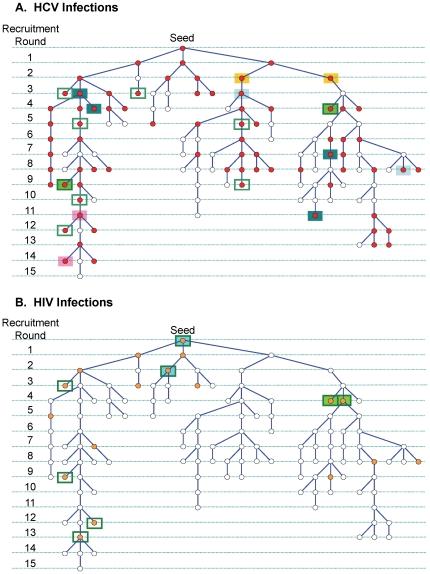
IDU recruited through a chain-referral method provided biological specimens for analysis. HIV and HCV positive specimens were sequenced and analyzed using phylogenetic methods (Neighbour-joining and bayesian) and transmission patterns of HIV and HCV evaluated in the context of the recruitment networks.
Among the 407 recruited IDU, HCV and HIV prevalence were 60.6% and 10.1%, respectively; 98% of HIV positive individuals were co-infected with HCV. Thirty-six percent of HCV sequences were associated with clusters, compared to 67% of HIV sequences. Four (16.7%) of the 24 HCV clusters contained membership separated by 2 or fewer recruitment cycles, compared to 10 (41.6%) derived from more than one recruitment component. Two (28.6%) of the 7 HIV clusters contained membership separated by 2 or fewer recruitment cycles while 6 (85.7%) were composed of inter component membership.
Few HIV and HCV transmissions coincided with the recruitment networks, suggesting that they occurred in a different social context or a context not captured by the recruitment network. However, among the complete cohort, a higher degree of HIV clustering indicates many are recent infections originating from within current social networks, whereas a larger proportion of HCV infections may have occurred earlier in injecting history and in the context of a different social environment.
与注射吸毒相关的风险行为和做法仍然是全球 HIV 和丙型肝炎病毒(HCV)传播的驱动因素。在这里,我们评估了从高发地区招募的注射吸毒者(IDU)的社交网络中 HIV 和 HCV 的传播模式,以便更好地了解导致 IDU 持续传播的因素。
通过连锁referral 方法招募的 IDU 提供了用于分析的生物样本。对 HIV 和 HCV 阳性样本进行测序,并使用系统发育方法(邻接法和贝叶斯法)进行分析,并在招募网络的背景下评估 HIV 和 HCV 的传播模式。
在所招募的 407 名 IDU 中,HCV 和 HIV 的流行率分别为 60.6%和 10.1%;98%的 HIV 阳性个体同时感染 HCV。与 HIV 序列相比,36%的 HCV 序列与聚类相关,而 67%的 HIV 序列与聚类相关。与超过一个招募成分有关。与超过一个招募成分有关。四个(16.7%)HCV 簇包含通过两个或更少的招募周期分开的成员,而 10 个(41.6%)来自于多个招募成分。两个(28.6%)HIV 簇包含通过两个或更少的招募周期分开的成员,而 6 个(85.7%)是由组件间成员组成的。
很少有 HIV 和 HCV 的传播与招募网络同时发生,这表明它们发生在不同的社会环境或招募网络无法捕捉到的环境中。然而,在整个队列中,HIV 聚类程度较高表明许多是近期感染,源自当前社交网络内部,而 HCV 感染的比例较高可能发生在更早的注射史中,发生在不同的社会环境中。