Center for Clinical Laboratory, Zhujiang Hospital,Southern Medical University, Guangzhou, People's Republic of China.
PLoS One. 2011;6(7):e22553. doi: 10.1371/journal.pone.0022553. Epub 2011 Jul 25.
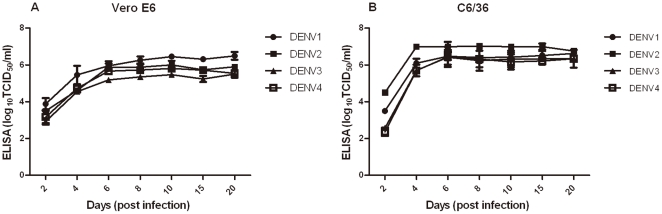
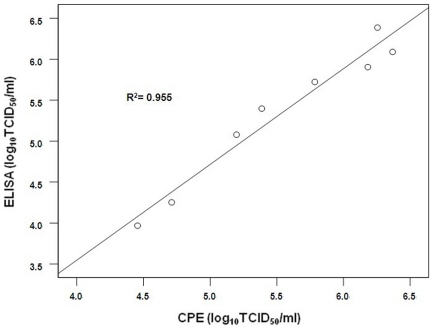
A dengue nonstructural protein 1 (NS1) antigen capture enzyme-linked immunosorbent assay (ELISA)-based tissue culture infectious dose-50 (TCID(50)) test (TCID(50)-ELISA) was developed as an alternative to the standard plaque assay for titrating dengue virus. Virus titers obtained by TCID(50)-ELISA were comparable to those obtained by the plaque assay and by the traditional TCID(50)-cytopathic effect (CPE) test (TCID(50)-CPE), with a better reproducibility and a lower coefficient of variation. Quantitative comparison of TCID(50)-ELISA and TCID(50)-CPE resulted in a correlation coefficient of 0.976. Moreover, this new method showed a wider application to C6/36, Vero E6, BHK-21, and Vero cells compared with other titration methods. In summary, the novel TCID(50)-ELISA method described here provides a more reliable and more accurate alternative compared to the plaque assay and TCID(50)-CPE for titration of dengue virus.
建立了一种基于登革热非结构蛋白 1(NS1)抗原捕获酶联免疫吸附试验(ELISA)的组织培养半数感染剂量-50(TCID50)检测(TCID50-ELISA),作为传统噬斑法检测登革热病毒滴度的替代方法。TCID50-ELISA 检测到的病毒滴度与噬斑法和传统 TCID50-细胞病变效应(CPE)检测法(TCID50-CPE)检测到的病毒滴度相当,具有更好的重现性和更低的变异系数。TCID50-ELISA 和 TCID50-CPE 的定量比较得到的相关系数为 0.976。此外,与其他滴定方法相比,该新方法显示出更广泛地适用于 C6/36、Vero E6、BHK-21 和 Vero 细胞。总之,与噬斑法和 TCID50-CPE 相比,这里描述的新型 TCID50-ELISA 方法为登革热病毒的滴定提供了一种更可靠、更准确的替代方法。