Department of Biochemistry, University of Cambridge, Cambridge, CB2 1GA, UK.
BMC Bioinformatics. 2011 Jul 29;12:313. doi: 10.1186/1471-2105-12-313.
Structural studies are increasingly providing huge amounts of information on multi-protein assemblies. Although a complete understanding of cellular processes will be dependent on an explicit characterization of the intermolecular interactions that underlie these assemblies and mediate molecular recognition, these are not well described by standard representations.
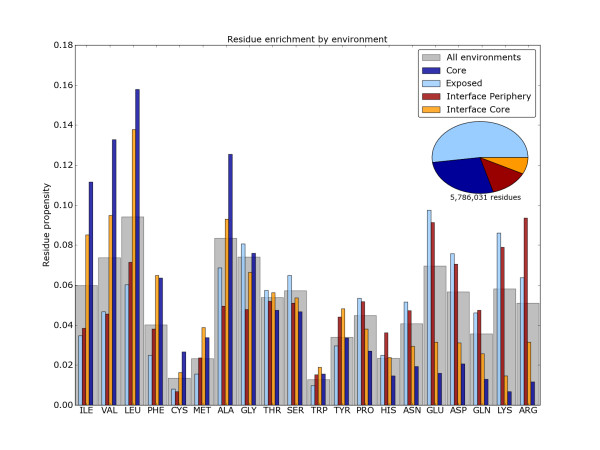
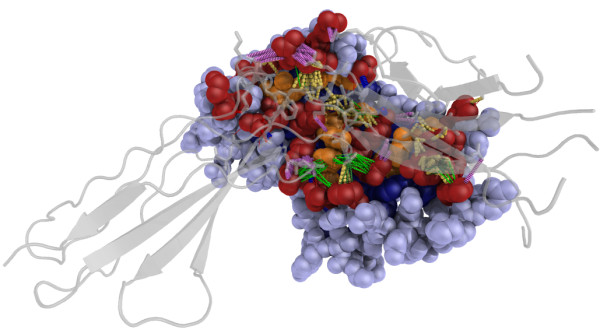
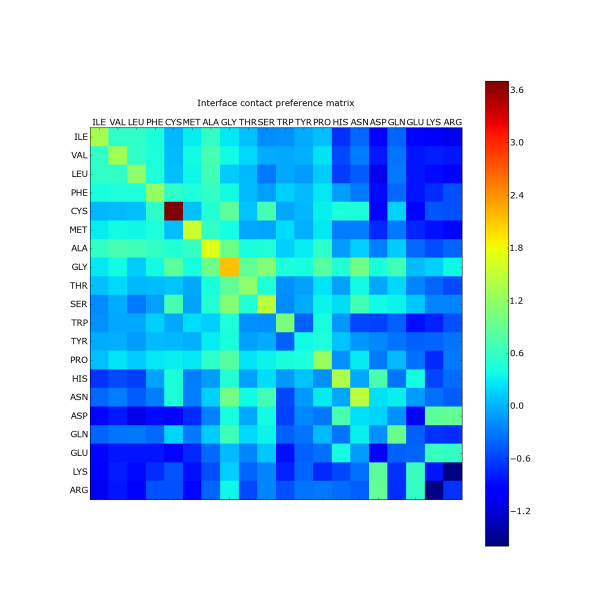
Here we present PICCOLO, a comprehensive relational database capturing the details of structurally characterized protein-protein interactions. Interactions are described at the level of interacting pairs of atoms, residues and polypeptide chains, with the physico-chemical nature of the interactions being characterized. Distance and angle terms are used to distinguish 12 different interaction types, including van der Waals contacts, hydrogen bonds and hydrophobic contacts. The explicit aim of PICCOLO is to underpin large-scale analyses of the properties of protein-protein interfaces. This is exemplified by an analysis of residue propensity and interface contact preferences derived from a much larger data set than previously reported. However, PICCOLO also supports detailed inspection of particular systems of interest.
The current PICCOLO database comprises more than 260 million interacting atom pairs from 38,202 protein complexes. A web interface for the database is available at http://www-cryst.bioc.cam.ac.uk/piccolo.
结构研究越来越多地提供关于多蛋白复合物的大量信息。尽管对细胞过程的全面理解将依赖于对这些复合物和介导分子识别的分子间相互作用的明确描述,但这些相互作用并不能很好地用标准表示来描述。
在这里,我们提出了 PICCOLO,这是一个全面的关系数据库,用于捕获经过结构表征的蛋白质-蛋白质相互作用的详细信息。相互作用是在相互作用的原子对、残基和多肽链的水平上描述的,其相互作用的物理化学性质被表征。距离和角度术语用于区分 12 种不同的相互作用类型,包括范德华接触、氢键和疏水接触。PICCOLO 的明确目标是为蛋白质-蛋白质界面的性质进行大规模分析提供支持。这可以通过对从比以前报告的更大的数据集派生的残基倾向和界面接触偏好的分析来说明。然而,PICCOLO 也支持对特定感兴趣系统的详细检查。
当前的 PICCOLO 数据库包含来自 38202 个蛋白质复合物的超过 2.6 亿个相互作用原子对。数据库的 Web 界面可在 http://www-cryst.bioc.cam.ac.uk/piccolo 上获得。