Klugmann Matthias, Goepfrich Anja, Friemel Chris M, Schneider Miriam
Translational Neuroscience Facility, Department of Physiology, School of Medical Sciences, University of New South Wales Sydney, NSW, Australia.
Front Behav Neurosci. 2011 Jul 13;5:37. doi: 10.3389/fnbeh.2011.00037. eCollection 2011.
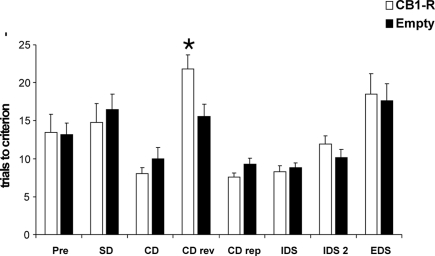
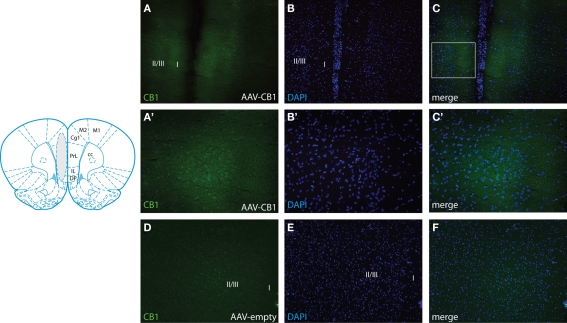
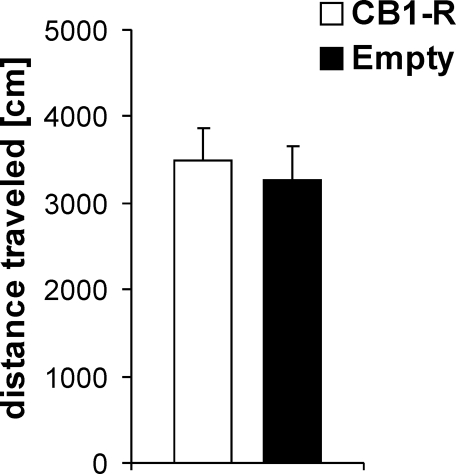
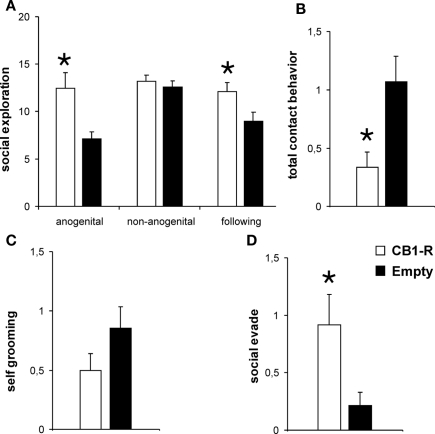
The endocannabinoid (ECB) system is strongly involved in the regulation of cognitive processing and emotional behavior and evidence indicates that ECB signaling might affect these behavioral abilities by modulations of prefrontal cortical functions. The aim of the present study was to examine the role of the CB1 receptor in the medial prefrontal cortex (mPFC) on cognitive flexibility and emotional behavior. Therefore, the CB1 receptor was overexpressed by adeno-associated virus vector-mediated gene transfer specifically in the mPFC of adult Wistar rats. Animals were then tested in different anxiety-related paradigms for emotional reactivity [e.g., elevated plus maze (EPM), light/dark emergence test (EMT), social interaction] and the attentional set shift task (ASST) - an adaptation of the human Wisconsin card sorting test - for cognitive abilities and behavioral flexibility. A subtle increase in exploratory behavior was found in CB1 receptor overexpressing animals (CB1-R) compared to Empty vector injected controls (Empty) in the EMT and EPM, although general locomotor activity did not differ between the groups. During social interaction testing, social contact behavior toward the unknown conspecific was found to be decreased, whereas social withdrawal was increased in CB1-R animals and they showed an inadequate increase in exploratory behavior compared to control animals. In the ASST, impaired reversal learning abilities were detected in CB1-R animals compared to controls, indicating reduced behavioral flexibility. In conclusion, upregulation of the CB1 receptor specifically in the rat mPFC induces alterations in emotional reactivity, leads to inadequate social behavior, and impairs cognitive flexibility. These findings might be relevant for neuropsychiatric disorders, since higher cortical CB1 receptor expression levels as well as similar behavioral impairments as observed in the present study have been described in schizophrenic patients.
内源性大麻素(ECB)系统在认知加工和情绪行为的调节中发挥着重要作用,有证据表明,ECB信号可能通过调节前额叶皮层功能来影响这些行为能力。本研究的目的是探讨内侧前额叶皮层(mPFC)中CB1受体在认知灵活性和情绪行为中的作用。因此,通过腺相关病毒载体介导的基因转移,在成年Wistar大鼠的mPFC中特异性过表达CB1受体。然后,对动物进行不同的焦虑相关范式测试,以评估其情绪反应性[例如,高架十字迷宫(EPM)、明暗箱试验(EMT)、社交互动],以及用于评估认知能力和行为灵活性的注意力集转换任务(ASST)——人类威斯康星卡片分类测试的一种改编形式。与注射空载体的对照组(Empty)相比,在EMT和EPM中,过表达CB1受体的动物(CB1-R)的探索行为略有增加,尽管两组之间的总体运动活动没有差异。在社交互动测试中,发现CB1-R动物对未知同种动物的社交接触行为减少,而社交退缩增加,并且与对照动物相比,它们的探索行为增加不足。在ASST中,与对照组相比,CB1-R动物的逆向学习能力受损,表明行为灵活性降低。总之,在大鼠mPFC中特异性上调CB1受体可导致情绪反应性改变,导致社交行为不足,并损害认知灵活性。这些发现可能与神经精神疾病有关,因为在精神分裂症患者中已经描述了较高的皮层CB1受体表达水平以及与本研究中观察到的类似行为障碍。