Faculty of Social Sciences, Psychology I, University of Kaiserslautern Kaiserslautern, Germany.
Front Psychol. 2011 Jul 15;2:169. doi: 10.3389/fpsyg.2011.00169. eCollection 2011.
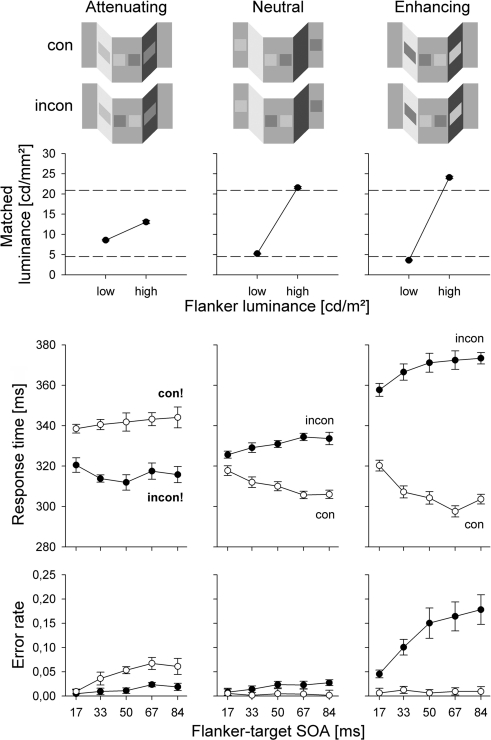
Visual stimuli can be classified so rapidly that their analysis may be based on a single sweep of feedforward processing through the visuomotor system. Behavioral criteria for feedforward processing can be evaluated in response priming tasks where speeded pointing or keypress responses are performed toward target stimuli which are preceded by prime stimuli. We apply this method to several classes of complex stimuli. (1) When participants classify natural images into animals or non-animals, the time course of their pointing responses indicates that prime and target signals remain strictly sequential throughout all processing stages, meeting stringent behavioral criteria for feedforward processing (rapid-chase criteria). (2) Such priming effects are boosted by selective visual attention for positions, shapes, and colors, in a way consistent with bottom-up enhancement of visuomotor processing, even when primes cannot be consciously identified. (3) Speeded processing of phobic images is observed in participants specifically fearful of spiders or snakes, suggesting enhancement of feedforward processing by long-term perceptual learning. (4) When the perceived brightness of primes in complex displays is altered by means of illumination or transparency illusions, priming effects in speeded keypress responses can systematically contradict subjective brightness judgments, such that one prime appears brighter than the other but activates motor responses as if it was darker. We propose that response priming captures the output of the first feedforward pass of visual signals through the visuomotor system, and that this output lacks some characteristic features of more elaborate, recurrent processing. This way, visuomotor measures may become dissociated from several aspects of conscious vision. We argue that "fast" visuomotor measures predominantly driven by feedforward processing should supplement "slow" psychophysical measures predominantly based on visual awareness.
视觉刺激可以被快速分类,以至于它们的分析可能基于视觉运动系统的单次前馈处理。前馈处理的行为标准可以通过响应启动任务来评估,在这些任务中,快速指向或按键反应是针对目标刺激做出的,而目标刺激之前是启动刺激。我们将这种方法应用于几类复杂刺激。(1)当参与者将自然图像分类为动物或非动物时,他们的指向反应时间表明,在整个处理阶段,启动和目标信号仍然严格按顺序出现,符合前馈处理的严格行为标准(快速追逐标准)。(2)这种启动效应通过对位置、形状和颜色的选择性视觉注意得到增强,这与视觉运动处理的自上而下增强一致,即使启动刺激不能被有意识地识别。(3)对蜘蛛或蛇特别恐惧的参与者观察到恐惧图像的快速处理,这表明长期知觉学习增强了前馈处理。(4)当复杂显示中的启动刺激的感知亮度通过照明或透明度错觉改变时,快速按键反应中的启动效应可以系统地与主观亮度判断相矛盾,使得一个启动刺激看起来比另一个更亮,但激活运动反应,就好像它更暗一样。我们提出,响应启动捕获了视觉信号通过视觉运动系统的第一次前馈传递的输出,并且该输出缺少更精细、递归处理的某些特征。这样,视觉运动测量可能与意识视觉的几个方面分离。我们认为,主要由前馈处理驱动的“快速”视觉运动测量应该补充主要基于视觉意识的“缓慢”心理物理测量。