I. Department of Medicine, Faculty of Medicine Mannheim, University of Heidelberg, Mannheim, Germany.
PLoS One. 2011;6(7):e21778. doi: 10.1371/journal.pone.0021778. Epub 2011 Jul 21.
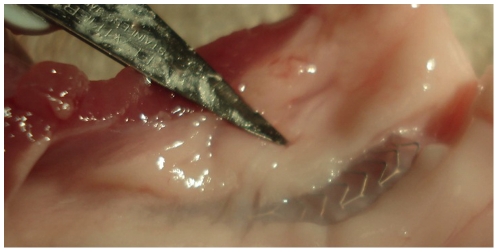
Treatment of coronary bifurcation lesions remains challenging, beyond the introduction of drug eluting stents. Dedicated stent systems are available to improve the technical approach to the treatment of these lesions. However dedicated stent systems have so far not reduced the incidence of stent restenosis. The aim of this study was to assess the expansion of the Multi-Link (ML) Frontier™ stent in human and porcine coronary arteries to provide the cardiologist with useful in-vitro information for stent implantation and selection.
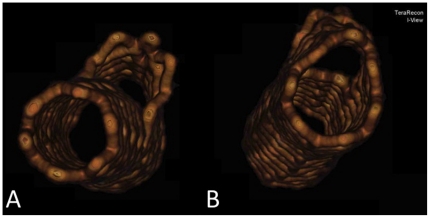
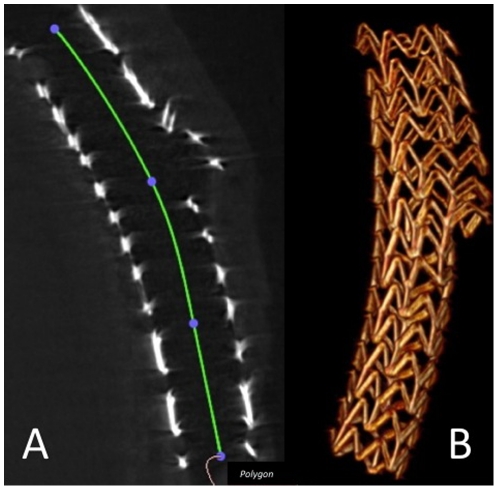
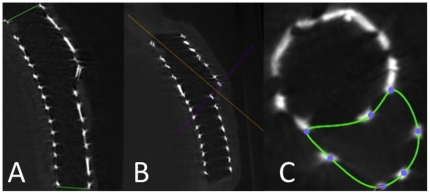
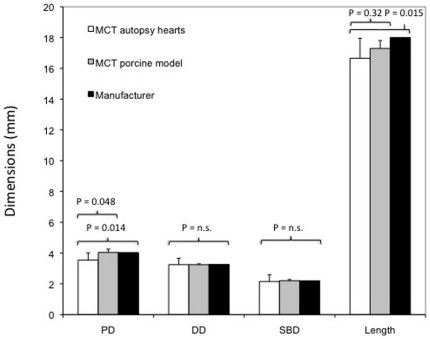
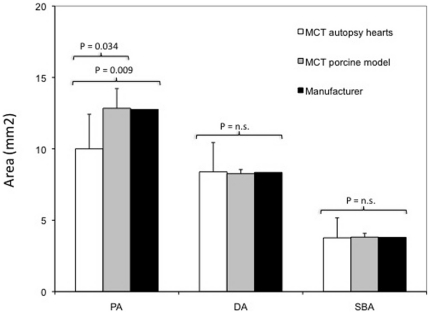
METHODOLOGY/PRINCIPAL FINDINGS: Nine ML Frontier™ stents were implanted in seven human autopsy heart samples with known coronary artery disease and five ML Frontier™ stents were implanted in five porcine hearts. Proximal, distal and side branch diameters (PD, DD, SBD, respectively), corresponding opening areas (PA, DA, SBA) and the mean stent length (L) were assessed by micro-computed tomography (micro-CT). PD and PA were significantly smaller in human autopsy heart samples than in porcine heart samples (3.54±0.47 mm vs. 4.04±0.22 mm, p = 0.048; 10.00±2.42 mm(2) vs. 12.84±1.38 mm(2), p = 0.034, respectively) and than those given by the manufacturer (3.54±0.47 mm vs. 4.03 mm, p = 0.014). L was smaller in human autopsy heart samples than in porcine heart samples, although data did not reach significance (16.66±1.30 mm vs. 17.30±0.51 mm, p = 0.32), and significantly smaller than that given by the manufacturer (16.66±1.30 mm vs. 18 mm, p = 0.015).
CONCLUSIONS/SIGNIFICANCE: Micro-CT is a feasible tool for exact surveying of dedicated stent systems and could make a contribution to the development of these devices. The proximal diameter and proximal area of the stent system were considerably smaller in human autopsy heart samples than in porcine heart samples and than those given by the manufacturer. Special consideration should be given to the stent deployment procedure (and to the follow-up) of dedicated stent systems, considering final intravascular ultrasound or optical coherence tomography to visualize (and if necessary optimize) stent expansion.
除了药物洗脱支架的应用外,冠状动脉分叉病变的治疗仍然具有挑战性。专用支架系统可用于改善这些病变的治疗技术方法。然而,专用支架系统迄今并未降低支架内再狭窄的发生率。本研究旨在评估 Multi-Link(ML)Frontier™支架在人体和猪冠状动脉中的扩张情况,为心脏介入医生提供支架植入和选择的有用的体外信息。
方法/主要发现:在 7 例已知冠状动脉疾病的人体尸检心脏样本中植入了 9 个 ML Frontier™支架,在 5 例猪心脏中植入了 5 个 ML Frontier™支架。通过微计算机断层扫描(micro-CT)评估近端、远端和侧支直径(PD、DD、SBD,分别)、相应的开口面积(PA、DA、SBA)和平均支架长度(L)。人体尸检心脏样本中的 PD 和 PA 明显小于猪心脏样本(3.54±0.47 mm 比 4.04±0.22 mm,p=0.048;10.00±2.42 mm² 比 12.84±1.38 mm²,p=0.034),也小于制造商提供的数据(3.54±0.47 mm 比 4.03 mm,p=0.014)。人体尸检心脏样本中的 L 小于猪心脏样本,尽管数据没有显著差异(16.66±1.30 mm 比 17.30±0.51 mm,p=0.32),但明显小于制造商提供的数据(16.66±1.30 mm 比 18 mm,p=0.015)。
微计算机断层扫描是一种用于专用支架系统精确测量的可行工具,并可能为这些设备的开发做出贡献。在人体尸检心脏样本中,支架系统的近端直径和近端面积明显小于猪心脏样本和制造商提供的数据。应特别注意专用支架系统的支架展开过程(以及后续过程),考虑进行最终的血管内超声或光学相干断层扫描以可视化(并在必要时优化)支架扩张情况。