Centre for Global Health Research, University of New Mexico Laboratories of Parasitic and Viral Diseases, Kenya Medical Research Institute, Kisumu, Kenya.
BMC Genet. 2011 Aug 6;12:69. doi: 10.1186/1471-2156-12-69.
Plasmodium falciparum malaria remains a leading cause of morbidity and mortality among African children. Innate immunity provides the first line of defence against P. falciparum infections, particularly in young children that lack naturally-acquired malarial immunity, such as the population examined here. Consistent with the fact that elevated interleukin (IL)-12 is an important component of the innate immune response that provides protective immunity against malaria, we have previously shown that suppression of IL-12 in African children is associated with the development of severe malarial anaemia (SMA). Since the role of IL12B variants in conditioning susceptibility to SMA remains largely unexplored, the association between a single nucleotide polymorphism (1188A→C, rs3212227), SMA (Hb<6.0 g/dL), circulating IL-12p40/p70 levels, and longitudinal clinical outcomes in Kenyan children (n = 756) residing in a holoendemic falciparum malaria transmission area were investigated.
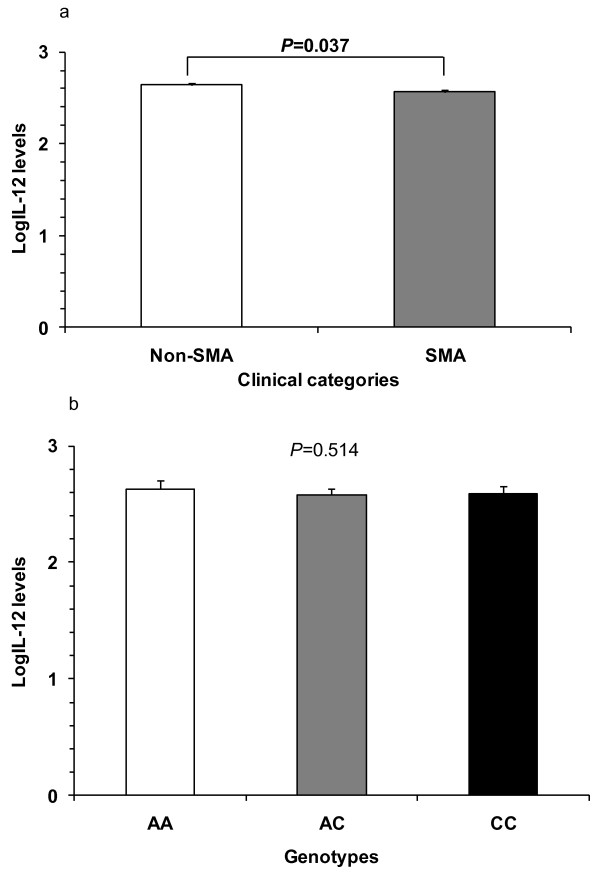
Multivariate logistic regression analysis in children with acute malaria (n = 544) demonstrated that carriers of the C allele had increased susceptibility to SMA (CC: OR, 1.674; 95% CI, 1.006-2.673; P = 0.047, and AC: OR, 1.410; 95% CI, 0.953-2.087; P = 0.086) relative to wild type (AA). Although children with SMA had lower IL-12p40/p70 levels than the non-SMA group (P = 0.037), levels did not differ significantly according to genotype. Longitudinal analyses in the entire cohort (n = 756) failed to show any significant relationships between rs3212227 genotypes and either susceptibility to SMA or all-cause mortality throughout the three year follow-up.
The rs3212227 is a marker of susceptibility to SMA in children with acute disease, but does not appear to mediate functional changes in IL-12 production or longitudinal outcomes during the acquisition of naturally-acquired malarial immunity.
恶性疟原虫疟疾仍然是非洲儿童发病率和死亡率的主要原因。先天免疫提供了抵抗恶性疟原虫感染的第一道防线,特别是在缺乏自然获得性疟疾免疫力的幼儿中,就像这里检查的人群一样。与升高的白细胞介素(IL)-12 是提供抗疟疾保护免疫的先天免疫反应的重要组成部分这一事实一致,我们之前已经表明,抑制非洲儿童的 IL-12 与严重疟疾性贫血(SMA)的发展有关。由于 IL12B 变体在决定对 SMA 的易感性中的作用在很大程度上仍未得到探索,因此研究了肯尼亚儿童(居住在恶性疟原虫流行地区)中单一核苷酸多态性(1188A→C,rs3212227)、SMA(Hb<6.0 g/dL)、循环 IL-12p40/p70 水平与纵向临床结局之间的关联(n = 756)。
对急性疟疾儿童(n = 544)进行的多变量逻辑回归分析表明,携带 C 等位基因的儿童更容易患 SMA(CC:OR,1.674;95%CI,1.006-2.673;P = 0.047,AC:OR,1.410;95%CI,0.953-2.087;P = 0.086)与野生型(AA)相比。尽管患有 SMA 的儿童的 IL-12p40/p70 水平低于非 SMA 组(P = 0.037),但根据基因型差异并不明显。在整个队列(n = 756)的纵向分析中,在整个三年随访期间,rs3212227 基因型与 SMA 易感性或全因死亡率之间均未显示出任何显著关系。
rs3212227 是儿童急性疾病中 SMA 易感性的标志物,但似乎不会影响 IL-12 产生的功能变化或自然获得性疟疾免疫过程中的纵向结局。