Department of Immunology, Lerner Research Institute, Cleveland Clinic Foundation, Cleveland, Ohio, USA.
Nat Immunol. 2011 Aug 7;12(9):853-60. doi: 10.1038/ni.2081.
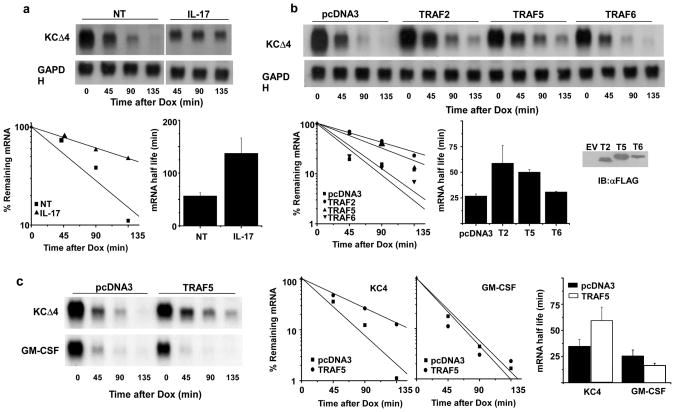
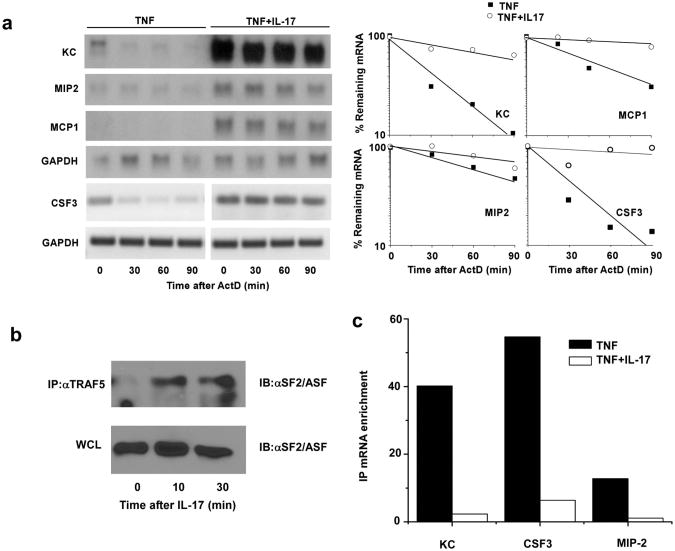
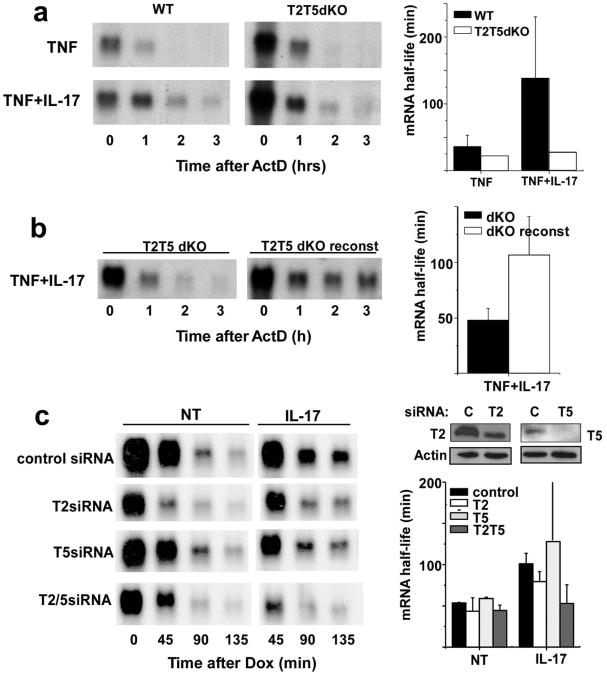
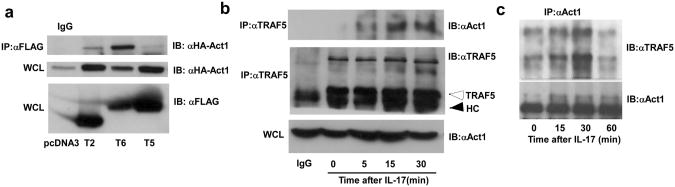
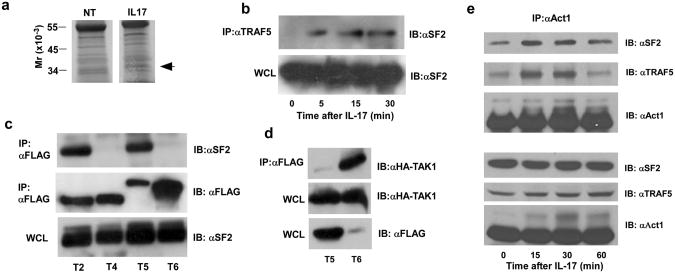
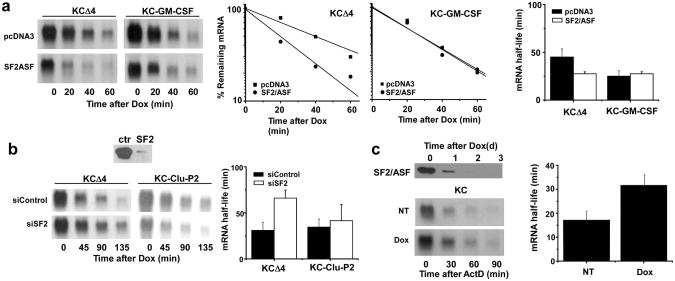
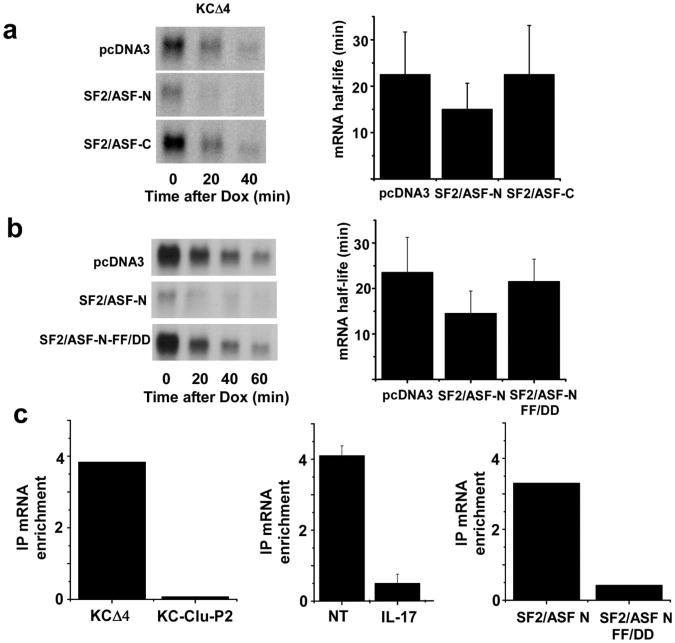
Interleukin 17 (IL-17) promotes the expression of chemokines and cytokines via the induction of gene transcription and post-transcriptional stabilization of mRNA. We show here that IL-17 enhanced the stability of chemokine CXCL1 mRNA and other mRNAs through a pathway that involved the adaptor Act1, the adaptors TRAF2 or TRAF5 and the splicing factor SF2 (also known as alternative splicing factor (ASF)). TRAF2 and TRAF5 were necessary for IL-17 to signal the stabilization of CXCL1 mRNA. Furthermore, IL-17 promoted the formation of complexes of TRAF5-TRAF2, Act1 and SF2 (ASF). Overexpression of SF2 (ASF) shortened the half-life of CXCL1 mRNA, whereas depletion of SF2 (ASF) prolonged it. SF2 (ASF) bound chemokine mRNA in unstimulated cells, whereas the SF2 (ASF)-mRNA interaction was much lower after stimulation with IL-17. Our findings define an IL-17-induced signaling pathway that links to the stabilization of selected mRNA species through Act1, TRAF2-TRAF5 and the RNA-binding protein SF2 (ASF).
白细胞介素 17(IL-17)通过诱导基因转录和 mRNA 的转录后稳定来促进趋化因子和细胞因子的表达。我们在这里表明,IL-17 通过涉及衔接蛋白 Act1、衔接蛋白 TRAF2 或 TRAF5 和剪接因子 SF2(也称为选择性剪接因子(ASF))的途径增强趋化因子 CXCL1 mRNA 和其他 mRNA 的稳定性。TRAF2 和 TRAF5 对于 IL-17 信号转导 CXCL1 mRNA 的稳定是必需的。此外,IL-17 促进了 TRAF5-TRAF2、Act1 和 SF2(ASF)的复合物的形成。SF2(ASF)的过表达缩短了 CXCL1 mRNA 的半衰期,而 SF2(ASF)的耗竭则延长了半衰期。SF2(ASF)在未刺激的细胞中结合趋化因子 mRNA,而在受到 IL-17 刺激后,SF2(ASF)-mRNA 相互作用要低得多。我们的研究结果定义了一种 IL-17 诱导的信号通路,该通路通过 Act1、TRAF2-TRAF5 和 RNA 结合蛋白 SF2(ASF)与选定的 mRNA 种类的稳定化相关联。