Chawla Raman, Jaiswal Sarita, Kumar Raj, Arora Rajesh, Sharma Rakesh Kumar
Division of CBRN Defence, Institute of Nuclear Medicine and Allied Sciences, Brig SK Mazumdar Marg, Delhi - 110 054, India.
J Pharm Bioallied Sci. 2010 Jul;2(3):213-9. doi: 10.4103/0975-7406.68503.
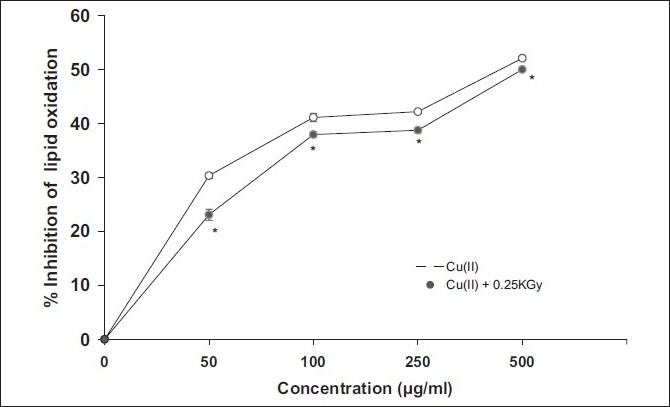
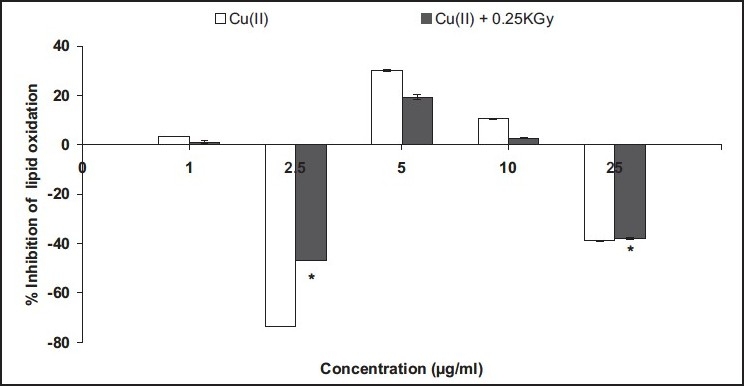
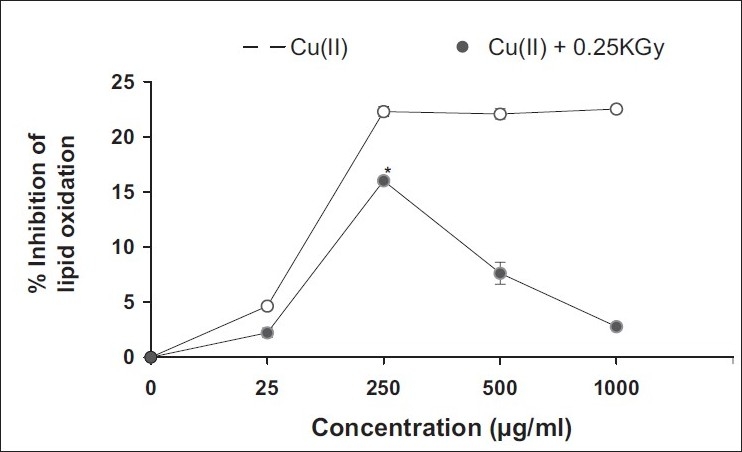
In recent years, a lot of interest has been generated world over in the area of radioprotection for first responders going to work in the hot zones at the incident site. A large number of molecular drugs have been screened for radioprotective efficacy, but with little success. The requirement of differential radioprotection necessitates a holistic approach, which can be realized using herbs in view of their multifaceted mode of action. Our earlier studies showed the radioprotective potential of Rhodiola imbricata, a Himalayan high-altitude plant. In this study, our focus has been to compare the pro-oxidant/antioxidant activities of three fractionated extracts of R. imbricata. The aqueous fraction exhibited significant (P < 0.05) pro-oxidant activity (up to 100 μg/ml) under metal ion-induced stress ± flux [transition metal (Fe/Cu) ± 0.25 kGy]. A decrease in the dielectric constant of the solvent system utilized for extraction, exhibited a significant (P < 0.05) negative correlation (-0.955) with mean protection potential of lipid against radiation flux. Such an effect was visualized as a significant shift from pro-oxidant to antioxidant activity in methanolic fraction (dielectric constant = 33), as compared to aqueous fraction (dielectric constant = 80). Aqueous fraction is predominantly pro-oxidant at maximal concentrations, indicating its anticancer potential. The presence of transition metals modulates such a biphasic activity differentially in various fractions, i.e., the conversion of Fe(III) or Cu(II) to Fe(II) or Cu(I), respectively, due to the presence of certain bioactive constituents (electron donation at lower concentrations), favors pro-oxidant activity. On the other hand, certain other active constituents involved in metal ion chelation contributed to the overall antioxidant activity. The methanolic fraction exhibited significant antioxidant activity up to 250 μg/ml, which contributed to its radioprotective efficacy. The aquo-methanolic fraction exhibited (disparate properties), i.e., concentration-dependant cytotoxicity (up to 250 μg/ml) and cytoprotection at 1000 μg/ml. R. imbricata, in general, exhibited a significant solvent-dependant variation in radioprotective efficacy. In conclusion, solvent extraction and dose are crucial in bioactivity modulation and R. imbricata could be developed as a potential prophylactic radiation countermeasure for use in nuclear and radiological emergencies.
近年来,全球范围内对前往事故现场热区工作的急救人员的辐射防护领域产生了浓厚兴趣。人们筛选了大量分子药物以评估其辐射防护效果,但收效甚微。差异化辐射防护的需求需要一种整体方法,鉴于草药具有多方面的作用模式,利用草药可以实现这一目标。我们早期的研究表明,喜马拉雅高海拔植物长鞭红景天具有辐射防护潜力。在本研究中,我们的重点是比较长鞭红景天三种分级提取物的促氧化/抗氧化活性。在金属离子诱导的应激±通量[过渡金属(铁/铜)±0.25千戈瑞]下,水相提取物在高达100微克/毫升时表现出显著(P<0.05)的促氧化活性。用于提取的溶剂系统介电常数降低,与脂质抗辐射通量的平均保护潜力呈现显著(P<0.05)负相关(-0.955)。与水相提取物(介电常数=80)相比,甲醇提取物(介电常数=33)中这种效应表现为从促氧化活性到抗氧化活性的显著转变。水相提取物在最大浓度时主要表现为促氧化,表明其具有抗癌潜力。过渡金属的存在在不同提取物中对这种双相活性有不同的调节作用,即由于某些生物活性成分的存在(在较低浓度下提供电子),分别将铁(III)或铜(II)转化为铁(II)或铜(I),有利于促氧化活性。另一方面,参与金属离子螯合的某些其他活性成分则有助于整体抗氧化活性。甲醇提取物在高达250微克/毫升时表现出显著的抗氧化活性,这有助于其辐射防护效果。水-甲醇提取物表现出(不同的性质),即浓度依赖性细胞毒性(高达250微克/毫升)和在1000微克/毫升时的细胞保护作用。总体而言,长鞭红景天在辐射防护效果上表现出显著的溶剂依赖性变化。总之,溶剂萃取和剂量在生物活性调节中至关重要,长鞭红景天有望开发成为一种用于核与辐射紧急情况的潜在预防性辐射对策。