Instituto de Tecnologia Química e Biológica, Universidade Nova de Lisboa, Oeiras, Portugal.
PLoS Comput Biol. 2011 Aug;7(8):e1002128. doi: 10.1371/journal.pcbi.1002128. Epub 2011 Aug 4.
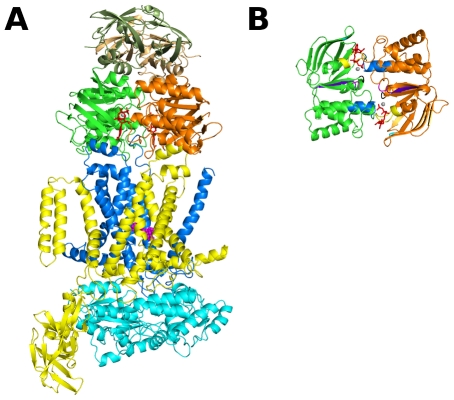
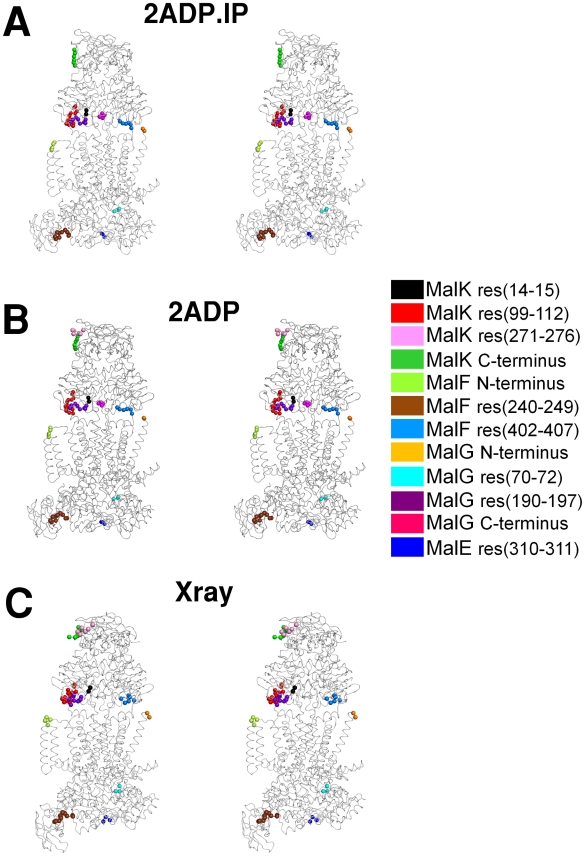
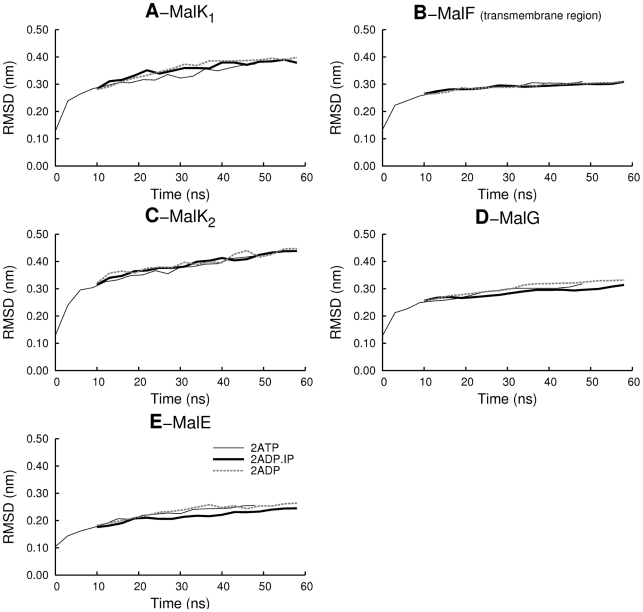
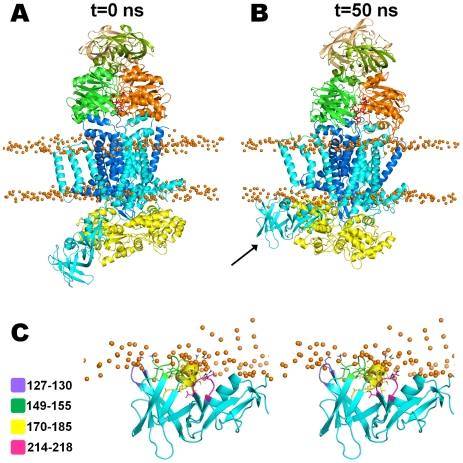
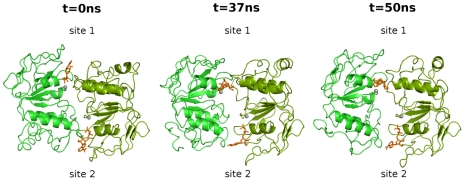
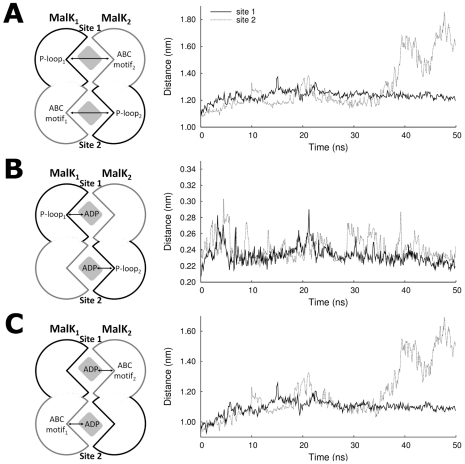
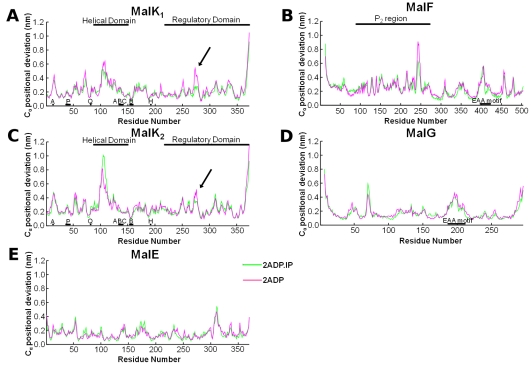
ATP-Binding Cassette transporters are ubiquitous membrane proteins that convert the energy from ATP-binding and hydrolysis into conformational changes of the transmembrane region to allow the translocation of substrates against their concentration gradient. Despite the large amount of structural and biochemical data available for this family, it is still not clear how the energy obtained from ATP hydrolysis in the ATPase domains is "transmitted" to the transmembrane domains. In this work, we focus our attention on the consequences of hydrolysis and inorganic phosphate exit in the maltose uptake system (MalFGK(2)E) from Escherichia coli. The prime goal is to identify and map the structural changes occurring during an ATP-hydrolytic cycle. For that, we use extensive molecular dynamics simulations to study three potential intermediate states (with 10 replicates each): an ATP-bound, an ADP plus inorganic phosphate-bound and an ADP-bound state. Our results show that the residues presenting major rearrangements are located in the A-loop, in the helical sub-domain, and in the "EAA motif" (especially in the "coupling helices" region). Additionally, in one of the simulations with ADP we were able to observe the opening of the NBD dimer accompanied by the dissociation of ADP from the ABC signature motif, but not from its corresponding P-loop motif. This work, together with several other MD studies, suggests a common communication mechanism both for importers and exporters, in which ATP-hydrolysis induces conformational changes in the helical sub-domain region, in turn transferred to the transmembrane domains via the "coupling helices".
三磷酸腺苷结合盒转运蛋白是普遍存在的膜蛋白,它们将来自三磷酸腺苷结合和水解的能量转化为跨膜区域的构象变化,从而允许底物逆浓度梯度转运。尽管已经有大量的结构和生化数据可用于该家族,但仍不清楚来自三磷酸腺苷酶结构域水解的能量是如何“传递”到跨膜结构域的。在这项工作中,我们专注于研究来自大肠杆菌的麦芽糖摄取系统(MalFGK(2)E)中水解和无机磷酸盐释放的后果。主要目标是识别和映射在一个三磷酸腺苷水解循环中发生的结构变化。为此,我们使用广泛的分子动力学模拟来研究三个潜在的中间状态(每个状态有 10 个重复):一个与三磷酸腺苷结合的状态、一个与二磷酸腺苷和无机磷酸盐结合的状态和一个与二磷酸腺苷结合的状态。我们的结果表明,主要重排的残基位于 A 环、螺旋亚结构域和“EAA 基序”(特别是在“耦合螺旋”区域)中。此外,在一个带有二磷酸腺苷的模拟中,我们能够观察到 NBD 二聚体的打开,伴随着二磷酸腺苷从 ABC 特征基序的解离,但不是从其相应的 P 环基序解离。这项工作与其他几项 MD 研究一起,提出了一个用于进口器和出口器的共同通讯机制,其中三磷酸腺苷水解诱导螺旋亚结构域区域的构象变化,进而通过“耦合螺旋”传递到跨膜结构域。