Solid State Physics Division, Bhabha Atomic Research Centre, Trombay, Mumbai, India.
PLoS One. 2011;6(7):e22767. doi: 10.1371/journal.pone.0022767. Epub 2011 Jul 28.
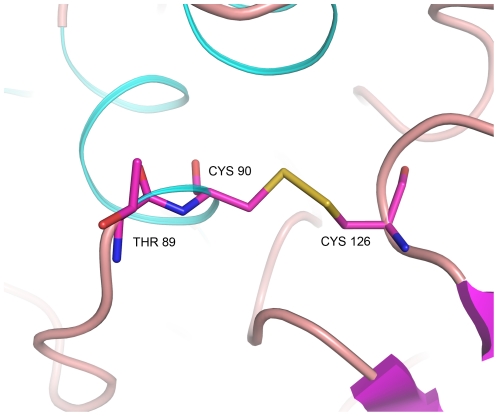
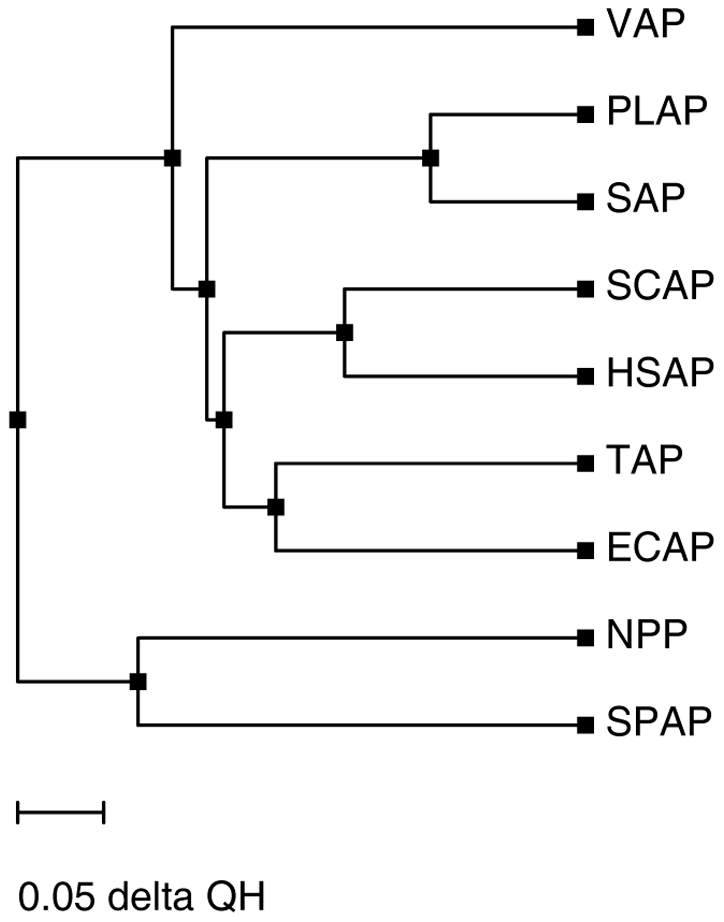
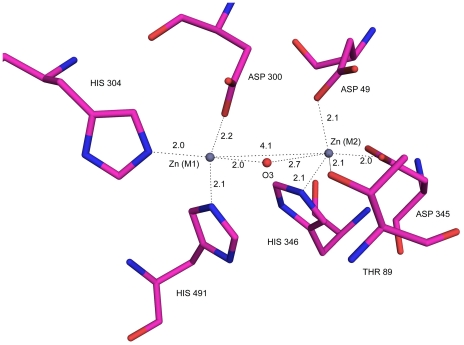
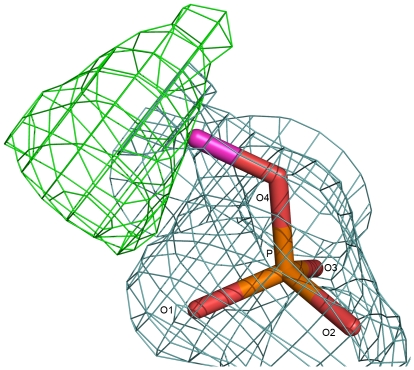
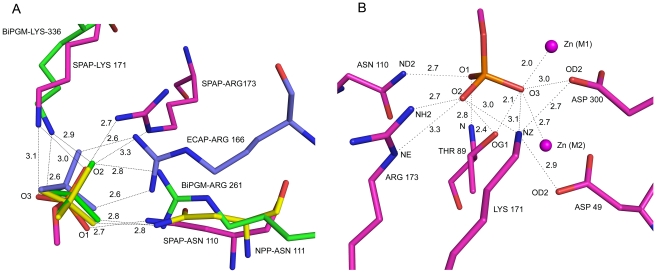
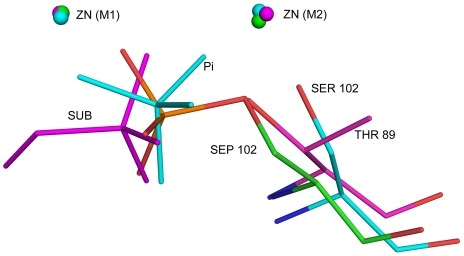
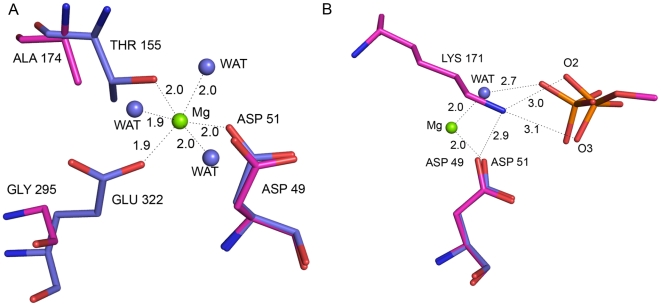
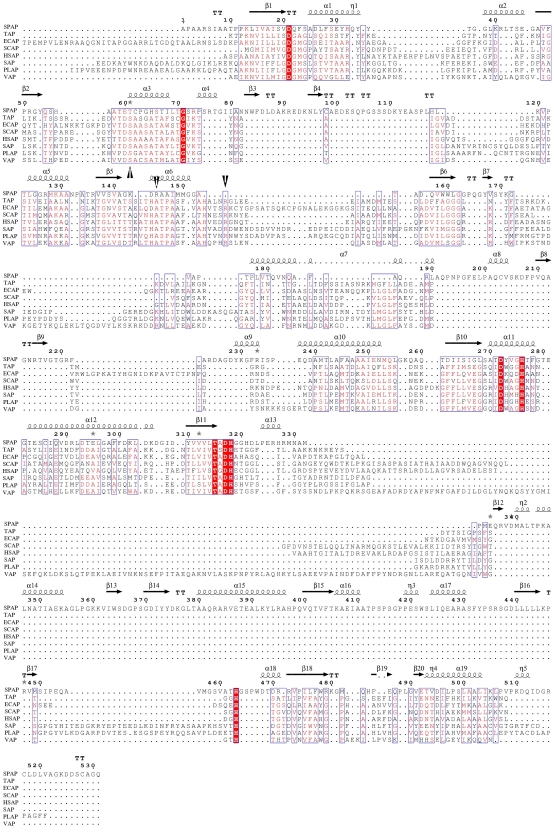
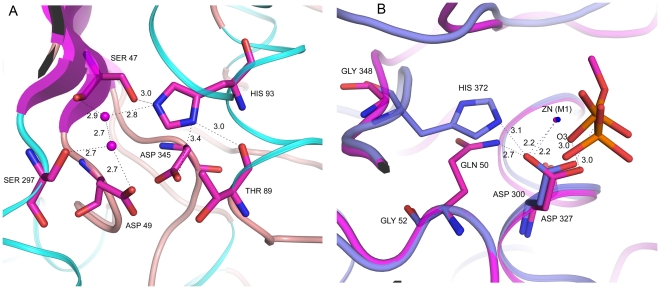
The alkaline phosphatase (AP) is a bi-metalloenzyme of potential applications in biotechnology and bioremediation, in which phosphate monoesters are nonspecifically hydrolysed under alkaline conditions to yield inorganic phosphate. The hydrolysis occurs through an enzyme intermediate in which the catalytic residue is phosphorylated. The reaction, which also requires a third metal ion, is proposed to proceed through a mechanism of in-line displacement involving a trigonal bipyramidal transition state. Stabilizing the transition state by bidentate hydrogen bonding has been suggested to be the reason for conservation of an arginine residue in the active site. We report here the first crystal structure of alkaline phosphatase purified from the bacterium Sphingomonas. sp. Strain BSAR-1 (SPAP). The crystal structure reveals many differences from other APs: 1) the catalytic residue is a threonine instead of serine, 2) there is no third metal ion binding pocket, and 3) the arginine residue forming bidentate hydrogen bonding is deleted in SPAP. A lysine and an aspargine residue, recruited together for the first time into the active site, bind the substrate phosphoryl group in a manner not observed before in any other AP. These and other structural features suggest that SPAP represents a new class of APs. Because of its direct contact with the substrate phosphoryl group, the lysine residue is proposed to play a significant role in catalysis. The structure is consistent with a mechanism of in-line displacement via a trigonal bipyramidal transition state. The structure provides important insights into evolutionary relationships between members of AP superfamily.
碱性磷酸酶(AP)是一种双金属酶,具有潜在的生物技术和生物修复应用价值,在碱性条件下可非特异性水解磷酸单酯,生成无机磷酸盐。水解通过酶中间体进行,其中催化残基被磷酸化。该反应还需要第三种金属离子,其反应机制被提议为涉及三角双锥过渡态的直线取代机制。通过双齿氢键稳定过渡态被认为是活性位点中精氨酸残基保守的原因。我们在这里报告了从细菌 Sphingomonas 中纯化的碱性磷酸酶(SPAP)的第一个晶体结构。该晶体结构与其他 AP 有许多不同之处:1)催化残基是苏氨酸而不是丝氨酸,2)没有第三个金属离子结合口袋,3)形成双齿氢键的精氨酸残基在 SPAP 中缺失。赖氨酸和天冬酰胺残基首次一起募集到活性位点,以以前在任何其他 AP 中都没有观察到的方式结合底物磷酸基团。这些和其他结构特征表明 SPAP 代表了一个新的 AP 类。由于其与底物磷酸基团的直接接触,赖氨酸残基被提议在催化中发挥重要作用。该结构与通过三角双锥过渡态的直线取代机制一致。该结构为 AP 超家族成员之间的进化关系提供了重要的见解。