Biodiversity Group, Department of Biology, Lund University, Lund, Sweden.
PLoS One. 2011;6(7):e23006. doi: 10.1371/journal.pone.0023006. Epub 2011 Jul 29.
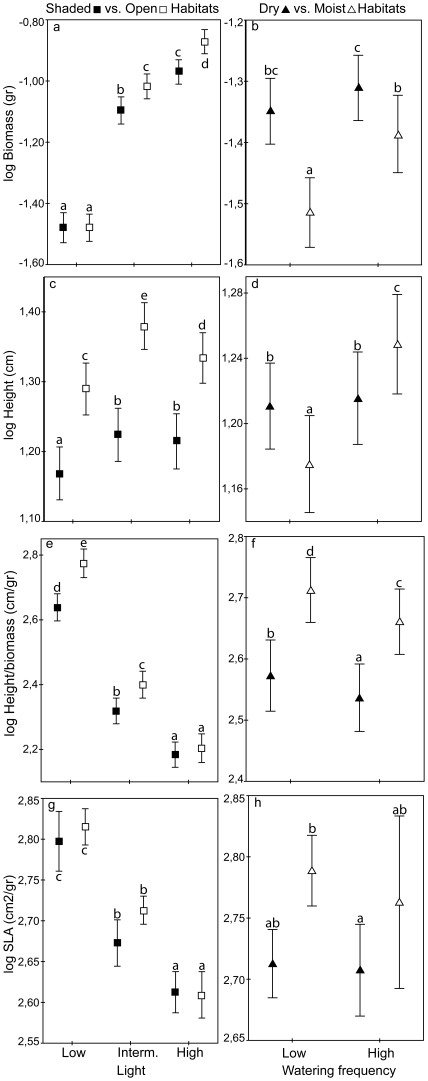
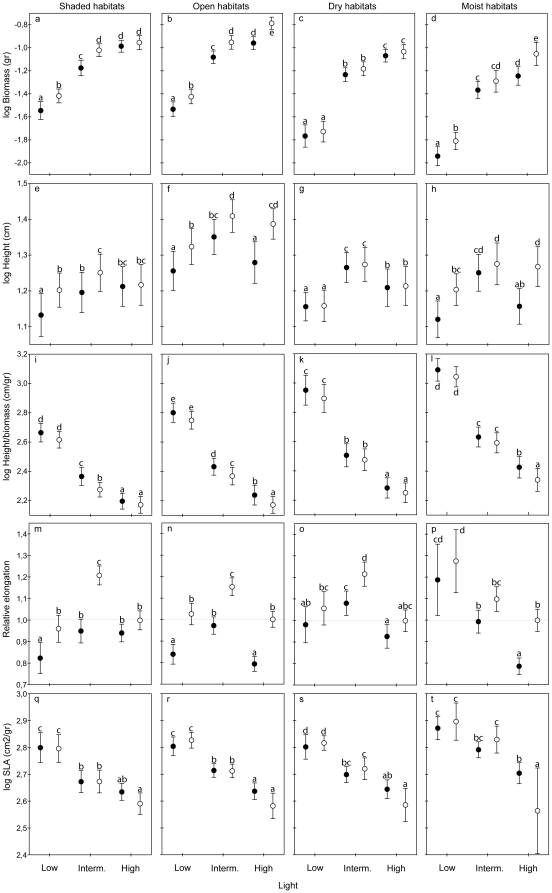
The regeneration niche has been little investigated in studies of community assembly and plant distribution. We examined adaptive associations between seedling traits and habitat specialization. Two habitat contrasts were investigated across several evolutionary lineages of angiosperms: species specialized to forest vs. open habitats and to dry vs. wet habitats. We also tested whether effects of shade and drought vary independently or, alternatively, if shade may amplify effects on drought-stressed plants. Seedling response in terms of growth rate, height, slenderness, specific leaf area (SLA) and degree of elongation (longest internode; petiole or leaf-sheath depending on species' morphology) to light and watering treatments was assessed. We used a factorial design involving three light regimes and two watering frequencies. The open-shaded habitat contrast and the dry-wet habitat contrast were investigated using six and five pairs of congeneric species, respectively. The congeneric species pair design controlled for confounding effects of evolutionary history prior to divergence in habitat specialization. Seedling growth rate generally decreased with shade and reduced watering frequency. Plant height was generally largest at intermediate light. Specialization to shaded habitats was associated with a more conservative growth strategy, i.e. showing a more modest growth response to increasing light. Species from all habitats showed the highest relative elongation at intermediate light, except for the moist-habitat species, for which elongation increased with shade. Contrary to our expectations, species from dry habitats grew bigger than species from moist habitats in all treatments. SLA responded to the light treatment, but not to watering regime. The contrasting light and moisture conditions across habitats appear to not have selected for differences in SLA. We conclude that seedling phase strategies of resource allocation in temperate herbs contribute to their habitat specialization. Habitat-specific seedling strategies and trade-offs in response to resource availability and environmental conditions may be important to adaptive specialization.
再生小生境在群落组装和植物分布的研究中很少被研究。我们研究了幼苗特征与栖息地特化之间的适应性关联。在被子植物的几个进化谱系中,我们调查了两个栖息地对比:专门适应森林和开阔栖息地的物种,以及适应干旱和湿润栖息地的物种。我们还测试了遮荫和干旱的影响是否独立变化,或者遮荫是否可能放大对受干旱胁迫植物的影响。根据光照和浇水处理对幼苗生长速度、高度、细长度、比叶面积(SLA)和伸长程度(最长节间;叶柄或叶鞘取决于物种形态)的反应来评估幼苗的响应。我们使用了一个涉及三种光照条件和两种浇水频率的析因设计。使用六个和五个对同属种对分别研究了开阔遮荫生境对比和干湿生境对比。同属种对设计控制了在生境特化之前的进化历史的混杂影响。幼苗生长速度通常随着遮荫和减少浇水频率而降低。植物高度通常在中等光照下最大。对遮荫生境的特化与更保守的生长策略有关,即对增加光照的生长反应更为温和。除了湿润生境的物种外,所有生境的物种在中等光照下表现出最高的相对伸长率,而在中等光照下,湿润生境的物种伸长率随着遮荫而增加。与我们的预期相反,在所有处理中,来自干旱生境的物种比来自湿润生境的物种生长得更大。SLA 对光照处理有反应,但对浇水制度没有反应。生境之间的对比光照和水分条件似乎没有选择 SLA 的差异。我们得出结论,温带草本植物幼苗阶段的资源分配策略有助于其生境特化。对资源可用性和环境条件的响应的生境特异性幼苗策略和权衡可能对适应性特化很重要。