Department of Medical Microbiology, University Medical Centre Utrecht, Utrecht, The Netherlands.
PLoS One. 2011;6(8):e22846. doi: 10.1371/journal.pone.0022846. Epub 2011 Aug 2.
Monitoring of healthcare-associated infection rates is important for infection control and hospital benchmarking. However, manual surveillance is time-consuming and susceptible to error. The aim was, therefore, to develop a prediction model to retrospectively detect drain-related meningitis (DRM), a frequently occurring nosocomial infection, using routinely collected data from a clinical data warehouse.
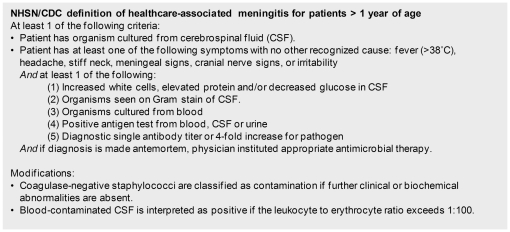
As part of the hospital infection control program, all patients receiving an external ventricular (EVD) or lumbar drain (ELD) (2004 to 2009; n = 742) had been evaluated for the development of DRM through chart review and standardized diagnostic criteria by infection control staff; this was the reference standard. Children, patients dying <24 hours after drain insertion or with <1 day follow-up and patients with infection at the time of insertion or multiple simultaneous drains were excluded. Logistic regression was used to develop a model predicting the occurrence of DRM. Missing data were imputed using multiple imputation. Bootstrapping was applied to increase generalizability.
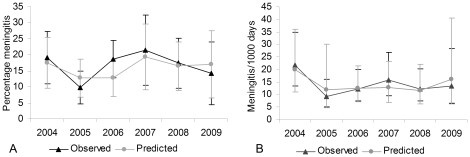
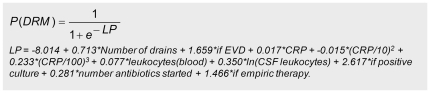
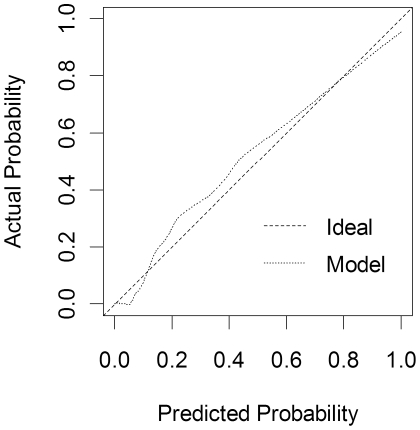
537 patients remained after application of exclusion criteria, of which 82 developed DRM (13.5/1000 days at risk). The automated model to detect DRM included the number of drains placed, drain type, blood leukocyte count, C-reactive protein, cerebrospinal fluid leukocyte count and culture result, number of antibiotics started during admission, and empiric antibiotic therapy. Discriminatory power of this model was excellent (area under the ROC curve 0.97). The model achieved 98.8% sensitivity (95% CI 88.0% to 99.9%) and specificity of 87.9% (84.6% to 90.8%). Positive and negative predictive values were 56.9% (50.8% to 67.9%) and 99.9% (98.6% to 99.9%), respectively. Predicted yearly infection rates concurred with observed infection rates.
A prediction model based on multi-source data stored in a clinical data warehouse could accurately quantify rates of DRM. Automated detection using this statistical approach is feasible and could be applied to other nosocomial infections.
监测医疗相关性感染率对于感染控制和医院基准比较非常重要。然而,人工监测既费时又容易出错。因此,本研究旨在开发一种预测模型,利用临床数据仓库中常规收集的数据,回顾性检测经常发生的医院获得性感染-引流相关脑膜炎(DRM)。
作为医院感染控制计划的一部分,所有接受外部脑室(EVD)或腰椎引流(ELD)的患者(2004 年至 2009 年;n=742)都通过感染控制人员进行了图表审查和标准化诊断标准来评估 DRM 的发生情况;这是参考标准。排除患有感染的患者,排除引流管插入后 24 小时内死亡或随访时间<1 天的患者,以及同时存在多个引流管的患者。使用逻辑回归来开发预测 DRM 发生的模型。使用多重插补法来填补缺失数据。采用自举法提高通用性。
应用排除标准后,有 537 例患者符合条件,其中 82 例发生 DRM(13.5/1000 天的发病风险)。用于检测 DRM 的自动模型包括放置引流管的数量、引流管类型、白细胞计数、C 反应蛋白、脑脊液白细胞计数和培养结果、住院期间开始使用的抗生素数量以及经验性抗生素治疗。该模型的区分能力非常好(ROC 曲线下面积 0.97)。该模型的敏感性为 98.8%(95%CI88.0%至 99.9%),特异性为 87.9%(84.6%至 90.8%)。阳性预测值和阴性预测值分别为 56.9%(50.8%至 67.9%)和 99.9%(98.6%至 99.9%)。预测的年感染率与观察到的感染率相符。
基于存储在临床数据仓库中的多源数据开发的预测模型可以准确量化 DRM 的感染率。使用这种统计方法进行自动检测是可行的,并且可以应用于其他医院获得性感染。