Department of Biochemistry and Immunology, Institute of Biological Sciences, Federal University of Minas Gerais, Belo Horizonte-Minas Gerais, Brazil.
PLoS One. 2011;6(8):e23135. doi: 10.1371/journal.pone.0023135. Epub 2011 Aug 2.
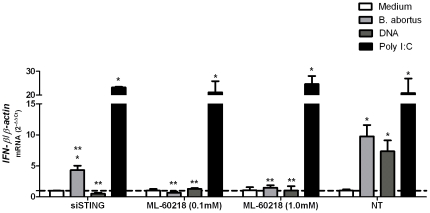
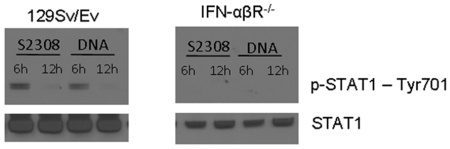
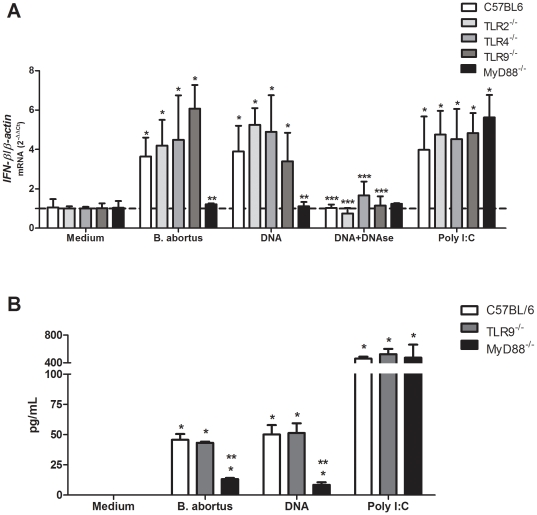
Type I interferons (IFNs) are cytokines that orchestrate diverse immune responses to viral and bacterial infections. Although typically considered to be most important molecules in response to viruses, type I IFNs are also induced by most, if not all, bacterial pathogens. In this study, we addressed the role of type I IFN signaling during Brucella abortus infection, a facultative intracellular bacterial pathogen that causes abortion in domestic animals and undulant fever in humans. Herein, we have shown that B. abortus induced IFN-β in macrophages and splenocytes. Further, IFN-β induction by Brucella was mediated by IRF3 signaling pathway and activates IFN-stimulated genes via STAT1 phosphorylation. In addition, IFN-β expression induced by Brucella is independent of TLRs and TRIF signaling but MyD88-dependent, a pathway not yet described for Gram-negative bacteria. Furthermore, we have identified Brucella DNA as the major bacterial component to induce IFN-β and our study revealed that this molecule operates through a mechanism dependent on RNA polymerase III to be sensed probably by an unknown receptor via the adaptor molecule STING. Finally, we have demonstrated that IFN-αβR KO mice are more resistant to infection suggesting that type I IFN signaling is detrimental to host control of Brucella. This resistance phenotype is accompanied by increased IFN-γ and NO production by IFN-αβR KO spleen cells and reduced apoptosis.
I 型干扰素 (IFNs) 是一类细胞因子,能够协调机体对病毒和细菌感染的多种免疫反应。虽然通常认为 I 型 IFN 是机体针对病毒产生的最重要的分子,但大多数(如果不是全部)细菌病原体也能诱导 I 型 IFN 的产生。在这项研究中,我们研究了 I 型 IFN 信号在布鲁氏菌属感染中的作用。布鲁氏菌属是一种兼性胞内细菌病原体,能引起家畜流产和人类波浪热。在此,我们发现布鲁氏菌属能诱导巨噬细胞和脾细胞产生 IFN-β。此外,布鲁氏菌属诱导 IFN-β 的作用是通过 IRF3 信号通路介导的,并通过 STAT1 磷酸化激活 IFN 刺激基因。此外,布鲁氏菌属诱导的 IFN-β 表达不依赖于 TLRs 和 TRIF 信号,但依赖于 MyD88,这是尚未在革兰氏阴性菌中描述的途径。此外,我们已经确定布鲁氏菌属 DNA 是诱导 IFN-β 的主要细菌成分,我们的研究表明,该分子通过一种依赖 RNA 聚合酶 III 的机制发挥作用,可能通过未知的受体通过衔接子分子 STING 来感知。最后,我们证明 IFN-αβR KO 小鼠对感染的抵抗力更强,表明 I 型 IFN 信号对宿主控制布鲁氏菌属是有害的。这种抗性表型伴随着 IFN-αβR KO 脾细胞中 IFN-γ 和 NO 产生的增加和凋亡的减少。