Institute of Public Health, Georgia State University, Atlanta, USA.
Am J Infect Control. 2012 May;40(4):369-74. doi: 10.1016/j.ajic.2011.04.324. Epub 2011 Aug 10.
The removal of personal protective equipment (PPE) after patient care may result in transfer of virus to hands and clothing of health care workers (HCWs). The risk of transfer can be modeled using harmless viruses to obtain quantitative data. To determine whether double-gloving reduces virus transfer to HCWs' hands and clothing during removal of contaminated PPE, we conducted a human challenge study using bacteriophages to compare the frequency and quantity of virus transfer to hands and clothes during PPE removal with single-gloving and double-gloving technique.
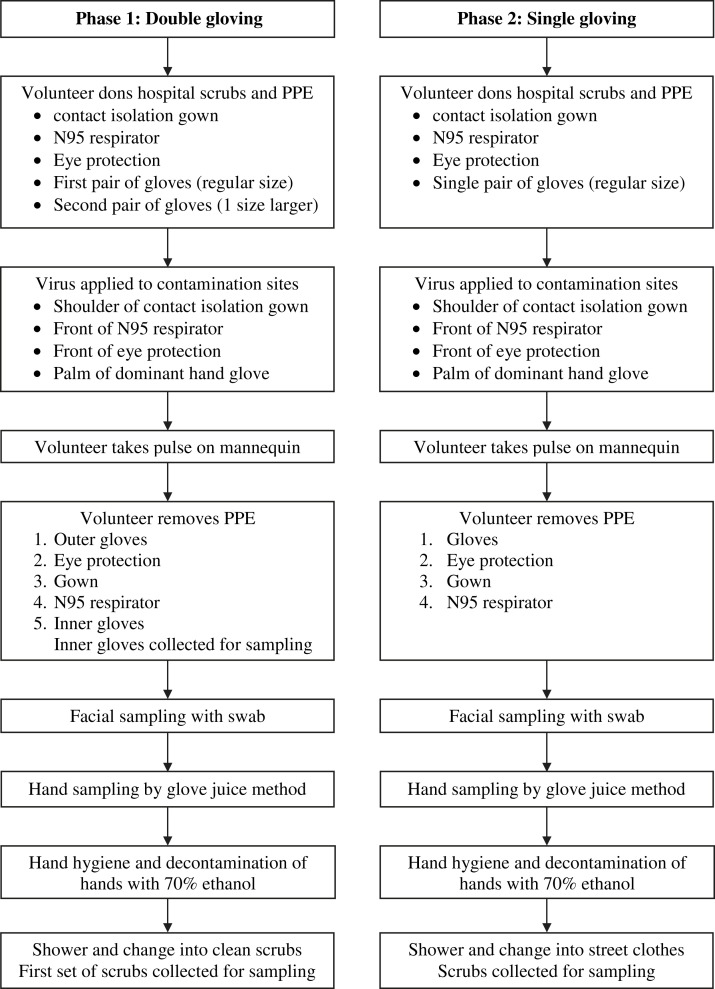
Each experiment had a double-gloving phase and a single-gloving phase. Participants donned PPE (ie, contact isolation gown, N95 respirator, eye protection, latex gloves). The gown, respirator, eye protection, and dominant glove were contaminated with bacteriophage. Participants then removed the PPE, and their hands, face, and scrubs were sampled for virus.
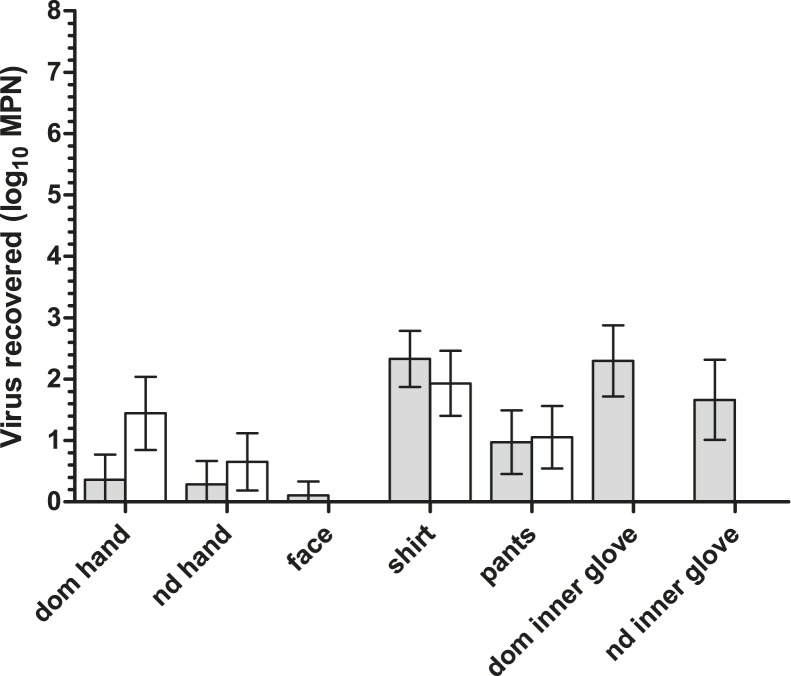
Transfer of virus to hands during PPE removal was significantly more frequent with single-gloving than with double-gloving. Transfer to scrubs was similar during single-gloving and double-gloving. The amount of virus transfer to hands ranged from 0.15 to 2.5 log(10) most probable number. Significantly more virus was transferred to participants' hands after single-gloving than after double-gloving.
Our comparison of double-gloving and single-gloving using a simulation system with MS2 and a most-probable number method suggests that double gloving can reduce the risk of viral contamination of HCWs' hands during PPE removal. If incorporated into practice when full PPE is worn, this practice may reduce the risk of viral contamination of HCWs' hands during PPE removal. The use of double gloves should be explored in larger controlled studies.
在进行患者护理后,去除个人防护设备 (PPE) 可能会导致病毒转移到医护人员 (HCW) 的手部和衣物上。可以使用无害病毒来模拟这种转移风险,以获得定量数据。为了确定在去除污染的 PPE 过程中双层手套是否可以减少病毒转移到 HCW 的手部和衣物上,我们使用噬菌体进行了一项人体挑战研究,比较了单手套和双手套技术在去除 PPE 时病毒转移到手部和衣物上的频率和数量。
每个实验都有双手套阶段和单手套阶段。参与者戴上 PPE(即接触隔离服、N95 口罩、眼部保护、乳胶手套)。隔离服、口罩、眼部保护和主要手套都被噬菌体污染。参与者然后脱下 PPE,并对他们的手部、面部和工作服进行病毒采样。
在去除 PPE 过程中,单手套转移到手上的病毒频率明显高于双手套。单手套和双手套的工作服转移病毒相似。转移到手上的病毒量范围为 0.15 到 2.5 对数(10)最可能数量。单手套后转移到参与者手上的病毒明显多于双手套后。
我们使用 MS2 和最可能数量方法的模拟系统比较了双层手套和单层手套,表明在去除 PPE 时,双层手套可以降低 HCW 手部病毒污染的风险。如果在穿着全套 PPE 时将其纳入实践,这种做法可能会降低 HCW 手部在去除 PPE 过程中病毒污染的风险。应在更大规模的对照研究中探索使用双层手套。